India After Modi? Hindutva's Self-Reflection

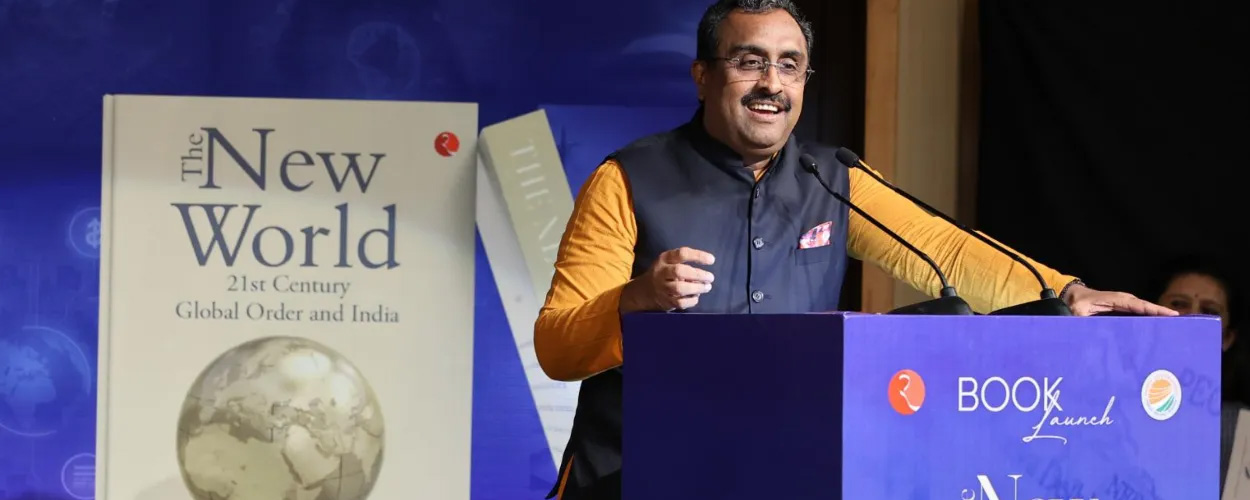
It’s unprecedented when a prominent Hindutva leader critiques Narendra Modi’s policies. However, the views expressed in Ram Madhav’s new book can also be seen as self-criticism, considering his role.
Ram Madhav, a senior figure associated with both the Bharatiya Janata Party (BJP) and the Rashtriya Swayamsevak Sangh (RSS), has written a new book, “The New World: 21st Century Global Order and India,” which can be read on three levels.
The first part offers a somewhat generic narrative of human history, descriptive in nature and therefore not explored further. However, the second part, where he discusses India, presents a quite interesting perspective. He expresses skepticism about India’s potential to become a “superpower,” offers veiled criticisms of government policies, and, notably, attempts to partially rehabilitate the legacy of the Congress party – a rare occurrence for an RSS leader.
Hindutva and “National Conservatism”: Ram Madhav is currently seen as an “organic intellectual” of Hindu nationalism. Yet, the book contains no mention of Savarkar, nor the RSS or its affiliated organizations. Instead, he attempts to present Hindutva as a version of “National Conservatism” within a global context, an ideology gaining popularity worldwide.
He claims that “Hindu and Greek civilizations” laid the foundations for a moral order in the pre-Christian era. Simultaneously, “Hindus established a superior social order through the Vedas, Upanishads, and Shastras.” He portrays India as the world’s largest economy in the first millennium, overlooking the fact that India’s economic prosperity peaked during the Mughal era. For him, the decline is attributed to “800 years of exploitation, first by the Mughals and Central Asian invaders, and then by the British through colonialism.”
Ideological Outrage Against Semitic Religions: According to Madhav, India’s ancient prosperity was due to the “tolerance of Hinduism,” while Islam and Christianity “pushed the world into a theocentric dictatorship,” a system where “nothing could withstand opposition to religion.” This statement highlights the paradox that while Hindutva speaks of “religion,” it often views Hindus as an ethnic identity, descendants of “Aryan ancestors” and India as a “sacred land.” This perspective can be compared to the Zionist identity of Jews.
India’s Diplomatic Dreams and Contradictions: Ram Madhav advocates for presenting India as “Brand India” on the global stage, stating that “the era of soft power is over; now is the time for smart power.” However, he also acknowledges that progress in this direction has been very limited. He defines India’s potential partners based on “shared enemies” – such as “liberals,” “cultural Marxists,” “Islamists,” “woke activists,” and NGOs. George Soros is mentioned as a symbol of fear, linked to issues like the farmer protests and the Adani controversy.
The Idea of ‘Dharmocracy’ and Supporting Social Structure: According to Madhav, India should move towards “Dharmocracy” – “Democracy, the Bharat way.” This implies that power would be accountable not to the people but to dharma, as interpreted by Brahmin Rajgurus. This essentially advocates for a form of Hindu theocracy. Furthermore, he legitimizes the caste system as part of India’s “diversity”: “India’s ethnic, linguistic, and religious diversity makes it colorful and festive.” Dismissing claims of discrimination against Muslims, he considers their population growth (7.81%) as proof of the minorities’ “comfort,” which is a superficial and misleading social analysis.
Skepticism about Progress and Self-Criticism
The second part of the book, focusing on India’s foreign policy, defense, and technological development, is surprisingly candid. In the context of the Modi government’s achievements, Madhav only speaks of symbols - such as the Sengol’s installation in Parliament, while listing serious shortcomings in the technical, economic and military fields.
He says that in India:
• ‘There is no culture of research and
innovation.’
• ‘We need ‘imagineers’ instead of engineers.’
• ‘Copying is not innovation, and imitation is not creativity.’
He offers harsh criticism of India’s education, R&D, quantum technology, defense production (such as the Tejas fighter jet), and naval weaknesses.
Perhaps the most surprising aspect of Ram Madhav’s book is the repeated praise for Congress leaders:
• Nehru’s diplomacy in Nepal and Sri Lanka is praised.
• Indira Gandhi’s contribution to the independence of Bangladesh is recognized.
• Narasimha Rao’s Look East policy is commended.
• Manmohan Singh’s Indian Ocean Naval Symposium initiative is acknowledged.
This partial acceptance suggests that the Modi government’s foreign policy has achieved very limited results so far.
The Dichotomy Between the Dream of “Brand India” and Reality: Ram Madhav ultimately admits that India’s “demographic dividend” could become an illusion if decisive interventions are not made in the areas of skilling, innovation, and employment. He quotes Lal Bahadur Shastri: “We can only gain the respect of the world when we are internally strong and eradicate poverty and unemployment.” This is perhaps a sign that the BJP should move beyond identity politics and towards socio-economic inclusion.
This article is published on https://www.harkaraonline.com