RIC: Fiery Path - The Crucible of Power (Cover Story)

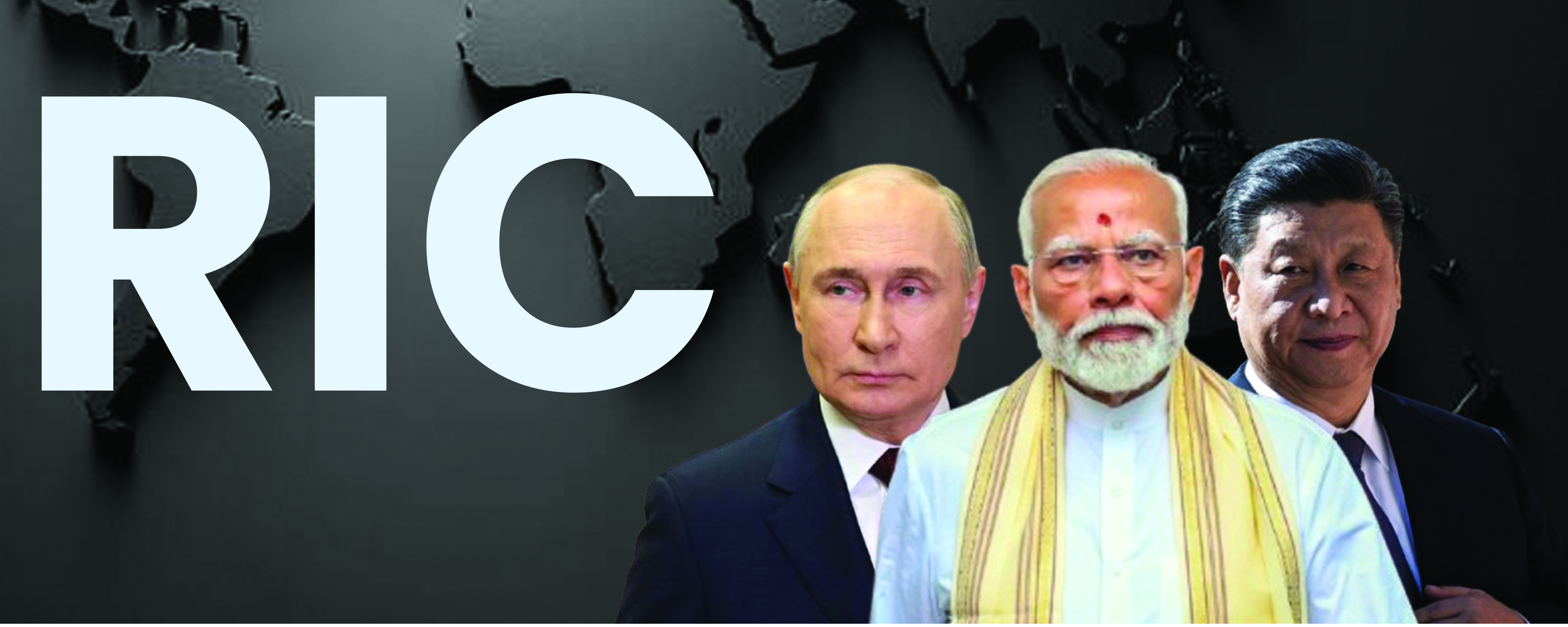
It was the twilight of the twentieth century. The grand edifice of the unipolar world order, built upon the ashes of the Cold War, now clearly showed cracks in its walls. The foundations of this Western-led fortress, whose leaders had boasted for decades of scripting the world's destiny, were now shaking. The earthquake of the 2008 financial crisis rattled its economic underpinnings, and the self-centered clamor of America's "America First" policies sowed seeds of distrust even among its own allies. A resentment, a profound indignation towards the system, smoldered across the world, especially in those nations marginalized by this order for decades.
This global discontent first found a platform in the form of non-Western alliances like BRIC, which began forming in 2006, and truly emerged with its first summit in Yekaterinburg, Russia, on June 16, 2009. Subsequently, with the inclusion of South Africa in 2010, it became BRICS. It was a collective roar from the Global South, an attempt to signal to the erstwhile masters that they would no longer dictate the rules of the game alone. BRICS, once dismissed as mere investment jargon, swiftly transformed into an institution that established its own bodies like the New Development Bank (NDB), directly challenging the Western fiefdom of the International Monetary Fund (IMF) and the World Bank.
Similar circumstances have been observed in global politics over the past decade. From within this global discontent, a new axis was being forged. This axis was not shaped by a single power, but by historical imperative and a shifting balance of power. And the triumvirate destined to become the icon of this new world order were – Russia, India, and China (RIC). This triumvirate aimed to project itself as an alternative world order, a non-Western provider of solutions to global problems, and create an environment challenging their Western adversaries. Simultaneously, they sought to convey that only they could offer respite from the oppressive atmosphere of this unipolar world.
Behind this entire scenario, the desire for a multipolar world was systematically playing its part. For Russia, India, and China in this new role, it was clear that their collaboration needed to present them as the sole alternative to the almost paralyzed old American-centric world order. Swiftly, this triumvirate appeared successful in turning all Western leadership failures into keys for their own success, emerging as a ray of hope in the frustrated and disillusioned environment of the Global South. The remaining shortfall was amply filled by the policies of US President Donald Trump's second term.
And it is from here that the rumblings of a new era began to be heard. An era where this Russia-India-China axis is seen as the driving force behind the colossal chariot of BRICS+. But the question remains: Can this triumvirate truly move forward in unison? Will this collaboration of the Elephant (India), the Dragon (China), and the Bear (Russia) write a new history on the global stage, or will their internal contradictions turn this script into a tragedy? For India, this is not just a global development, but an 'Agneepath' – a trial by fire – where every step must be taken with utmost caution.
The Three Faces of the Triumvirate
The resurgence of RIC on the global stage is akin to a play where each of the three main characters has their own script, their own compulsions, and their own goals. They are on the same stage, but their gazes are fixed in different directions. Without unraveling the layers of these characters' minds, understanding the direction of this play is impossible.
Character Number One: Russia
Today, if anyone is most restive for this trilateral dialogue, it is Russia. Shackled by Western sanctions after its 2022 attack on Ukraine, Russia is knocking on the doors of the East to break its diplomatic isolation. For it, RIC is not merely a diplomatic platform but a means to preserve its existence and prove that it remains a crucial global player. Russian Foreign Minister Sergei Lavrov's call to revive RIC reflects Moscow's internal dual conflict.
First, it's an open message to the West that their days of hegemony are over. The more you try to isolate us, the stronger new allies we will find. Second, and perhaps more significantly, it is an attempt to protect itself from the fear of being completely absorbed into China's embrace. Today, Russia's economy and politics have become dangerously dependent on China. Their bilateral trade is skyrocketing, but Moscow is aware of the asymmetry of this relationship. It knows it is becoming a junior partner in this relationship. In this context, the RIC platform provides it with psychological leverage to negotiate on an equal footing with China. India's presence on this platform offers Russia an invaluable opportunity to balance its dependence on China. For Russia, RIC is a 'Sanjeevani Booti' – a life-giving elixir – to regain its lost global prestige and maintain its relevance in Eurasia.
Character Number Two: China
China's affinity for RIC is not a result of emotional attachment but a calculated strategic move. The Dragon's eyes are fixed on Taiwan and the South China Sea. Its entire focus is on transforming its military into the world's most powerful. Thus, it does not want a new front to open on its land border with India. RIC serves as a slow burner to melt the ice that has frozen relations with India since the bloody Galwan clash of 2020. It offers China an opportunity to maintain a controlled dialogue with India, without giving any substantial concessions on core issues like border disputes.
Furthermore, China is embroiled in an all-out confrontation with the United States. From trade wars to technological dominance, Washington is attempting to encircle it on every front. In this scenario, China utilizes platforms like RIC and BRICS to demonstrate that it is not alone, and that many major nations stand with it against the American order. This is an attempt to entice the Global South and convey the message that Beijing, not Washington, will lead the future world. However, China also doesn't shy away from flexing its muscles. From disrupting India's auto industry by restricting rare earth exports to halting fertilizer shipments – these subtle maneuvers are enough to remind who the 'big brother' is in this relationship. For China, RIC is merely a pawn in its grand strategic game.
Character Number Three: India
And then comes India – the Elephant, methodically charting its path through this complex geopolitical jungle with its slow but steady gait. For India, RIC is a riddle it is compelled and needs to solve. India has always envisioned a multipolar world, where no single nation's arbitrary will dictates. But today, it stands at a peculiar crossroads. On one side is its deepening strategic and economic partnership with the US and the West, while on the other is its decades-old, time-tested friendship with Russia.
However, the policies of US President Donald Trump are shattering the bridge of trust built with America over nearly three decades. Be it Trump's claims of orchestrating a ceasefire in Operation Sindoor, the absence of a trade deal with India coupled with heavy tariffs up to 25 percent, and to top it all, an additional 25 percent tariff as a penalty for buying oil from Russia.
To navigate such circumstances, India has adopted the mantra of 'strategic autonomy'. It refuses to be a satellite of any single bloc. RIC is a crucial instrument in maintaining this autonomy. It provides India a platform to balance Western pressure, energize its relations with Russia, and most importantly, keep a channel for dialogue open with China despite tensions. This is a highly delicate balance. When India eases visa norms for Chinese citizens or opens doors for Chinese investment, it signals to the world that it is not averse to dialogue, while simultaneously maintaining its iron grip on the border. For India, RIC is a strategic hedge, an option it will always want to keep in its foreign policy quiver.
Cracks and Contradictions
The image of this triumvirate, as alluring as it appears from the outside, is equally hollow and riddled with cracks within. Numerous unresolved questions and deep contradictions exist that could shake the very foundations of this purported alliance at any moment.
The Unresolved Knot of Distrust
The most vulnerable corner of this triangle, its 'Achilles' heel', is the unresolved border drawn across the snowy peaks of the Himalayas between India and China. This is not merely a boundary dispute, but a festering wound of deep distrust between two civilizations that has been oozing for decades. The sacrifice of Indian soldiers in the Galwan Valley in 2020 deepened that chasm of mistrust even further. Although agreements have been made to de-escalate tensions in some areas of Ladakh, this is merely like applying ointment to a wound, not curing the disease. Until China ceases its attempts to unilaterally alter the status quo on the border and respects India's sovereignty, true trust between the two nations will remain a distant dream. This mistrust is a heavy burden on the soul of RIC. How can nations redraw the world map when they cannot even define their own? For India, standing on any platform with China comes with the risk of a stab in the back. However, this month's visit by Chinese Foreign Minister Wang Yi to India has begun to thaw the ice in relations, and where complexities are fewer, an agreement on border demarcation has been reached between the two countries. Similarly, in the initial week of September, Indian Prime Minister Narendra Modi is slated to attend the SCO summit, where he will meet not only Xi Jinping but also Vladimir Putin. It is hoped that the situation will progress positively.
A Red Flag for India
Another significant threat is the burgeoning 'unbreakable' camaraderie between Russia and China, which is drawing lines of concern in the corridors of power in New Delhi. The Ukraine war has rendered Russia so weakened and isolated that it has been compelled to become a junior partner to China. This partnership dangerously skews the balance of power within RIC in Beijing's favor. India's apprehension is natural: that RIC might not become a platform where Beijing and Moscow together pressure New Delhi to acquiesce on a particular issue. India wishes to remain the third corner of this triangle, not a target created by the other two. If Russia loses its independent foreign policy identity and begins to dance entirely to China's tune, RIC could transform from a beneficial platform into a dangerous trap for India.
The Tangled Threads of Economy
The foundation of this triangle rests not merely on politics but also on economics, and even this base is not very robust. Trade between India and China is substantial, but it is largely one-sided. India's market is flooded with Chinese goods, whereas the access of Indian products to the Chinese market is severely limited. This massive trade deficit is a perpetual headache for India's economy. The situation is similar with Russia, where India imports vast quantities of oil and weapons but struggles to open the Russian market for its own products.
Furthermore, the differing regulations, business practices, and technical standards across the three countries make seamless economic integration seem almost impossible. India's digital data laws do not align with China's state-controlled internet model. Until these structural impediments are overcome, RIC cannot become an effective economic bloc.
Can This Triumvirate Make History?
Despite these myriad challenges and thorns, there remains a glimmer of hope for some flowers of opportunity to bloom in the courtyard of RIC. If these three nations can set aside their differences and focus on common interests, they could usher in a new dawn not just for themselves, but for the entire Global South.
The Foundation of a New Economic Order: India's UPI has today become a symbol of the digital payment revolution globally. China too possesses robust platforms like Alipay. If these countries were to jointly develop a shared digital payment system, they could significantly reduce their dependence on the dollar and Western financial systems. The 2025 Submarine Internet Cable Project is also a step in this direction, which could liberate them from the 'slavery' of Western infrastructure for data flow.
Partnership in Technology and Innovation: China is a world leader in green energy and 5G. India has established its prowess in solar energy and software. Russia possesses vast experience in space and defense technology. If these three nations collaborate in research and development, they could give the West formidable competition in next-generation technologies.
A Strong Voice on Global Platforms: Institutions like the UN Security Council still represent the world of 1945. RIC, acting in concert, could exert pressure for reforms in these institutions, ensuring that emerging powers like India receive their rightful due and the voice of the Global South is not ignored.
India's Agneepath (Trial by Fire)
Ultimately, this emerging Russia-India-China axis presents both an opportunity and a challenge for India. It is an 'Agneepath' – a trial by fire – upon which India must prove both its diplomatic dexterity and national resolve.
The path ahead for India is clear, but not easy. Its strategy must rest on three pillars:
Iron Resolve on the Border: While channels for dialogue with China may remain open, there should be no room for any laxity or weakness on the border. India must continuously strengthen its military and infrastructural capabilities, for respect and security stem from strength.
The Protective Shield of Multi-alignment: India should not pin all its hopes on RIC. It must also strengthen the Quad with the United States, Japan, and Australia. Furthermore, it must deepen its ties with Europe, ASEAN, and Middle Eastern countries. Holding onto the thread of dialogue with RIC on one hand, while standing shoulder-to-shoulder with its democratic partners on the Quad platform on the other – this is the diplomatic tightrope walk that has become India's destiny today.
Pragmatic and Issue-Based Cooperation: Within RIC, India must avoid emotional rhetoric and focus purely on pragmatic interests. Cooperation should be pursued on issues where interests converge, such as terrorism, climate change, trade, and connectivity, but it must never cross its 'Laxman Rekha' (red line) on strategic matters.
This collaboration of the Dragon, the Bear, and the Elephant is perhaps the most intriguing and significant drama in global politics. They may never sing in perfect unison, but in the changing symphony of the world, they must find a way to remain on stage together. For India, deftly playing its role in this drama, preserving its autonomy, and advancing its national interests is the greatest challenge of the 21st century. This is a struggle that will not be fought in the corridors of power in Delhi, but on the global chessboard of diplomacy, and its outcome will determine India's place in future history.