COVER STORY- YOUTHQUAKE: Gen-Z Shaking The Thrones of South Asia
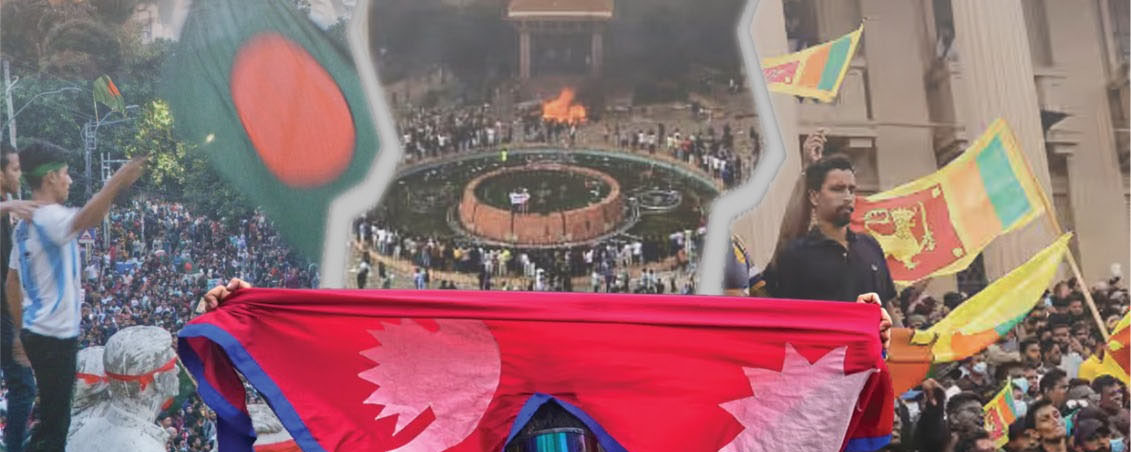
In recent years, South Asian politics has witnessed an unprecedented turn, its script penned not by old guard leaders, but by ‘Gen Z.’ From the bustling streets of Bangladesh to the sun-drenched beaches of Sri Lanka and the serene hills of Nepal—young hands, placards and mobiles in tow, have poured onto the streets. The result? Decades-old thrones have trembled, and the old fortresses of power have begun to crumble. While those in power and their supporters dismissed these as spontaneous movements, hinting at external conspiracies, others argued this narrative merely served as a smokescreen for governments to conceal their failures and corruption. This article attempts to unravel these complexities – uncovering the true causes of these movements, the pivotal role of social media and digital power, and the intricate global game of powers poised to shape South Asia’s future.
For years, South Asia’s political landscape has been scripting a new, unpredictable chapter. Accustomed to military coups or traditional electoral upheavals, a new force has emerged in the region: ‘Gen Z.’ This is the generation that, from Bangladesh to Sri Lanka and Nepal, has taken to the streets, challenging and, in many cases, overturning old power equations. This isn’t merely a regional phenomenon; it echoes the ‘Arab Spring,’ its roots reaching back to the Iranian Revolution – a pervasive trend where public discontent, especially among youth, ignites unexpected political change. But are these movements solely the result of domestic discontent, or is a ‘Global Deep State’ fanning these fiery revolts from behind the scenes, pursuing its own interests? This question transforms the entire sequence of events into a complex geopolitical puzzle, whose layers must be carefully peeled back.
The ‘Spring’ Awakens in South Asia
From Sri Lanka’s ‘Aragalaya’ to Bangladesh’s ‘Second Liberation’ and Nepal’s ‘Gen Z Revolt,’ these movements have clearly signaled the dawn of a new era of political instability in South Asia. Each country had its unique backdrop and immediate triggers, but all harbored a deep and shared dissatisfaction, anger against broken promises, rampant corruption, and the indifference of a political elite that had pushed the younger generation towards a bleak future.
Sri Lanka: When an Economic Tsunami Drowned a Dynasty
Sri Lanka’s ‘Aragalaya’ (Sinhala for ‘struggle’) movement in 2022 was not just a protest; it was a direct response to the economic tsunami that brought the once-prosperous island nation to its knees. Months of unprecedented inflation, endless queues for fuel and cooking gas, 12-hour power cuts, and severe shortages of essential goods turned daily life into hell. The Rajapaksa family, which had governed the country for 15 out of the preceding 18 years, bore the direct brunt of blame for this economic catastrophe. As the economy collapsed and daily life became unbearable, the movement intensified, forcing dynastic leaders like Gotabaya Rajapaksa to relinquish power.
Public outrage reached such a crescendo that protestors took control of President Gotabaya Rajapaksa’s lavish residence and ‘Gota Go Gama,’ a protest site in Colombo where a unique hub of dissent developed through art, music, and speeches. This movement, largely organized by young activists via social media, compelled Gotabaya Rajapaksa to flee the country. It was not merely the downfall of a leader, but the end of a dynastic rule deeply entrenched in the nation’s politics. The echoes of ‘System Change’ resonated through the streets of Colombo, signifying an aspiration for institutional and structural reforms far beyond just replacing leaders. Investigations into claims of foreign conspiracy behind the movement yielded no decisive evidence. Instead, human rights organizations attributed it squarely to domestic failures and popular outrage.
Bangladesh’s ‘Second Liberation’
Bangladesh’s 2024 political upheaval began as a student-led campaign targeting a ‘discriminatory’ quota system in government jobs. This quota, reserving up to 30% of seats for descendants of 1971 Liberation War veterans, struck the younger generation as a blatant symbol of ingrained corruption and nepotism. Prime Minister Sheikh Hasina scoffed at the demand, dismissing students as ‘Razakars’ (Pakistani collaborators) – an insult that only ignited the revolt further. Students proudly wore the term as a ‘badge of honor,’ with chants like ‘Who are you? Who am I? Razakar. Who said it? The dictator!’ echoing through the streets.
Police brutality, leading to hundreds of innocent protestors’ deaths, fundamentally altered the movement’s character. It was no longer just about quotas but a widespread uprising against Sheikh Hasina’s long and authoritarian rule, which had spanned over fifteen years. For a generation that had known nothing but Hasina’s regime, her leadership had become synonymous with oppression and a dearth of opportunities. Social media provided the movement with a loose structure and broad reach, culminating in Sheikh Hasina fleeing the country to India on August 5, 2024. An interim government, led by Nobel Laureate Muhammad Yunus, was established with the goal of steering the nation towards new and fair elections. While Bangladesh’s ruling party floated rumors of Pakistani or American intervention among the student protestors, independent reports consistently confined the movement’s roots to the nation’s socio-economic inequalities and the unpopular policies of the ruling party.
Nepal’s ‘Gen Z Revolt’
Nepal’s 2025 movement was sparked by an immediate trigger: a government ban on social media platforms, justified by claims of ‘misuse’ and non-registration. Yet, this ban was merely the fuse. Decades of festering inequality, pervasive corruption, nepotism, and power concentrated in the hands of a political elite had bred deep discontent among the youth. Social media trends like #NepoKid starkly exposed the lavish lifestyles and foreign education of politicians’ children, while the nation’s youth grappled with unemployment and mass migration. This was a ‘moral outrage,’ as analysts described it, against a generation that had stolen their future.
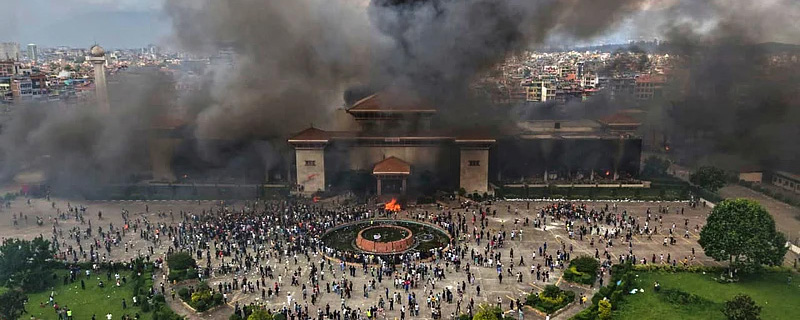
Prime Minister K.P. Sharma Oli initially scoffed at the protestors, but as the demonstrations turned violent, leaving over 70 dead and protestors occupying the parliament building and even his own home, Oli was forced to resign. Despite the violence, the youth’s voice could not be suppressed. Former Chief Justice Sushila Karki was appointed interim Prime Minister, a decision notably influenced by youth-led online surveys—a potent symbol of a new form of ‘digital democracy.’ The key demands of Nepal’s Gen Z movement were the eradication of corruption, transparent and accountable governance, and the lifting of the social media ban. While the government and some supporters attempted to frame it as a foreign conspiracy, the movement’s leaders, human rights observers, and international analysts largely attributed it to local discontent and a failing governance system. Although rumors of misinformation and external influence did surface on social media in various places, there was no conclusive evidence that the movement was primarily a foreign plot.
Generational Divide and Shattered Hopes
Beneath the surface of all these movements lie profound structural issues, painting a bleak future for South Asia’s young population. Initially, ruling parties were quick to allege foreign conspiracies or opposition collusion. However, the consensus among established journalists, researchers, and human rights organizations points to corruption, economic failures, unemployment, and undemocratic tendencies as the true catalysts. Digital platforms provided a powerful new stage for youth dissatisfaction, and despite government claims, these movements stand as symbols of widespread domestic discontent.
The Quagmire of Opportunity and Economic Mismanagement:
South Asia is a young region, with nearly 50% of the population in these three countries under 28 years old. They boast literacy rates exceeding 70%, yet their per capita GDP lags significantly behind the global average. This vast chasm between educational attainment and economic opportunity is the very root of their anger. Youth unemployment rates – 22.3% in Sri Lanka, 16.8% in Bangladesh, and 20.8% in Nepal – create a combustible mix. This is a generation that has experienced at least two major economic recessions (2008-09 and COVID-19) in their lifetime. They feel their potential and aspirations have been crushed by the political system, exacerbating the ‘brain drain’ phenomenon, where millions of young people are migrating abroad in search of better opportunities. Nepal’s economy, for instance, relies on remittances for a third of its GDP, underscoring the severity of this exodus. This is not merely about economic decisions; it is a silent referendum on governmental incompetence.
The Termite of Corruption and the Vine of Nepotism:
The level of corruption in these nations is so profound that it has hollowed out every aspect of public life. Their dismal rankings in Transparency International’s Corruption Perception Index (all above 100) expose a grave institutional failure. Bribery in government offices, arbitrary practices in government contracts and tenders, and prioritizing ‘their own people’ for public jobs have become commonplace. The #NepoKid movement directly channeled youth anger at this pervasive nepotism. When the children of the political elite live lavish lives abroad while ordinary youth yearn for jobs, this moral outrage creates a combustible situation. Suman Pandey, a veteran of Nepal’s tourism industry, described it as a ‘mafia’ rule, where ‘for the last 30 years, it was a game of musical chairs between three people, and they never gave a chance to young politicians.’
Erosion of Power and Lack of Dialogue:
A poignant aspect of these movements is the vast age gap between the leaders and the young protestors. Oli of Nepal was 73, Hasina of Bangladesh 76, and Rajapaksa of Sri Lanka 74. Meenakshi Ganguly, Human Rights Watch’s Deputy Asia Director, notes, ‘Young people in South Asia found nothing to connect to with their political leaders. The mismatch was too great.’ This mismatch wasn’t just about age, but about priorities, perspectives, and values. Older leaders often focused on their legacy and past struggles, while the youth centered on the future, opportunities, and justice. Traditional political parties, often personality-driven and plagued by factionalism, failed to understand the aspirations of the youth or meaningfully include them in the political process.
Digital Empowerment: The New Arena of Resistance:
Gen Z is a generation that grew up on the internet, and for them, digital platforms are not just tools of entertainment but powerful instruments for community, organization, and self-expression. Social media played a crucial role in organizing these movements, disseminating messages, and mobilizing broad support. Hashtag campaigns like #GoHomeGota and #NepoKid gave the protests a unified voice. Live streaming and online communication helped protestors connect in real-time and exposed government repressive efforts to the world. When governments attempted to block internet access or specific platforms, it often backfired, further fueling the youth’s anger. Digital technology helped keep these movements ‘leaderless’ and decentralized, creating a new resilience against traditional oppressive strategies.
Revolts Inspiring Each Other:
These movements have drawn inspiration from one another, developing a ‘digital protest playbook.’ Nepali youth closely observed and learned from the protests in Sri Lanka and Bangladesh. Rumela Sen of Columbia University states that the tactics employed in these movements, ‘including social media hashtag campaigns and decentralized organization, represent an emerging playbook of digital protest.’ This regional integration, though informal, is a powerful signal that the younger generation does not view their problems as isolated incidents but as part of a broader pattern.
The Shadow of a ‘Global Deep State’?
As these widespread popular movements swelled, a controversial concept—the ‘Global Deep State’—began to loom large, casting its shadow over the narratives. This hypothesis, often flirting with conspiracy theories, posits that powerful, opaque actors (state and non-state) operate on a global scale to orchestrate regime changes, serving their geopolitical and economic agendas through various organizations and channels. From the Arab Spring to the earlier Iranian Revolution, this theory suggests these forces have been actively shaping political landscapes. In these youth-led South Asian revolts, accusations of external meddling are rife, especially when power shifts occur with such bewildering speed that even locals express disbelief.
Deconstructing the ‘Deep State’: The term ‘Deep State’ typically refers to a parallel, covert power structure operating within a country, independent of its elected government, often through intelligence agencies, military establishments, and powerful bureaucrats. The ‘Global Deep State’ extends this concept internationally, envisioning intelligence agencies of powerful nations, multinational corporations, think tanks, international financial institutions, and global non-governmental organizations working behind the scenes. Their objectives might include fostering political instability, weakening governments, or facilitating regime changes beneficial to their strategic or economic interests. These interventions are often cloaked in the rhetoric of ‘promoting democracy,’ ‘protecting human rights,’ or ‘establishing stability,’ but critics view them as a façade for external powers to advance their geopolitical agendas.
Whispers of External Interference on South Asia’s Frontlines: In these South Asian cases, accusations and counter-accusations regarding the role of external forces have been constant. However, it’s crucial to acknowledge that external actors rarely conjure mass movements from a vacuum. Instead, they exploit existing domestic vulnerabilities, discontent, and institutional fractures.
- India’s Complex Equation with Nepal: Nepal’s instability has immediate and direct security implications for India. With an open border and deep historical-cultural ties, India desires a stable and reliable partner in Kathmandu. Nepali leftists and monarchists have frequently accused India of meddling in their politics. K.P. Sharma Oli’s pro-China policies would have undoubtedly made India uneasy. Delhi’s swift welcome of the interim government following Oli’s downfall could signal that India viewed this shift as favorable to its interests.
- China’s Growing Strategic Inroads: Nepal’s northern border adjoins China’s Tibet Autonomous Region, and Beijing has increased its diplomatic and economic footprint in Nepal in recent years. China’s ambitious Belt and Road Initiative (BRI) seeks to integrate Nepal into a ‘Trans-Himalayan Network,’ which India often perceives as part of China’s expansionist strategy. The lean of Nepal’s leftist parties towards China is evident. Oli’s participation in Beijing’s military parade and his objection to the India-China agreement on the Lipulekh pass showcased his growing proximity to China. Geopolitical analysts like Chandra Bhatt term this ‘unusual,’ given Nepal’s traditional alignment with India and the West.
- The West’s ‘Democratic’ Influence: Western nations like the US and EU often support policy frameworks and civil society in Nepal through funding. The $530 million Millennium Challenge Corporation (MCC) grant from the US for power grid and road infrastructure in Nepal, often seen as a counter to China’s BRI, underscores Western strategic interests. During Sri Lanka’s ‘Aragalaya,’ some ultra-nationalists accused USAID of funding the protests, though no concrete evidence emerged. Western interests frequently operate under the guise of democratic values, human rights, and good governance—which ‘Deep State’ theorists consider a form of external intervention.
- Pressure from International Financial Institutions: The International Monetary Fund’s (IMF) role in Sri Lanka’s economic crisis was significant. Any bailout package from the IMF often comes with stringent conditions for implementing tough economic reforms and austerity measures, which can exacerbate public discontent in the short term. While the IMF doesn’t directly promote regime change, its policies can indirectly influence political instability, creating opportunities for external powers to ‘manage’ outcomes.
- The nuanced interplay of Geopolitical Powers: It is more realistic to argue that the primary drivers of these South Asian movements are deep-seated domestic grievances and institutional failures. External powers rarely conjure mass movements from a vacuum; instead, they stand ready to capitalize on existing discontent, economic crises, and weak governance. The Dalai Lama’s congratulatory message to Nepal’s interim government or Japan’s swift welcome of Oli’s downfall might be indicators of outcomes ‘preferred’ by external actors, rather than direct instigation. The Gen Z earthquake in South Asia, it seems, is fundamentally a homegrown tremor, though its aftershocks are certainly felt and subtly influenced by the complex global currents that shape our world.
Geopolitical powers often engage in ‘information warfare’ and ‘narrative construction,’ where social media becomes a primary battleground. They can employ targeted propaganda to amplify protests, sway public opinion towards a specific outcome, or establish a narrative favorable to their interests. This is the intricate game of ‘soft power,’ where influence is exerted through ideas and information.
The role of military institutions is also significant in this geopolitical equation. In Sri Lanka, Bangladesh, and Nepal, the military displayed a certain restraint during periods of government change. In Sri Lanka, the army refrained from direct force against protestors and facilitated Rajapaksa’s safe exit. In Bangladesh and Nepal, the military, at times, played a ‘kingmaker’ role, ensuring a smoother (though uncertain) transition. This restraint might stem from internal evaluations, but it could also be a result of understanding or pressure from external powers who prefer regional stability over chaos, as complete anarchy would be far more detrimental to their investments and strategic interests.
In summary, it is more plausible that external actors attempt to ‘manage’ or ‘navigate’ these movements rather than ‘create’ them. Their objective is often to ensure a favorable outcome aligned with their long-term interests, which are often tied to stability, economic access, and geopolitical balance. They might invest in exacerbating existing problems, but not in generating those problems, which are already inherent in domestic conditions.
Chaos or a New Dawn?
The outcomes of these youth-led movements are both immediate and long-term, fraught with considerable uncertainty and new challenges. While prime ministers have resigned and interim governments have been established, the real struggle now begins.
The Power Vacuum and the Knock of Opportunists: Despite their ‘leaderless’ nature, these movements often create a political vacuum that various political parties and opportunistic groups attempt to fill. In Sri Lanka, the leftist Janatha Vimukthi Peramuna-led National Peoples Power (NPP) coalition successfully capitalized on the ‘Aragalaya’s energy, securing a significant victory in the 2024 elections. This demonstrates how a populist movement can pave the way for an established political party to seize power, even if that party was previously marginalized. In Bangladesh, the victories of Jamaat-e-Islami-backed organizations in university elections underscore a concerning trend, where radical ideologies can exploit political vacuums to emerge. In Nepal, while there is talk of forming new youth-based political parties, the old guard is also waiting to return with fresh faces.
The Enduring Challenge of Institutional Reforms: While movements can bring about immediate regime change, implementing lasting institutional reforms is a far more difficult and prolonged struggle. In Sri Lanka, the Rajapaksa dynasty was overthrown, but institutional corruption and accountability issues persist. The NPP government, which promised change, also faces tough decisions amidst IMF agreements and economic challenges, which may deviate from its electoral promises. In Bangladesh, the interim government must contend with long-standing authoritarian systems, deep political polarization, and the pervasive challenge of violence against minorities. In Nepal, too, the interim government faces the dual challenge of taking action against corrupt elements of the previous regime and holding free and fair elections.
The Gen Z earthquake in South Asia, it seems, is fundamentally a homegrown tremor, though its aftershocks are certainly felt and subtly influenced by the complex global currents that shape our world.
Youth’s Impatient Hopes and Regional Stability:
Interim governments must now restore the trust of the populace, especially the youth, whose expectations run incredibly high. They are compelled to act decisively against corruption, deliver economic stability, and most crucially, create ample employment opportunities. Should they fail to meet these soaring hopes, a new cycle of disillusionment could ignite, increasing the likelihood of further protests.
Regionally, political instability in one nation can have a ‘contagion’ effect on others, fostering similar movements across the entire subcontinent. This could morph into a ‘New Doctrine of Instability for South Asia,’ where youth outrage spills from one country to the next. Such a scenario would also compel external powers to reassess their geopolitical strategies. Nations like India, China, and the United States may shift their diplomatic and economic aid in a bid to safeguard their own interests.
South Asia at a Crossroads
The Gen Z-led movements for regime change in South Asia are a vivid illustration of the digital age’s ‘public sphere,’ where social media has provided a unified platform for anti-establishment sentiments. These revolts are a direct consequence of deeply rooted domestic discontent, economic mismanagement, rampant corruption, and the profound disillusionment of the youth with the political elite. They have unequivocally proven that the younger generation is no longer willing to surrender its future to outdated political equations.
Looking at the bigger picture, two distinct possibilities emerge. A positive trajectory involves these movements successfully ushering in lasting institutional reforms – encompassing transparency, accountability, and inclusive governance – potentially leading South Asia into a new era of democracy and development. The victory of the NPP in Sri Lanka and the establishment of interim governments in Bangladesh and Nepal, if steered in the right direction, could herald a fresh start. Conversely, a negative path looms if this energy remains confined to mere ‘regime change’ without concrete institutional reforms. In such a scenario, the resulting political vacuum would be filled by new opportunists, radical elements, and undemocratic forces, plunging the region into an even deeper cycle of instability.
It is also clear that the ‘Global Deep State’ does not instigate these events but rather harnesses them for its own benefit. The objective of external powers is not to foster chaos but to manage it in a way that tilts the outcomes in their favor. They exploit existing domestic fissures, engage in information warfare, and strive to mold crises to align with their geopolitical goals. The ‘restrained’ behavior of military institutions is often part of this broader geopolitical management, aiming to prevent utter chaos and ensure regional stability. Therefore, arguments about foreign conspiracy largely appear to be attempts by governments to deflect attention from their own responsibilities and failures. What unequivocally emerged in these countries was that youth anger was ignited by local causes, with corruption, government failure, and the erosion of democratic values – not external plots – being the root motivations.
Ultimately, this sends a direct and unambiguous message to South Asian governments: mere elections and symbolic transfers of power are no longer sufficient. They must strengthen transparency and accountability, provide meaningful employment and economic opportunities for the youth, align educational systems with market needs, and implement economic reforms that are genuinely people-centric. Otherwise, the potent combination of educational knowledge, the sting of unemployment, and the power of digital platforms will relentlessly continue to spark new revolts. Gen Z has set the agenda. It is now up to the regional leadership to channel this vibrant energy into a sustainable and positive direction, or risk letting it dissipate into a vortex of renewed chaos. South Asia stands at a critical crossroads, where the path to its future will depend entirely on the choices it makes.