SIR: The ‘Reverse Exodus’
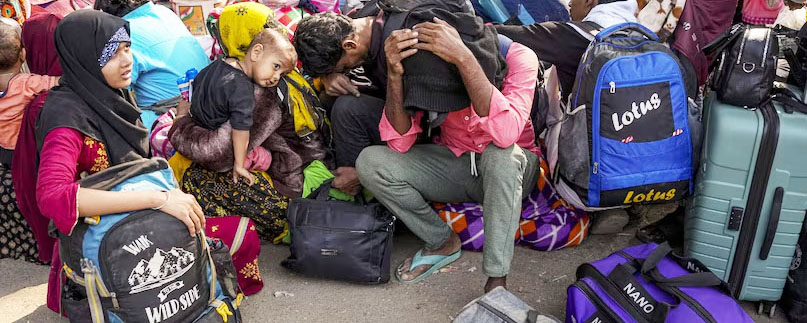
When the sun sets over the India-Bangladesh border, a peculiar restlessness begins to float upon the layers of sand and dust wrapped in the crimson sky. The Hakimpura border outpost, a silent witness to infiltrators creeping in under the cover of darkness for decades, is today witnessing an unprecedented historical reversal. Where shadows once crossed barbed wires to step onto Indian soil and vanish overnight into the nation's crowds, today, those same paths are clogged with footsteps of return in the broad daylight. This scene is not normal. It is not merely a migration; it is the sound of the cracking of a political and social structure that had held West Bengal’s demographics in its grip for years.
Thousands of people, clutching not old receipts but small bags containing their entire existence, now stand in queues to leave the country they had come to call home. BSF officials are calling it a 'Reverse Exodus,' but is this term sufficient to explain the deep political earthquake currently shaking the soil of Bengal? Is this a voluntary return? Is it the fear of the law? Or is it the manifestation of a political reality before which the illegal fortress of appeasement, standing for decades, is finally crumbling?
At the center of this turmoil lies an administrative process—Special Intensive Revision (SIR). While the term sounds technical and mundane, its impact is explosive. Initiated by the Election Commission of India, this process of revising the voter list has unleashed a storm in West Bengal politics. The opposition labels it 'politics of fear' and 'dictatorship,' sharp attacks are being launched against Election Commissioner Gyanesh Kumar, and pleas for 'human rights' are being made. Yet, amidst this political cacophony, the silence prevailing at the borders of Hakimpura and Ghojadanga is the most vocal. It is a silence written on thousands of faces that were Indian voters until yesterday, but today, are forced to return to Bangladesh with their true identities.
Viewed through a deeply analytical lens, this development is not just an electoral tug-of-war. It is a moment in the history of Indian democracy where the blurred line between 'Vote Bank' and 'National Security' is beginning to fade. For right-wing thinkers and the Bharatiya Janata Party (BJP), this moment marks a historical correction. They believe this is not an administrative exercise, but the restoration of India's sovereignty as a nation. For years, it has been argued that infiltration in Bengal was not merely a problem born of poverty, but a planned political industry. Today, when the SIR process has pressed the pulse of that industry, the entire ecosystem is writhing.
The scenes described in reports by The Indian Express and other media outlets diverge from traditional narratives of human tragedy. People like Abdul Momin, sitting under trees with their life's savings stuffed in plastic sacks, waiting for the border to open, are not refugees of war. They were beneficiaries of a system that has now broken. Momin and thousands like him, who were engaged in domestic work here for years, sweating in factories, and most importantly—queuing up to vote in elections—are today saying, "We can no longer stay here. The risk is too great." This sentence tells the whole story. What is this risk? It is the risk of being caught. It is the risk of answering the question that Bengal’s politics suppressed for decades—"Who are you, and by what right are you here?"
For the first time, SIR has shown these people a mirror. This process is not just checking papers; it is breaking the back of the illegal economy that thrived on infiltration. Reports from The Economic Times reveal that crossing the border and becoming an Indian citizen was an organized business. Crossing the border cost five to seven thousand rupees, and for fifteen to twenty thousand, fake Aadhaar cards, ration cards, and Voter IDs were prepared. The statement of 29-year-old Manirul Sheikh exposes this entire corruption—"I paid about twenty thousand rupees to get the papers made, but SIR changed everything." This confession reveals how Indian citizenship and franchise were turned into commodities for sale. As long as there was political patronage, this business flourished, but the moment the administration showed firmness, it began to scatter like a house of cards.
It is essential to understand the unease in the opposition parties and the leftist camp at this time. They term SIR a weapon against the poor and minorities. Their argument is that this process is designed to target and intimidate a specific community. But a fundamental question arises here—Does a sovereign nation not have the right to verify the sanctity of its voter list? If the names of millions of deceased voters remain alive on the list, if thousands play a role in choosing the country's policies and governments based on fake documents, is this not a betrayal of democracy? A BSF officer's statement that "They came in the dark, now they are going back in the light through the right path" reflects both the gravity and irony of the situation. This is not oppression, but the re-establishment of the 'Law of the Land.' For years, the border of Bengal was ruled not by the law, but by the 'Rule of the Vote.' SIR has reversed this equation for the first time.
This exodus can be termed 'Operation Silent Cleanse.' According to reports, over twelve hundred people have returned in the last few days. Queues stretch for two to three kilometers. Police stations and BSF camps are filled beyond capacity. These scenes can be heart-wrenching. When a child says he will miss his friends in New Town, it stirs human emotions. But emotions cannot be a substitute for national security. This situation exposes a bitter truth: illegal settlement, no matter how old, cannot gain legitimacy. This is not a human rights crisis, but the logical conclusion of an illegal arrangement.
The noise in the political corridors right now is actually the echo of fear born from shifting power equations. Leaders of the Trinamool Congress and the INDI Alliance are accusing the Election Commission of acting like a BJP spokesperson. However, viewed impartially, this accusation seems laughable. If the Election Commission's job is to conduct fair elections, removing fake voters is its primary duty. The question should be asked not to the Commission, but to those parties that kept these illegal migrants alive as their 'Vote Bank' for decades. The opposition alleges this is 'Voter Deletion' and 'Political Cleansing.' To this, a large section of analysts believes that yes, this is cleansing—but not of any religion or caste, but a cleansing of fake identities that had infiltrated democracy.
The biggest and most far-reaching question is whether SIR is already writing the script for the 2026 Bengal Assembly Elections. If illegal voters are ousted from the list, if the network of infiltrators that influenced local politics breaks, it will directly impact the vote percentage. The TMC, a large base of which rests on these demographic equations in rural and border areas, may suffer heavy losses. On the other hand, the BJP's aggressive nationalist narrative will find a new edge. This process reinforces the BJP's claim that demographic change in Bengal is a reality and strict steps were needed to stop it.
Some human rights organizations and intellectuals are presenting this as a battle of Humanity vs. Sovereignty. Arguments are being deflected using scenes of poverty, helplessness, and fear as shields. But the nationalist perspective is clear—poverty does not give anyone a license to cross borders and break another country's laws. India's constitution grants illegal immigrants neither the right to citizenship nor political participation. These people may be economically destitute, but in the eyes of the law, they are not innocent. They have violated not just a country's borders, but its democratic system as well.
This scene at Hakimpura is not merely a local event; it is also a mirror of geopolitical reality. The Bangladeshi government has often questioned India's border management, but the SIR proceedings have proven that the problem was not just in the border fence. The problem lay in the internal mechanism that welcomed infiltrators, provided them documents, and made them part of the system. Today, when this internal mechanism is under scrutiny, there is turmoil across the border too. Dhaka can no longer turn away from the reality that its citizens were living illegally in India in large numbers.
Slogans written on walls can be erased, but the cracks emerging on the wall of history cannot be ignored. The way SIR is unraveling the truth layer by layer in West Bengal sends a clear message—Politics is changing. The voter is changing. And the country is reconfiguring its democratic DNA. Infiltration is no longer just an electoral issue; it has become a question of national identity. This process is breaking the decades-old illusion that India is a 'Soft State' where anyone can come and become part of the system.
In conclusion, considering SIR merely an administrative exercise would be a mistake. It is a 'Surgical Audit' of India's security and sovereignty. If the voter list is purified, the benefit will accrue not just to one party, but to Indian democracy as a whole. The queues of departing people, the despair on their faces, and the silence stretching across the border—all signal the dawn of a new era. This is the era of an India that does not view its borders merely as lines drawn on a map, but as the guardian of the nation's soul. Today, that soul is being cleansed—slowly, silently, but decisively. And in this process, the politics of Bengal is about to change forever.