Washington–Riyadh: The Desert Alliance Recalibrates
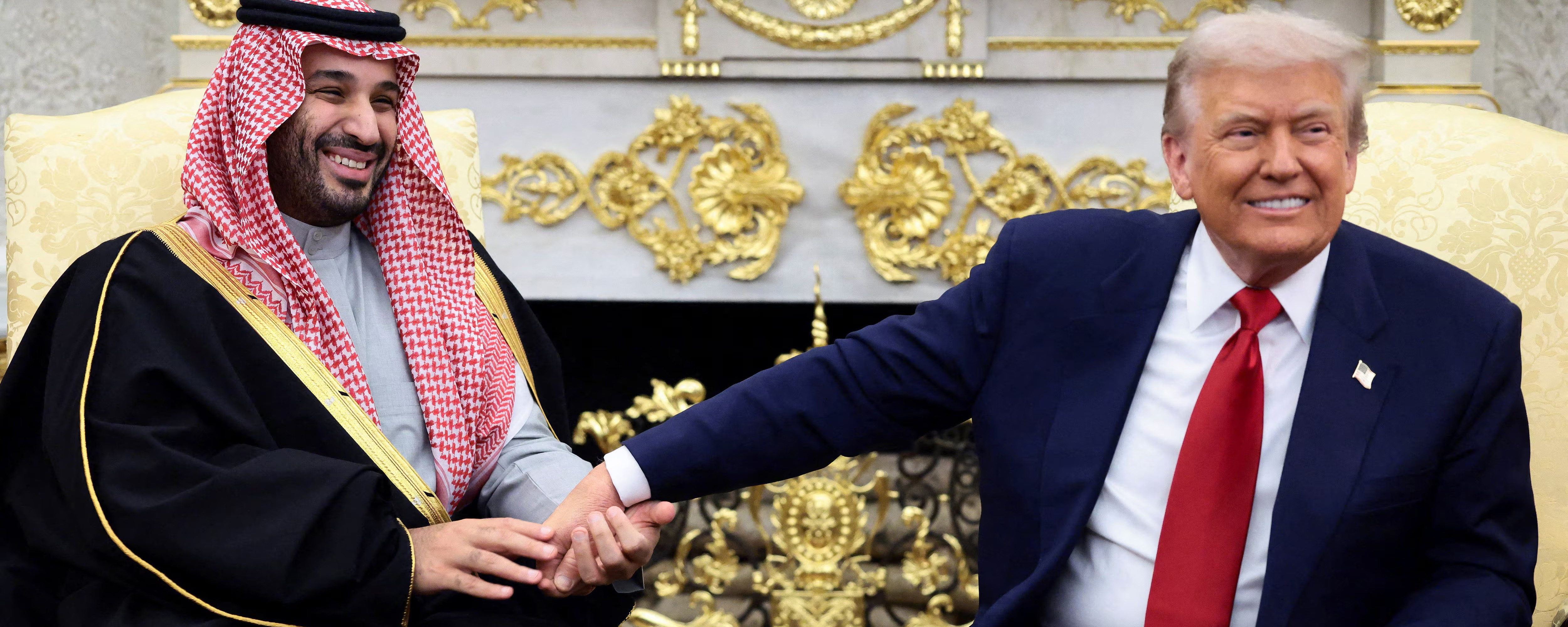
Mohammed bin Salman the Crown Prince of Saudi Arabia, was in Washington this week to formalize the most significant enhancement of the U.S.–Saudi strategic relationship in recent memory. There is much to be said about the visit, from the remarkable press availability in the Oval Office to the deal fever evident across business and investment forums throughout the week.
I thought I would focus on the major issues discussed between the two countries, the deals that were struck (and the ones that remain stuck), and try to provide some historic context.
Some eighty years ago, in the twilight of World War II and fresh off the Yalta Conference, President Franklin D. Roosevelt first attempted to strike a grand bargain with Saudi Arabia’s founding ruler, King Abdul Aziz Al Saud. FDR and Ibn Saud, as he became known, convened aboard the American cruiser USS Quincy while it sat on the Great Bitter Lake in the Suez Canal. It was Ibn Saud’s first time at sea and one of his first times outside the fledgling nation.
Much has changed since then—and much hasn’t.
Dinner was certainly different. According to the account of FDR’s Saudi envoy William A. Eddy, Ibn Saud “had not yet…had any experience with refrigeration in his country” and adhered strictly to Islamic dietary laws. He therefore insisted to the Quincy’s commodore that—against Navy regulations—seven of the “best and fattest sheep” from his personal flock be brought aboard and slaughtered daily for the enjoyment of his retinue and the crew. It was a far cry from the lavish dinner President Donald Trump threw in the East Room of the White House, complete with Elon Musk and Cristiano Ronaldo.
However, what I find most striking about the talks aboard the Quincy, which took place in a tent pitched on its deck, is that the substantive agenda was nearly identical to the agenda discussed at the White House this week.
Cruising through the Suez on the Quincy, FDR made three pitches to Ibn Saud: allow the Jewish people to form a state in the Holy Land, let Saudi oil flow freely, including—and especially—to the United States; and, finally, embrace the United States as the Kingdom’s principal strategic partner. Ibn Saud agreed in broad strokes with the second and third points, but disagreed over Israel, suggesting instead that, since Germany lost World War II, the Jewish refugees ought to get, as reparations, Bavaria as their homeland.
This week, Trump and MBS brought the United States and Saudi closer than ever to realizing FDR’s vision for a strategic partnership. Trump also received vague assurances on oil production. But, while MBS expressed general interest in Saudi Arabia one day joining the Abraham Accords, the lack of a clear path toward a two-state solution made normalization with Israel an item of unfinished business.
Nonetheless, Trump elevated Saudi Arabia to the status of a major non-NATO ally, and the two sides signed a new Strategic Defense Agreement that expands U.S. military access rights, formalizes Saudi burden-sharing commitments to defray U.S. costs associated with defending the Kingdom, and clears the way for major arms transfers, including future F-35 deliveries and nearly three hundred U.S. tanks. The U.S. and Saudi Arabia also signed a civil nuclear cooperation declaration establishing the United States—and U.S. firms—as Riyadh’s preferred partners for the Kingdom’s burgeoning civil nuclear program. A critical minerals framework was concluded to channel Saudi capital into U.S. supply-chain projects, and a landmark AI memorandum granted the Kingdom structured access to advanced American systems and hardware—including leading edge chips from firms such as Nvidia and AMD—while imposing safeguards to prevent diversion or leakage of U.S. technology to countries of concern (e.g., China). The arrangement, coupled with Saudi Arabia’s rapid buildout of AI infrastructure, positions U.S. firms to play a central role in the Kingdom’s model-training and high-performance computing ecosystem. In turn, MBS increased Saudi Arabia’s commitment to invest in the United States to nearly $1 trillion, up from the $600 billion pledged in May, though the nature, timing, and feasibility of this pledge remained unclear.
In plain terms, the Saudis got most of what they wanted, barring a mutual defense treaty with the United States—which, by all accounts, remains contingent on Saudi-Israel normalization and would require Senate ratification. The bilateral relationship has stabilized from its generational low in 2021, when President Joe Biden declared MBS a pariah, after the U.S. intelligence community implicated the Crown Prince in the brutal murder of Washington Post columnist Jamal Khashoggi.
Did the United States get what it wanted? More or less, yes. The Kingdom doubled down on the United States as its strategic partner in the military and technological domains. The Saudis promised to invest substantial capital in the United States. And the issue of normalizing relations with Israel remains on the table, albeit unlikely in the near term. But one thing is clear: it is easier to announce a deal than it is to fully execute one. Let’s assess each on its own merits.
The likelihood of the arms deal being fully implemented is open to question. Traditionally, U.S. arms sales to Saudi Arabia (and other Arab states) have been constrained by Israel’s Qualitative Military Edge (QME)—a de facto U.S. policy later codified into law in 2008, which stipulates that the United States must ensure Israel maintains superior military capabilities to its neighbors in the Middle East. When asked about QME directly, Trump put it this way: “As far as I'm concerned, I think they are both [Israel and Saudi Arabia] at a level where they should get top of the line.” Will the United States end up selling Saudi Arabia the top-of-the-line F-35s? And, if not, will the sales materialize? Whether they do or not, (a similar deal with the UAE collapsed in part due to U.S. restrictions on exported F-35s) the reality is that the real win for the Saudis already took place: the prestige of a sitting U.S. president publicly declaring that they could buy F-35s in the first place. Trump appears to put Saudi Arabia on par with Israel as a strategic partner of the United States.
The AI deal may be the most viable of the lot. It turns on whether the U.S. trusts the Saudis to protect American advanced technology from falling into the hands of its competitor and potential adversary. The Saudis have too much to lose by becoming a conduit for Chinese firms looking to circumvent U.S. export controls. After all, the Kingdom’s entire economic transformation hinges on unfettered access to Western technology, capital, and talent. While there is some risk that Saudi could misuse AI applications it develops, the President appears comfortable with this tradeoff. The agreement also fits neatly into a broader strategic shift in the United States’ international AI policy toward maximizing American market share and the diffusion of U.S.-designed AI systems. The real execution risk is whether or not the Kingdom can stand up the physical infrastructure, workforce, and domestic applications ecosystem required to productively deploy tens of thousands (or more) leading-edge GPUs.
Finally, the investment pledge is the least plausible of this week’s agreements. The math doesn’t pencil out. On Wednesday, I had a chance to speak with Michael Ratney, a CFR member who served as Ambassador to the Kingdom of Saudi Arabia from 2023 to 2025. He just published an op-ed for the New York Times on MBS’ new set of priorities. In our conversation, he pointed out something obvious but often overlooked: both sides are keenly focused on attracting foreign direct investment and less focused on doling it out.
On the Saudi side of the ledger, after years of massive outbound foreign direct investment by various state-owned investment vehicles, MBS is now determined to focus his country’s resources domestically and to attract Western capital to finance Vision 2030, his strategic transformation of the Kingdom’s economy. And while the Kingdom is rich in oil wealth (pumping some $500 million per day), oil prices are slumping and production is constrained by output caps agreed to by the Organization of Petroleum Exporting Countries (OPEC). The Kingdom’s main sovereign wealth fund, the Public Investment Fund (PIF), is also low on cash, having invested it abroad, and more recently, poured tens of billions into Neom and other ill-fated domestic megaprojects. On balance, it’s unlikely that the Kingdom can afford to meet its commitment to Trump and deploy hundreds of billions of dollars directly into the United States every year for the next several years without compromising some of its domestic economic agenda—something MBS is neither willing nor politically able to do. The far more likely outcome is creative accounting, repackaged commitments, or a shortfall against the headline number which might become evident only after President Trump leaves office.
Some of these deals had been in the works for over a year, from when the U.S.-Saudi relationship stabilized during the latter half of the Biden administration. Still, clearly the personal relationship between President Trump and the Crown Prince played an important role in their advancement this week. To ensure the enduring stability in this strategic relationship, Saudi Arabia would be well advised to work to prevent U.S.-Saudi relations from being defined along partisan lines and to build strong support among Democrats as well as Republicans. Otherwise, what might be viewed as strategic today could be reviewed as only transactional later.
Michael Froman is president of the Council on Foreign Relations (CFR). He previously served as vice chairman and president, strategic growth, at Mastercard, chairman of the Mastercard Center for Inclusive Growth, and a distinguished fellow at CFR.