Rising Tides, Naval Strides

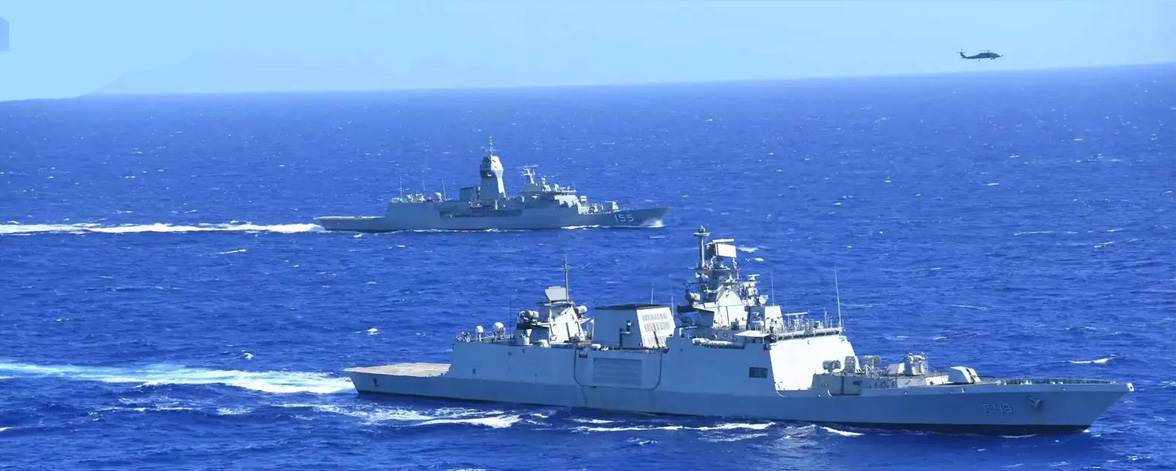
A new trend is visible among the maritime nations of the Global South. It seems as though the navies of these countries have entered an era of renaissance. These nations appear so intent on grooming and modernizing their naval forces that they overlook whether these exercises are excessive in proportion to the actual threats at their maritime borders. The primary goal for most is to elevate their maritime power to a new level through the development of naval capabilities.
South Africa, Brazil, Iran, Thailand, and others are adding state-of-the-art frigates, submarines, and multi-role warships to their fleets, thereby increasing geo-strategic competition in the Indian Ocean and southern maritime regions. In this landscape of naval renaissance, the continuous expansion of the Chinese Navy, the cooperation between the Pakistani and Bangladeshi navies, and the manner in which China is aiding both, is noteworthy.
India must keep a close watch on the naval preparations of China, Pakistan, and Bangladesh in South Asia, and prepare itself accordingly. Given the naval expansion in the global scenario, it must also stay apprised of developments in Sri Lanka, the Maldives, and other nations in the region.
The Pakistani warship that reached Bangladesh on a goodwill visit—passing through the Bay of Bengal for the first time in 54 years to strengthen defense cooperation—departed on November 12, leaving India with a pressing question: Why and how is a plot for naval strengthening brewing between these two countries?
The Chittagong port is near the country's eastern coast in the Bay of Bengal; China wishes to establish a base here, so the movement of Pakistani and Chinese ships will increase the threat to India's maritime security. Under 'Forces Goal 2030', the Bangladesh Navy is not only purchasing new warships but also enhancing capabilities in submarines, ISR (Intelligence, Surveillance, Reconnaissance), and indigenous manufacturing. The country's largest naval base is being constructed in Rabnabad to augment submarine and maritime aircraft operations.
Pakistan is engaged in a 9-year modernization program for warships and submarines with the help of China and Turkey, alongside purchasing several vessels made by them. Its first Hangor-class submarine, developed with Chinese assistance, will join its navy next year, with plans to increase this number to eight by 2028. There are reports that the Babur-class frigate, built in Turkey and equipped with state-of-the-art weapons and stealth features, will be inducted this year.
The Pakistan Navy is conducting joint exercises with the Maldives, which is inducting the Dogan-class fast attack craft donated by Turkey into its navy. Behind these exercises, Pakistan's objective is not only the security of maritime resources and strategic sea routes but also a show of force. The Sri Lankan Navy is also trying to increase its strength in collaboration with Chinese, Russian, and Western partners.
China recently launched its third state-of-the-art aircraft carrier, the Fujian, and with the announcement of a fourth, it has sounded the bugle of its maritime ambition and power projection in the Indian Ocean, the Bay of Bengal, and the Strait of Hormuz. With the arrival of the Fujian, featuring an electromagnetic catapult system, the Chinese Navy has become the second navy in the world after the US to possess a carrier fleet equipped with such modern technology. Modern aircraft like the J-35 stealth fighter, KJ-600 warning aircraft, and J-15 can be deployed on a large ship like the Fujian, capable of taking off and landing even on shorter runways. This will enhance its navy's capacity to sustain long-range strike capabilities for days without interruption. It can conduct defense, rescue, attack, and surveillance operations simultaneously for extended periods. Consequently, China can project its power in Taiwan, the South China Sea, and the Indian Ocean.
Now, China can combine its three carriers—the Russian-designed Liaoning and Shandong, and the indigenous Fujian—to form a Carrier Strike Group, and India will be the sole nation in this region significantly affected by this. India's trouble is that its fuel supply and trade routes pass through here. Although it remains to be seen how quickly the Fujian will be war-ready, its arrival will undoubtedly increase pressure on the Indian Navy to modernize its ships, aircraft, and radar systems.
India currently possesses two aircraft carriers, INS Vikramaditya and INS Vikrant. Both utilize ski-jump ramp technology, whereas the opponent possesses technology far superior to this, placing their navy miles ahead of the enemy during war. Although India is considering building next-generation warships equipped with electromagnetic catapult systems, judging by today's pace, achieving this goal will take many years.
INS Vikramaditya may be retired in 2035. To maintain strategic balance in the Indian Ocean, a third aircraft carrier is needed, preparations for which are being accelerated; there are also plans to deploy two other warships. But the question is: Will they be as modern as the Fujian?
While Bangladesh's cooperation with China and the latter's expansion through naval bases is a cause for concern, the Pakistan-China alliance, China-Bangladesh maritime intrusion in the Bay of Bengal, and China’s gaze upon the Africa-Arabian Sea put India under strategic pressure. Our competitors have adopted time-bound programs; in response, we have adopted such a rapid process that our lagging behind is impossible.
However, the new naval preparations of neighbors and Global South nations will directly impact India's strategic and policy actions in the future, necessitating a vigilant, advanced, and cooperative approach. We must enhance multi-domain vigilance, surveillance, and naval power projection in the Bay of Bengal, the Arabian Sea, and the Indian Ocean. With the game of power projection increasing due to competitive naval expansion, maritime connectivity, resource protection, security of supply chains, and multi-lateral coordination will become essential. Therefore, we must further increase technological upgradation, international cooperation, and strategic and diplomatic proactivity to maintain a bespoke balance of power.
However, the era of naval renaissance in the Global South presents opportunities alongside challenges for India. If India implements self-reliant, indigenous new naval capabilities with stability and expansion in a timely manner, it can ensure its leadership in the Indian Ocean Region. The government and the Navy are aware that through capability development, maritime interests must be translated into actual power. Lagging in this direction could be risky. Significant concrete steps have already been taken in this regard. Undoubtedly, India's power at sea will increase, and geopolitical equations there will soon turn.