Corridor of Power

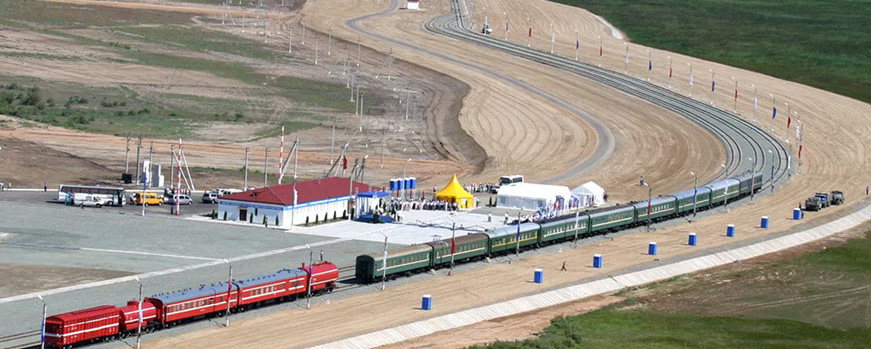
The Eastern Corridor of the International North-South Transit Corridor (INSTC) achieved a significant milestone on 8 November 2025, when a cargo train originating north of Moscow arrived in Iran, carrying 62 40-foot containers through Central Asia. The 900-km journey to the Aprin dry port in Tehran took 12 days, crossing Kazakhstan and Turkmenistan before entering Iran at Incheh Borun.
Since March 2025, New Delhi has been using the same route to send cargo from the Mundra Port in Gujarat to Central Asia via Iran’s Bandar Abbas port. For India, the INSTC’s Eastern Corridor not only provides an alternative to the Suez Canal but is also vital to fulfilling India’s goal of achieving US$2 trillion in exports by 2030. Additionally, given Beijing’s export restrictions on specific rare earth minerals, the Eastern Corridor presents India with a significant opportunity to tap into the export potential of Central Asian markets and reduce its dependence on China for critical minerals by utilising the large reserves in Central Asian nations.
INSTC’s Eastern Corridor
Signed in 2000, the INSTC is a multimodal transport corridor connecting India with Eurasia, bypassing the Suez Canal, and involving Russia, Iran, and India. However, the corridor has been experiencing slow progress due to conflicting interests and infrastructure challenges, resulting in lower cargo volumes. However, its 928-km railway line, also known as the Eastern Route or the Kazakhstan-Turkmenistan-Iran (KTI) route, is set to boost the route’s trade volumes. KTI’s construction began in 2009, following a 2007 trilateral agreement between Kazakhstan, Turkmenistan, and Iran. The Islamic Development Bank contributed US$370 million of KTI’s total cost of approximately US$1.4 billion. Commissioned in 2014, KTI provided a vital link between Central Asian countries, Iranian ports, and India. The Moscow-Aprin railway line (approximately 600 km shorter than the other easterly route through Sarakhs) has further enhanced KTI’s connectivity.
The 5,100-km Western Corridor of INSTC, which connects the most populous regions from the Russian-Finnish border to Bandar Abbas port, is the shortest route. However, sanctions on Iran and other geopolitical issues have slowed its progress, with the critical Rasht-Astara railway line remaining unfinished. The Eastern Corridor was officially launched in 2022 with the first train establishing a direct link between Russia and Iran, crossing Kazakhstan and Turkmenistan. In 2023– 2024, the corridor delivered approximately 1.8 to 2 million tonnes of goods to Iran, nearly tripling the amount from the previous year. In 2023, Russia, Turkmenistan, and Kazakhstan established a new joint venture for operations on this corridor, granting transit tariff discounts of up to 20-40 percent, depending on the type of goods and route sections. The route also connects to the Trans-Caspian railways of the Tsarist era, providing access to Uzbekistan and Tajikistan.
The Relevance of INSTC’s Eastern Route for India
In March 2025, India shipped a cargo consignment from the Mundra Port in Gujarat to Kazakhstan via the Eastern Route of the INSTC, travelling from Bandar Abbas Port to Central Asia. The consignment boosted India’s connectivity and trade with landlocked Central Asia. India already has several agreements with Central Asia, including New Delhi’s accession to the Ashgabat Agreement in 2018, which aims to establish a transit corridor between the Persian Gulf and Central Asia, and the The Customs Convention on the International Transport of Goods under Cover of TIR Carnets (TIR Convention, 1975), which allows cargo transport across multiple international borders with a single document.
Furthermore, Central Asian countries have consistently promoted greater connectivity and trade with India, supporting India’s efforts to lead regional connectivity projects. Both regions have engaged through bilateral and multilateral forums to enhance trade and connectivity. Since 2019, the foreign minister-level India-Central Asia dialogue has primarily focused on direct connectivity. In 2020, New Delhi launched a US$1 billion credit line for infrastructure development in the region. A joint working group was established in 2023 to bolster connectivity through the Chabahar port. Central Asia has also supported the inclusion of this port within the INSTC framework. In 2024, New Delhi signed a ten-year contract with Iran to upgrade the facilities of Chabahar Port, creating pathways for “bigger investments to be made in the port”. Regional connectivity and trade between India and Central Asia will receive further impetus when the rail link connecting Chabahar and Zahedan is commissioned in 2026.
India’s trade with Afghanistan via the Chabahar port has now reached around US$1 billion, helping to counteract Beijing’s expanding influence in the Indian Ocean and Eurasia. Central Asia has gained increased strategic importance for India, driven by internal economic shifts and the Russia-Ukraine conflict. As a result, the region has sought closer alignment with the European Union (EU), Türkiye, India, and the United States (US).
The region has also experienced increased global competition due to its vast reserves of rare earth and critical mineral resources. Central Asia boasts multi-trillion-dollar deposits of rare-earth minerals and strategic assets to diversify global supply chains, with Kazakhstan alone endowed with around 5,000 deposits valued at approximately US$46 trillion. Most of the critical minerals are currently exported to China for processing, creating a strategic vulnerability for the region. Central Asia has already initiated partnerships on rare earths with the EU and the US through technological assistance, exploration, and processing, aiming for balanced geoeconomic and political ties.
Under such circumstances, New Delhi should align more closely with the Eastern Route of INSTC for resilient, reliable, and diverse supply chains, as well as sustainable transport links. The route can be a game-changer, as India, in 2025, entered into a strategic partnership with Central Asian countries focusing on rare earths and critical minerals to minimise Chinese dominance over rare earth supplies. The Eastern route can boost New Delhi's trade diversification, secure mineral supplies, and help counterbalance China's influence in Eurasia, with Chabahar port as a key logistics hub in the INSTC.
Ayjaz Wani is a Fellow with the Strategic Studies Programme, Observer Research Foundation.