The 'Kamal' Grooms the Future
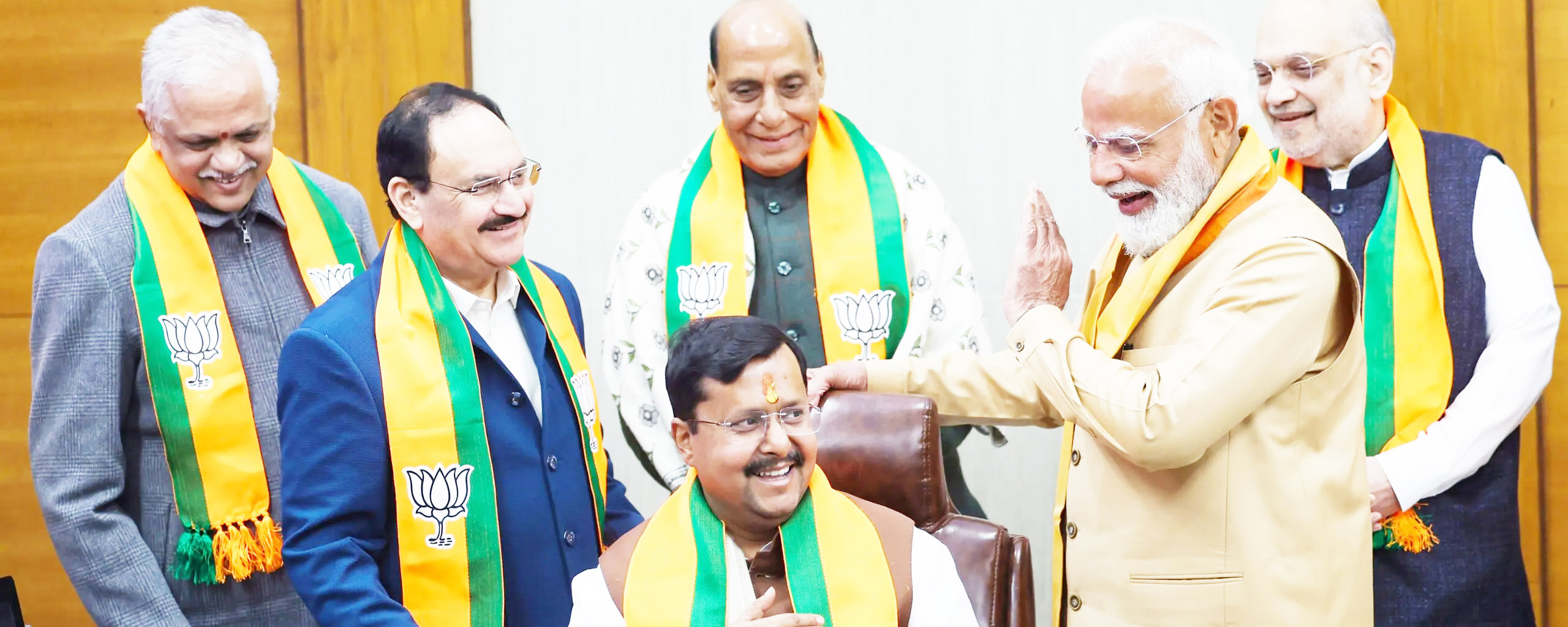
In the mild winter sunlight of January 2026, a new chapter of political history was written at the Bharatiya Janata Party headquarters on Deendayal Upadhyaya Marg in Delhi. When Nitin Navin’s name was announced as the BJP’s national president, the political corridors fell into the same stunned silence and quiet astonishment that so often follows decisions taken by Prime Minister Narendra Modi and Home Minister Amit Shah. After J.P. Nadda’s calm and organisation-focused tenure, the reins have now passed to a young, energetic, and relatively unexpected face.
Nitin Navin’s elevation is not merely a promotion. It is the outcome of a deeper churning underway within the BJP—a churning aimed at cultivating a new generation of leadership for the future. Among BJP supporters, the moment is being celebrated as a festival: a youthful president envisioned as a bridge between the aspirations of a future India and the party’s ideology of cultural nationalism. Prime Minister Modi, once again, has used the occasion to reinforce the BJP’s branding as a “party with a difference.”
Yet, amid the drumbeats, slogans, and visible enthusiasm of party workers, a sharper and more uncomfortable question is troubling political analysts: is Nitin Navin’s rise truly the result of a democratic “election,” or is it a carefully engineered “selection” by the top leadership? Is the BJP genuinely different from the Congress and other dynastic parties, or has the culture of high command merely donned a new saffron robe?
‘Party with a Difference’: Reality or Political Slogan?
The BJP’s strongest claim has long been its self-image as a party free from dynastic politics. From Atal Bihari Vajpayee to L.K. Advani, Murli Manohar Joshi, Kushabhau Thakre, Bangaru Laxman, Venkaiah Naidu, Rajnath Singh, Nitin Gadkari, Amit Shah, and J.P. Nadda—none became party president by inheriting the position from a political family. Nitin Navin’s name has now been added to this distinguished list.
It is true that, unlike the Congress—where the party presidency has often been treated as the private estate of the Gandhi family (with Mallikarjun Kharge being an exception, though even there debates about “remote control” persist)—the BJP has consistently elevated leaders from ordinary backgrounds to the top. But the question here is not one of background; it is one of process. Is the BJP’s method of choosing its president democratic?
The uncomfortable truth is that while BJP presidents may not be dynastic, the process by which they are chosen cannot, by modern democratic standards, be described as a “free and fair election.” The role of the “gatekeeper” is overwhelming. In political science, gatekeepers are those senior and powerful figures who decide who gets entry, who advances, and who ultimately reaches the summit of the organisation. What is popularly called “high command culture” in India is, in essence, this very gatekeeping.
The BJP, having won three consecutive Lok Sabha elections and emerged as India’s system-defining party, is no exception. Signs of internal reform are minimal. What exists is not an election, but an indirect selection, cloaked in the language of consensus.
Election vs Selection: The Congress–BJP Contrast
A genuinely free and fair election rests on two essential pillars: uncertainty of outcome and fair competition. Unfortunately, within India’s political parties, both are largely absent.
In the BJP’s case, Nitin Navin’s appointment fails the test of fair competition. Yet it contains one element that distinguishes it sharply from the Congress—and makes it remarkably effective: uncertainty of outcome.
When the Congress held its presidential election, the result was widely seen as predetermined. Shashi Tharoor’s candidacy was largely symbolic; everyone knew that whoever received the Gandhi family’s blessing—Mallikarjun Kharge—would prevail. There was no suspense, no excitement.
In contrast, before Nitin Navin’s name was announced, hardly anyone—even major media houses or seasoned political observers—had any inkling that he would become the next president. Only when he was first appointed interim president did it become evident that the top leadership—the gatekeepers—had made their choice.
This uncertainty is the BJP’s greatest strength. It injects a powerful sense of hope and aspiration among millions of party workers. When an ordinary worker sees a young leader like Nitin Navin, or figures such as Mohan Yadav and Vishnu Deo Sai, suddenly elevated to chief ministerial positions, it reinforces the belief that “any worker can rise to any post.” Prime Minister Modi’s oft-repeated assertion—“I am a party worker”—exists precisely to cement this belief. Nitin Navin’s elevation is the latest and most tangible validation of that narrative.
The Limits of Democracy and the Dominance of Gatekeepers
Yet, from an analytical standpoint, this process undeniably centralises power within the party. When ordinary workers lack the right to directly choose their leader, decision-making rests with an elite core. The sequence—first appointing Nitin Navin as interim president and then confirming him as full-time president—was a clear signal of whom the high command had chosen.
In such a scenario, any challenge to Nitin Navin would not merely be a contest between candidates; it would amount to challenging the collective decision of Modi, Shah, and the RSS. In today’s BJP, no one is positioned to take such a risk. The fate of Shashi Tharoor in the Congress—pushed to the margins after daring to contest—serves as a cautionary example. In Western democracies, internal party contests involve debate, dissent, and eventual accommodation of rivals. Indian parties remain far removed from that level of maturity. Here, contesting an election is often seen as rebellion.
Thus, Nitin Navin is not an “elected” president; he is a “selected” one. And selection, invariably, is driven by strategy.
Between Hope and Reality
Taken as a whole, Nitin Navin’s appointment demonstrates that structurally, the BJP is not vastly different from other Indian political parties. Here too, elections are largely symbolic, and real decisions are made behind closed doors by gatekeepers. The ideal of internal democracy—where workers directly choose their leader—remains absent.
Yet, the BJP has turned this very “undemocratic” process into a strategic weapon. Where selection in other parties produces dynastic continuity or stagnation, in the BJP it produces uncertainty and merit. This is the alchemy that energises the BJP’s cadre. An ordinary BJP worker sees his or her future reflected in Nitin Navin. There is a belief that hard
work will eventually catch the eye of the gatekeepers, enabling a rise from the floor to the summit. This psychological advantage places the BJP miles ahead of its rivals, especially the Congress.