Iran: A Soul Under Siege
The silence of that dark and frozen January night of 2026 is no longer the kind that brings peace. It is the silence that settles either just before a great storm breaks or after a terrible calamity has already passed. In the city’s atmosphere, alongside the icy winds descending from the Alborz mountains, lingers the stench of burnt tyres, tear-gas canisters, and dried blood. This smell has now become Tehran’s identity.
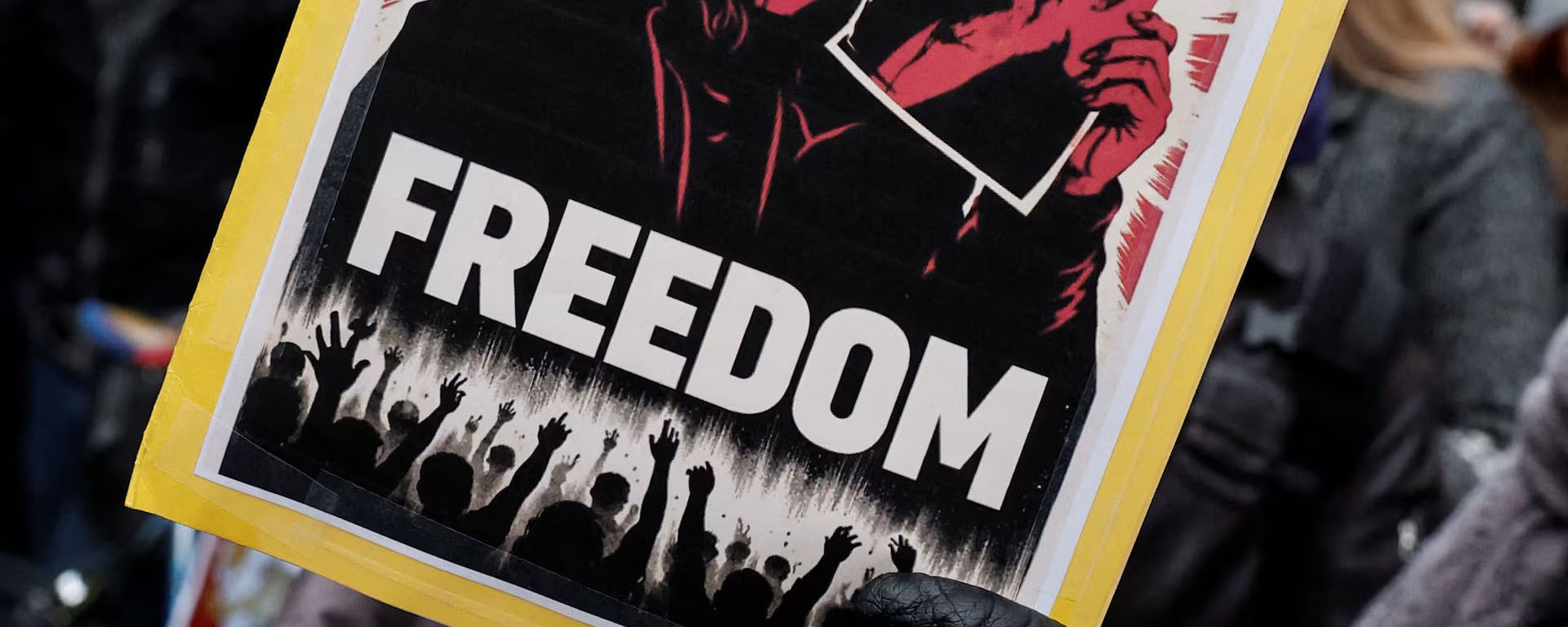
Azadi Square—the grand Azadi Tower, once a symbol of Persian pride—stands today as a mute witness to the suppression of its own children. Police sirens snarl through the streets like starving wolves. Internet lines have been severed—the entire nation pushed into a digital darkness so the world cannot see what is happening behind closed doors. Yet no darkness, however dense, can imprison voices. From alleyways, rooftops, and hearts, a single chant rises—no longer just a demand, but the final prayer of people standing face to face with death. They are not asking for bread. They are not asking for reforms. They want to uproot the entire system that has placed a chokehold on their breath. Across seven seas, in the air-conditioned chambers of Washington D.C. and London, the world’s most powerful leaders watch this spectacle unfold on giant screens. Words like “democracy,” “human rights,” and “freedom” emerge draped in velvet. US President Donald Trump thunders on social media: “We stand with the brave people of Iran.”
It sounds like the climax of a Hollywood film, where the hero arrives as a savior. But pause for a moment. History tells a different story. Is this sympathy truly for the masked girl standing unarmed before a tank on a Tehran street? Or is this the same old chessboard, where the pawn is the Iranian people and the prize is black gold—oil—for which empires have always risen and fallen? To understand this story, we must step out of today’s smoke and walk into the alleys of history where Iran’s fate was first bargained away.
Let us return to the year 1953.
These very streets of Tehran were restless then too, but that unrest carried a strange energy, a dream. That dream lived in the eyes of an elderly, European-educated lawyer—Mohammad Mossadegh Mossadegh was no ordinary leader. He was Iran’s first democratically elected prime minister. His crime? He dared to believe that Iran’s oil belonged to Iranians. At the time, the Anglo-Iranian Oil Company (known today as British Petroleum, or BP) lay coiled around Iran’s oil resources like a python. It was a colonial relic, filling Britain’s royal coffers by keeping Iranian workers in conditions fit for animals.
Mossadegh did the unthinkable—he nationalized the oil. Britain erupted in fury. This was not merely a financial loss; it was a blow to colonial arrogance—the belief that Eastern nations could survive only at Western mercy.
London knocked on Washington’s door. It argued that Mossadegh was drifting toward communists, that he might become a Soviet puppet. In the Cold War era, this argument was enough. The CIA and Britain’s MI6 conspired together, assigning the plot a codename—Operation Ajax. Imagine the scene. CIA agent Kermit Roosevelt arrives in Tehran with suitcases full of dollars. His mission: to buy democracy. Newspaper editors were bribed, clerics were incited, and gangs were unleashed onto the streets. Mossadegh—named Time magazine’s “Man of the Year” in 1952 and hailed as “Iran’s George Washington”—was overnight branded a traitor and a madman.
August 19, 1953.
The day Iran’s soul suffered its first deep wound. Tanks surrounded Mossadegh’s home. After nine hours of gunfire, more than 300 Iranians lay dead. An elected prime minister fled across his own rooftop, only to surrender the next day to General Zahedi—the general chosen by the CIA to take power.
The cost?
Less than $100,000.
The time?
Barely six days.
The outcome?
The murder of a democratic possibility and the coronation of a dictator—Shah Mohammad Reza Pahlavi—who turned Iran into the West’s police station for the next 26 years.
The West got its oil back. Iran lost its future.
That wound of 1953 never healed. The Islamic Revolution of 1979 was the pus that burst from it, setting the entire region ablaze. And today? In 2026, as Western leaders speak of “fighting dictatorship,” history stands in the corner and smiles. Because in 1953 they toppled a democracy to impose a dictatorship, and today they speak of toppling a dictatorship—yet the objective remains unchanged: control.
Oil: The Thirst of Empires and the Blood of the People
Iran’s tragedy is that its geography became its greatest enemy. When oil was discovered there in 1908, it proved more curse than blessing. During World War I, Winston Churchill decided to shift the British navy from coal to oil—and Iran became the lifeline of that decision.
The rise of Reza Khan in 1925 and later the reign of his son Mohammad Reza Pahlavi—all rested on the blade of oil. For the West, Iran was not a country but a “strategic asset.” As long as rivers of oil flowed toward London and New York, the Shah’s brutality, the SAVAK’s torture chambers, and human rights violations were forgiven.
But history turns its wheel.
In 1979, the same oil workers suppressed for decades went on strike. Oil production plunged from six million barrels a day to 1.5 million. The Shah’s spine snapped. The revolution overthrew him—but what followed was the West’s nightmare. Ayatollah Khomeini canceled all post-1954 oil contracts. “You looted us,” he said.
Overnight, Iran transformed from “ally” to “enemy.” The nation once hailed as a symbol of modernity became part of the “axis of evil.” This was not an ideological shift—it was the fury of losing control.
The Battlefield of the Present
We return to today. Protests that began on December 28 have taken the shape of a civil war. What started as anger over inflation, corruption, and economic suffocation has crystallized into a single demand: the end of the Islamic Republic.
The Iranian regime has opened its old playbook. The same repression. The same violence. Human rights groups estimate over 12,000 deaths in recent weeks. Internet blackouts ensure true numbers may never surface. This is a digital massacre, where truth is strangled before it can reach the world.
But this time, something is different. The West is not merely issuing statements—it sees opportunity. President Trump, a lifelong advocate of “maximum pressure,” is warming his hands by this fire. He has promised to help protesters—but what kind of help? Another covert operation like 1953? Or military intervention like Syria or Libya? Western hypocrisy stands exposed. They shed tears for Iranian women’s freedom, yet impose sanctions that deny ordinary Iranians food and medicine. “They don’t care whether you live or die,” wrote an Iranian student online before his account was shut down. “To them, we are just a bargaining chip.”
Death Played Out on a Regional Chessboard
Iran burns, and its neighbors peer through their windows—some in fear, some with concealed satisfaction. Each searches for advantage in the flames.
Israel: Between Hope and Dread
Tel Aviv is restless. For Israel, Iran’s current regime is an existential threat. Calls for Israel’s destruction, the nuclear program, Hezbollah’s rockets—this has defined Iran for decades. Israelis want the regime gone. Some dream of Reza Pahlavi’s return, recalling warmer ties.
Yet Israeli strategists know from experience that power vacuums in the Middle East are often filled by demons. They fear a post-Ayatollah Iran descending into military dictatorship or chaos, losing control of nuclear weapons. An unstable Iran with ballistic missiles may be more dangerous than a stable enemy. For Israel, this is a gamble—fear of hail the moment one shaves one’s head.
The Gulf States: Silent Spectators
In Riyadh and Abu Dhabi’s glass palaces, a muted smile flickers. Recent rapprochement with Iran—reopened embassies, talk of investments—was born not of trust, but compulsion.
Now, as Iran fractures internally, Gulf rulers breathe easier. Since 2023, Houthi missile attacks on Saudi cities had declined, but the fear never vanished. Today they watch a regime that built a web of proxies now losing to its own people. Yet they remain silent. A wounded lion is more dangerous. Oman, ever the messenger between Tehran and Washington, still hopes for dialogue. Others merely watch the clock—waiting for the moment Tehran’s throne topples.
Lebanon: Hezbollah’s Existential Crisis
In Beirut’s narrow lanes, Hezbollah fighters sweat. Chants from Iranian streets—“Not Gaza, not Lebanon, my life for Iran”—burn their ears like molten glass. Iranians no longer want their money spent on Hamas and Hezbollah.
For Hezbollah, this is not just about funding—it is about survival. Iran is their lifeline. If Tehran falls, Hezbollah becomes an orphan. Lebanese citizens, already suffocating under Hezbollah’s weapons, cheer Iranian protesters. It is a domino effect—one brick falls in Tehran, buildings shake in Beirut.
Turkey: The Opportunist Neighbor
In Ankara, President Erdoğan twirls his mustache. Turkey and Iran are historic rivals—in Syria, Iraq, everywhere. A weakened Iran is Turkey’s golden chance. Turkish-backed Sunni forces have already gained ground in Syria. If Iran destabilizes further, Turkey could crown itself the region’s “big brother.”
But Erdoğan walks a razor’s edge. Civil war in Iran would send millions of refugees toward Turkey. Kurdish insurgency could reignite. Hence Ankara’s measured tone: “External forces should stay away.” They want the snake dead without breaking the stick.
An Unfinished Tale and the Question of Tomorrow
We return to the Tehran street where we began.
Amid smoke, the young woman still stands. A stone in her hand. An armored vehicle before her. She does not know who Mossadegh was. She likely does not remember 1953. She does not know how her rebellion moves oil prices in Washington or what Israel’s security cabinet debates. She knows only that she wants to breathe.
She wants freedom—from forced hijab, morality police, and poverty that broke her father’s back.
The tragedy is that someone else is pricing her freedom. Her screams have become currency. If power changes tomorrow and a Western-backed leader ascends, will she truly be free? Or will she get another “civilized dictator,” selling oil to the West while crushing his people—just like 1953?
In 2000, Madeleine Albright admitted the 1953 coup was “a setback for Iran’s political development.” Today, in 2026, the world prepares for another “setback.”
Iran’s story teaches us that morality in international politics is an illusion. There are only interests. In 1953, it was not communism—it was oil. In 2026, it is not democracy—it is oil and geopolitical dominance again.
Amid all this, Iran’s people—the nation of poets, artists, philosophers—are being crushed under history’s wheel.
Yet hope… hope is that stubborn seed that grows even in deserts. Perhaps this time, Iran’s people will write their own story—not in foreign embassies, but on Tehran’s streets. Perhaps this time, they will win not for oil, but for their soul. Until that dawn arrives, Tehran will burn. And the world, as always, will clap or look away—according to convenience. Because in the end, as that anonymous Iranian protester said: “They don’t care if you die, as long as their oil keeps flowing.”
This is not just Iran’s story.
It is another bloody chapter in the eternal struggle between power, greed, and human liberation.