THE DIMMING LANTERN
Nearly eight decades into its journey as a sovereign republic, India stands at a paradoxical crossroads. To the world, the image of Mahatma Gandhi remains the quintessential symbol of Indian identity—a moral compass that guided a sub-continent toward liberty. Yet, beneath the veneer of official reverence, the 'Gandhian Soul' of India is experiencing a quiet, steady entropy. The relentless surge of urbanization, the technological revolution, and a shift toward aggressive modernization have rewritten the Indian psyche.
The India of 2026 is no longer the nation of self-reliant villages that Gandhi envisioned. It is a digital behemoth, connected by fiber optics and driven by a globalized culture where information travels in milliseconds and lifestyle aspirations are dictated by social media algorithms. In this transition, the values of simplicity (Sadgi), self-reliance (Atmanirbharata), and moral absolutism are being replaced by the unyielding march of material luxury and consumerist hedonism. The distance between the Mahatma’s moral exhortations and today’s social reality is no longer a gap; it is a canyon.
The Urban Juggernaut and the Death of the Village Republic
Gandhi’s philosophy was rooted in the soil of the village. For him, the village was not merely a geographical unit but a 'Village Republic' (Gram Swaraj)—a moral and economic entity that was to be the bedrock of Indian democracy. He was fundamentally opposed to the unchecked expansion of cities, which he viewed as parasitic entities that drained the lifeblood of the rural heartland.
However, the trajectory of post-independence India has been an antithesis to this vision. In 1951, only 17.29% of Indians lived in cities. By 2011, this rose to 31.16%, and as of 2026, it is estimated to have touched 36%. The rural share of the population has plummeted from over 82% to nearly 64%. The city has become the new temple of the Indian dream.
Driven by the quest for better education, employment, and the allure of a 'modern' life, millions have migrated from the hinterlands. While cities are undoubtedly melting pots of culture and innovation, they are also the graveyards of Gandhian values. The urban Indian of 2026 is a global citizen, more attuned to the rhythms of London, New York, or Singapore than the quiet self-sufficiency of a village. The 'Village Republic' is now a fading relic, surviving only in the nostalgic rhetoric of political speeches.
From Moral Restraint to the Billion-Dollar Bottle
Perhaps the most striking divergence from Gandhian thought lies in India’s relationship with intoxicants. Gandhi was a fierce, uncompromising advocate for total prohibition. He famously described liquor as the 'Devil’s Invention,' an evil that destroyed the soul and reduced man to a beast. His conviction was so deep that he once declared if he were made the 'Dictator of India' for just an hour, his first act would be to shut down every liquor shop without compensation.
This Gandhian zeal was enshrined in Article 47 of the Indian Constitution, which mandates the State to endeavor toward the prohibition of consumption of intoxicating drinks and drugs. Yet, the reality of 2026 presents a startling irony. India has emerged as one of the world's most lucrative liquor markets. According to the World Health Organization and current market data, per capita alcohol consumption in India has surged to over four liters annually.
Today, Indian whiskey accounts for nearly 48% of global consumption. The social stigma that once attached to drinking—a legacy of Gandhian morality—has evaporated, particularly among the urban elite and increasingly among women. While states like Bihar and Gujarat maintain a façade of prohibition, the thriving black markets tell a different story. In the battle between Gandhian restraint and the revenue-generating power of the liquor industry, the Mahatma has lost. Practicality has triumphed over piety.
Khadi: The Fraying Thread of Resistance
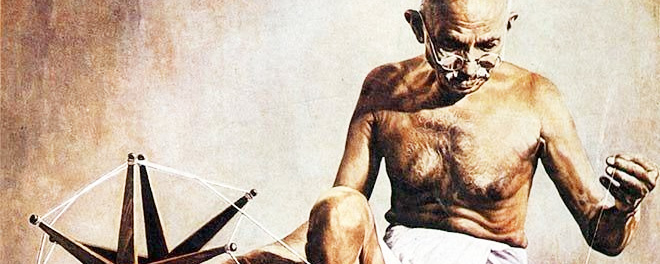
During the freedom struggle, Khadi—the hand-spun and hand-woven fabric—was more than just a cloth; it was a 'Livery of Freedom.' Gandhi used the spinning wheel (Charkha) as a weapon of economic defiance against the British colonial machine. The British would export Indian raw cotton to the mills of Lancashire and sell the finished cloth back to Indians at a premium, a process that Gandhi sought to dismantle through Khadi.
In the early years of the Republic, Khadi remained a proud symbol of patriotism, worn by political leaders and citizens alike. In 1956, the government established the Khadi and Village Industries Commission (KVIC) to preserve this heritage. However, the logic of the industrial age proved too powerful. Khadi, with its high production costs and distribution challenges, struggled to compete with the sheer volume and low cost of mass-produced synthetic fabrics.
The market philosophy of 'Best Value at Lowest Price' has marginalized Khadi. While there are sporadic efforts to reinvent Khadi as a premium fashion brand or a luxury eco-friendly fabric, its market share remains minuscule. In 2023, while Khadi sales reached approximately ₹5,943 crore, they were a mere drop in the ocean compared to the ₹7 lakh crore total apparel market in India. On the streets of modern India, Khadi is no longer the fabric of the masses; it is either a niche fashion statement for the elite or a ceremonial uniform for a dwindling class of politicians.
The Moral Sunset
Mahatma Gandhi’s principles of Truth (Satya), Non-violence (Ahimsa), and Simplicity (Sadgi) continue to be taught in classrooms and celebrated on national holidays. They remain a source of moral inspiration for individuals across the globe. Yet, as a collective political and social entity, India has moved in an entirely different direction.
The nation’s path toward becoming a global industrial power has necessitated a shift toward pragmatism, urbanization, and consumer-led growth. In this pursuit, the Gandhian vision of a decentralized, rural-centric, and austere society has been sacrificed at the altar of the 21st-century dream.
Ramnath Jha is a Distinguished Fellow at the Observer Research Foundation.