HYDRO DIPLOMACY

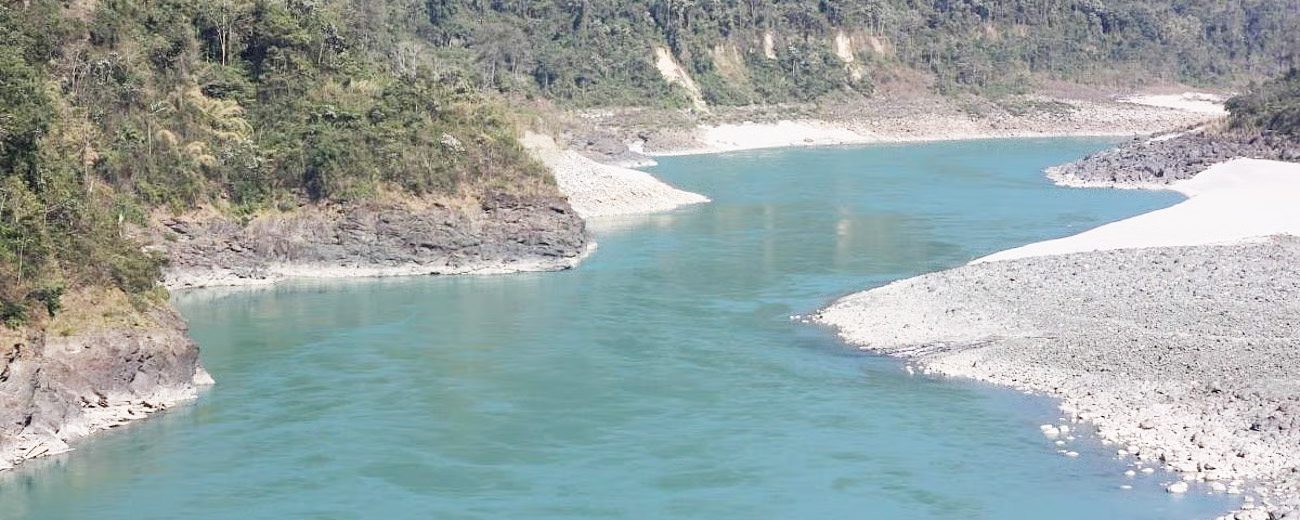
Northeast India is a geographical marvel, a mosaic of eight states, each possessing a distinct temperament and identity. This region is one of Asia’s most prolific riverine landscapes, a direct result of the colossal tectonic collision between the Indian and Eurasian plates that birthed the Himalayas. This ancient, violent surge of the earth created a complex mesh of slopes and valleys, a natural architecture that dictates the flow of water from North to South and East to West. For millennia, these rivers have not only carried water but have transported the very soil of the mountains, depositing silt to create the fertile floodplains of Assam, Bangladesh, and beyond. In this landscape, water is not just a resource; it is the architect of civilization and the primary agent of geography.
The Brahmaputra: The Masculine Sovereign of the East
At the heart of this aquatic network stands the Brahmaputra—a river so formidable and powerful that in Indian tradition, it is referred to as a 'Nada' (a male river). Its journey is nothing short of an epic. Originating as the Yarlung Tsangpo from the Angsi Glacier on the northern slopes of the Himalayas in Tibet, it flows eastward across the high plateau. At the Namcha Barwa, it takes a dramatic, near-vertical 'Great Bend' to enter Arunachal Pradesh. From the heights of the eastern Himalayas, it meanders through the lush plains of Assam before merging with the Padma (Ganges) in Bangladesh and finally surrendering to the Bay of Bengal.
The Brahmaputra is more than a river; it is a geostrategic pivot. It serves as a lifeline for agriculture, irrigation, and massive hydroelectric potential. More importantly, it is a connector, linking India to China, Bhutan, Bangladesh, and Myanmar. This riverine connectivity transforms Northeast India into a critical strategic bridge between the Indian subcontinent and the broader Indo-Pacific architecture.
The Arteries of Commerce: A Historical Legacy
Historically, the river systems of the Northeast—primarily the Brahmaputra and the Barak—were the primary arteries of trade and military expeditions. Long before the era of modern highways, these were the everyday routes of commerce. The British East India Company recognized this strategic value as early as 1844, establishing a functional waterway from Kolkata to Dibrugarh. By 1847, steamships were a common sight, ferrying tea and timber between Assam and Kolkata through the deltaic channels of Eastern Bengal (now Bangladesh).
During this colonial era, the Barak-Surma-Meghna waterway connected Silchar in southern Assam to the port of Kolkata. However, the tragedy of the 1947 Partition severed these liquid lifelines. When Sylhet was ceded to East Pakistan, the seamless connectivity was lost. Vibrant ports like Dhubri, Dibrugarh, Pandu (Guwahati), and Tezpur in the Brahmaputra Valley, and Badarpur and Silchar in the Barak Valley, suddenly found themselves isolated. The routes to the sea now passed through a foreign, often hostile, territory.
Reviving the Liquid Highways: The Modern Mandate
The National Waterways Act of 2016 marked a significant shift in India’s strategic thinking. It aimed to restore the hydroelectric and navigational prowess of the Northeast's river networks. Under this framework, the Brahmaputra (National Waterway NW-2) has seen a resurgence in commercial activity. Today, approximately 600,000 tonnes of cargo—including food grains, fertilizers, bamboo, and construction materials—traverse this route annually.
However, the Barak river (NW-16), despite its historical importance as a trade link between the Barak Valley and Bengal, requires more robust intervention. The lack of consistent dredging and modern port facilities continues to limit its commercial potential. Currently, the trade volume on NW-2 and NW-16 is a mere fraction of what is seen on NW-1 (the Ganga-Bhagirathi-Hooghly system). To truly unlock the Northeast, these rivers must be transformed from seasonal streams into year-round commercial corridors.
Transboundary Ripples: Teesta, Manipur, and the Kaladan
The hydro-politics of the Northeast is further complicated by transboundary issues. The Teesta river, originating from the glaciers of North Sikkim, is a crucial source of hydroelectric power and irrigation for North Bengal and Bangladesh. Historically, it was an ancient trade route connecting Tibet to the Bay of Bengal. However, the unresolved water-sharing dispute between India and Bangladesh has hampered the development of essential commercial infrastructure. Similarly, the Manipur river, which flows into Myanmar, has historical military significance, having been used by the Japanese army during World War II. While it holds the potential to be an alternative route to the Bay of Bengal, the difficult terrain and political instability in Myanmar have kept this possibility largely unexplored.
In contrast, the Kaladan river in Mizoram is the centerpiece of the Kaladan Multi-Modal Transit Transport Project (KMTTP). This ambitious project aims to connect Mizoram to the Sittwe Port in Myanmar’s Rakhine State, providing a vital alternative to the narrow Siliguri Corridor (the 'Chicken’s Neck'). The Sittwe Port, expected to be fully operational by 2027, could open unprecedented trade opportunities for the Northeast, linking it not just to Myanmar but to Nepal, Bhutan, and the global markets of the Indo-Pacific.
Navigating the Diplomatic Tightrope
The path to this riverine revival is fraught with political volatility. Recent unrest in both Bangladesh and Myanmar has clouded the future of regional cooperation. In Myanmar, the conflict between the military junta and the Arakan Army has made the security of projects like the KMTTP a daunting challenge. India is forced to walk a diplomatic tightrope, engaging with both the military government and ethnic armed groups to protect its strategic interests. For India, the Sittwe Port is not just a commercial asset; it is a strategic necessity. It provides an alternative maritime access point that bypasses the traditional, often congested routes. Maintaining a stable, long-term relationship with Bangladesh is equally crucial, as it remains the primary anchor for the 'Act East' policy.
From Natural Assets to Strategic Arteries
Initiated in 1991, the ‘Look East’ policy evolved into ‘Act East,’ positioning Northeast India’s rivers as strategic diplomatic tools. These waterways are vital arteries linking local geography to global trade. To transform this landlocked frontier into a thriving hub, India must prioritize dredging, modern barrages, and completing the Trilateral Highway and KMTTP. Integrating these riverine networks into the Indo-Pacific framework is essential for a secure, prosperous, and connected future.
Jyoti Bhattacharya is a Professor of Political Science at Assam (Central) University, Silchar, specializing in India’s foreign policy and Northeast India.