THE RED SUNSET
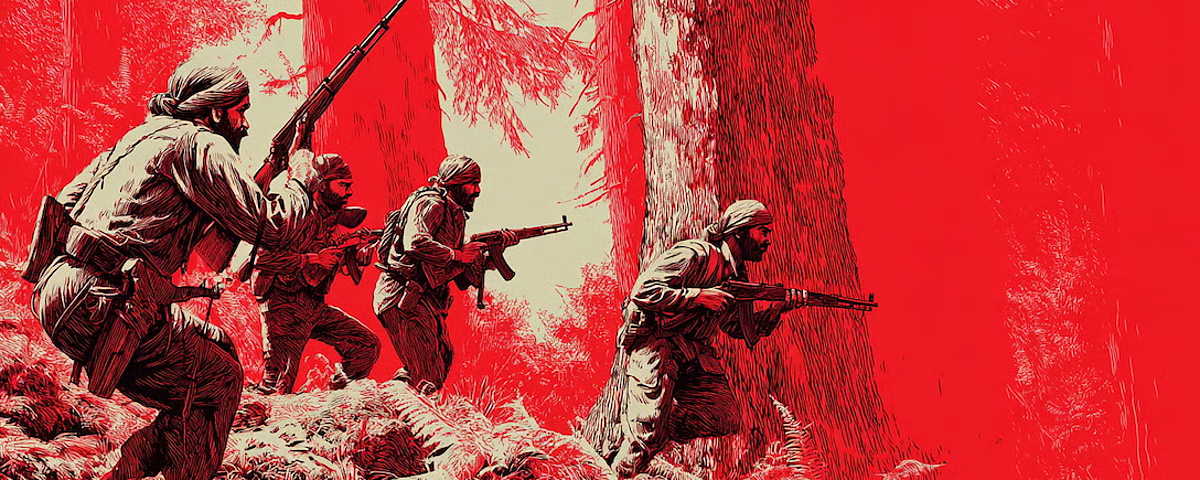
Deep within the primordial and enigmatic canopy of Bastar lies Kutul—once the ‘undeclared capital’ of the Maoist insurgency. By the first quarter of 2026, the Indian government’s claim has solidified into a stark reality: the sun is finally setting on the world’s longest and bloodiest rebellion. As the red flags descend from the mud-brick rooftops, Kutul stands at a civilizational crossroad. The air, once thick with the acrid scent of cordite and the tension of a guerrilla war, now vibrates with a new, albeit daunting, wave of modernity.
For the tribals of Kutul, the Maoist ‘Jungle Raj’ was never a revolutionary dream; it was an invisible and oppressive incarceration. Rebels entered these forests promising a shield against predatory state projects, but instead, they turned the indigenous community into disposable ‘pawns’ for an external ideological war. Education was systematically strangled—a cold calculation that an unlettered tribal follows orders, while an educated one asks questions. Their egalitarian facade was merely a mirror of the very caste structures they claimed to despise, with top commanders being high-caste outsiders who subjected the locals to menial labor and tedious indoctrination. It was a machinery of fear that sought to crush the very soul of the forest. To dismantle this fortress of fear, the state refined the art of ‘Puchkaar aur Phatkaar’ (Persuasion and Punitiveness). While security forces neutralized hundreds of fighters, the government also opened its treasury for those willing to walk out of the shadows. Today, figures like ‘Comrade Arab’—a once-dreaded commander—wear floral shirts in rehabilitation centers, marking a psychological conquest over a physical one. The most lethal blow to the Maoist ‘ideological spine’ came when former rebels were recruited into the ‘District Reserve Guard’ (DRG). Wearing the very uniform they once swore to burn, these men now hunt their own former comrades. The state has successfully turned the rebel’s own pawns into its most effective bishops, hollowing the movement from within.
However, as the Maoist footprint recedes into history, an aggressive wave of development is rushing into the void. High-speed internet, asphalt roads, and digital IDs are the manifest dreams of ‘Digital India.’ Yet, beneath this glitter of progress, an ancient suspicion is taking root. The tribals ask: is the expulsion of red cadres a prelude to ‘Mining Raj’? There is a palpable fear that the forest, their deity and identity, is now being appraised by corporations as a mere repository of iron ore and rare minerals. If the post-insurgency landscape is defined only by the roar of JCB machines, the forest will inevitably birth a new generation of resentment and rebellion.
The Ministry of Home Affairs’ symbolic deadline of March 31, 2026, is a blend of military reality and political theater. While the rebellion has been squeezed into a mere handful of districts, true peace is more than the absence of gunfire. The ultimate challenge remains the restoration of ‘Tribal Trust’ pulverized in the crossfire of decades. Guns can be silenced by superior firepower, but if dignity and justice are not firmly established, this silence is merely a ‘temporary ceasefire.’ Kutul today is the crucible of modern India’s conscience. The ‘Jungle Raj’ is ending, but the ‘Reign of Justice’ is yet to be inaugurated. This is the final battle for the true reconstruction of Bastar.As the Maoist footprint recedes into history, an aggressive and high-speed wave of development is rushing into the vacuum. The arrival of high-speed internet, asphalt roads, and Aadhaar cards in Kutul is the manifest dream of ‘Digital India.’ However, beneath this glittering surface of progress, a profound and ancient suspicion is taking root among the locals.
The tribals of Bastar are asking a harrowing question - What is the true motive behind the expulsion of the red cadres? Is this the birth of a new era of prosperity, or is it a calculated ‘land clearance’ to facilitate the entry of ‘Corporate Mining’? There is a palpable fear that the end of ‘Jungle Raj’ will inevitably be followed by a ruthless ‘Mining Raj.’
The forest, which the tribals revere as their deity and the guardian of their identity, is now being appraised by the state and corporations as a mere repository of iron ore and rare minerals. Kutul today stands at a civilizational crossroads. On one side is the magnificent promise of a digital future; on the other is a desperate, final struggle to preserve their ancestral roots.