WEST BENGAL: BOUNTY VS. BATTLE-CRY

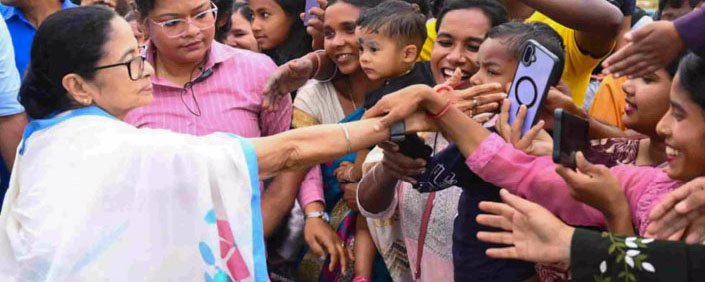
The 2026 Assembly Election on the soil of West Bengal is far more than a cold calculation for 294 seats. It is a grand ideological meta-narrative playing out on the political map of India. This battle represents a collision between two distinct philosophies of governance—the 'Welfare State' and the 'Nationalist State.' The clash between the Trinamool Congress (TMC), led by Mamata Banerjee, and the BJP, commanded by the Modi-Shah duo, is effectively a friction between two visions of India. On one side stands the TMC, which has nourished its roots with the fertilizer of 'Direct Benefit Politics.' On the other stands the BJP, which has transformed this election into an ideological crusade centered on national security, identity, and the sanctity of governance. This is a battlefield where the rhythmic clinking of the Lakshmir Bhandar doles meets the reverberating roar of nationalism.
TMC’s 'Beneficiary Democracy'
The gravitational center of the Trinamool Congress’s politics today is neither a radical policy shift nor a grand industrial revolution. Its core is 'Direct Benefit.' Mamata Banerjee has engineered a model that can be described as 'Political Clientelism 2.0.' She has established a direct, umbilical relationship between the State and the voter, where the government is no longer a distant administrator but has assumed the intimate role of the 'Elder Sister' (Didi) of every household.
The Lakshmir Bhandar scheme has turned the rural women of Bengal into an impenetrable fortress for the TMC. When a woman receives cash directly into her account, it is not merely money; it is the seal of 'trust'—the most potent currency in politics. Schemes like Swasthya Sathi and the Student Credit Card have further expanded this trust. The TMC model rests on a triad of 'Policy, Emotion, and Profit.' By weaving the narrative of being the 'Daughter of the House' (Ghar-er Meye), Mamata Banerjee strikes at the visceral chord of Bengali identity, where cold logic often surrenders to emotion. With over 50% of its vote bank in rural areas anchored in this 'Beneficiary Democracy,' the TMC has extended its organizational veins into every village, ensuring its presence on every plate and in every bank account.
The Lightning Bolt of Nationalism
In stark contrast to the TMC’s 'Welfare Model,' the BJP has erected a 'Nationalist Narrative' that aims for the heart. For the BJP, this election is not merely a transfer of power; it is a cultural and security-driven transformation. The party has weaponized issues of corruption, infiltration, and internal security to lure the urban elite and the restless youth.
The BJP’s model is both ideological and national in scale. They project the TMC as the architect of Bengal’s decline. By issuing a 'charge-sheet' against 15 years of Trinamool rule, they portray a long saga of 'corruption and appeasement.' Issues like National Security and Border Control (CAA/NRC) are the arrows in the BJP’s quiver, used effectively to create an atmosphere of polarization. The party’s journey from a mere 10% vote share in 2016 to a formidable 38% in 2021 is a testament to its organizational sharpness. This is the axis that challenges 'Beneficiary Democracy' with the force of 'Ideological Nationalism.'
The Binary of Arithmetic: Light and Shadow
A glance at the data for 2026 reveals a landscape that is far from blurred; it is fiercely competitive. In the 2021 Assembly elections, the TMC held 215 seats while the BJP was restricted to 77. However, that 38.15% vote share signaled the BJP’s arrival as a force that had effectively erased the Left and the Congress from the Bengali soil. Current opinion polls suggest a tightening race, with TMC projected between 155-170 seats and the BJP surging toward 120-135. This indicates a contraction of the TMC’s space and the emergence of a more aggressive and consolidated opposition.
Four 'Master Keys' will unlock this election: First, the 'Women's Vote Bank,' which remains the TMC’s strongest shield. Second, 'Religious Polarization,' the BJP’s most lethal weapon. Third, the 'Voter List Controversy,' where the addition of 1.2 million new voters and allegations of mass deletions have cast a shadow over the game. Fourth, 'Organization vs. Leadership,' where the TMC’s superior grassroots network faces the national charisma of Narendra Modi and Amit Shah.
The Existential Duel
This election is an existential question for West Bengal. The TMC’s argument is simple: "The State must take care of the citizen." The BJP counters with: "The Nation first, Security first." This is a war of models. The TMC possesses a governance machinery that reaches the 'last mile,' yet it is stained by allegations of corruption and a chronic lack of employment. On the other hand, the BJP offers a clear national vision and a firm ideological ground, but its local organization still struggles to pierce the 'territorial dominance' of the TMC.
The Laboratory of Democracy
Ultimately, the election hinges on a singular choice: Will the Bengali voter prioritize the 'direct benefit' in their pocket, or will they leap into the fire of 'Ideological Nationalism' ignited by the BJP? If the poor and the women remain decisive, the TMC’s return is inevitable. However, if the tide of polarization rises high enough, the BJP could pull off a massive upset. The possibility of a hung assembly or a razor-thin victory cannot be discounted.
The 2026 West Bengal election is the laboratory of Indian democracy. It will test whether the 'Welfare Model' can withstand the storms of 'Nationalism.' For the TMC, this is the final fortress of survival; for the BJP, it is the golden opportunity to hoist its flag on the 'Eastern Front.' Regardless of the victor, one truth remains: Bengal’s politics will never be the same. Both sides must accept that Bengal is now habituated to an 'issue-driven' polarization. The future of Indian politics is being cooked in the fires of this laboratory, and the noise rising from the streets of Bengal will soon dictate the direction of the entire nation. This election is a blueprint for the India of tomorrow, posing the ultimate question: Is a citizen’s stomach larger than their pride, or is the question of identity more visceral than the need for bread?