COVER STORY/ War, Wealth, Wreckage

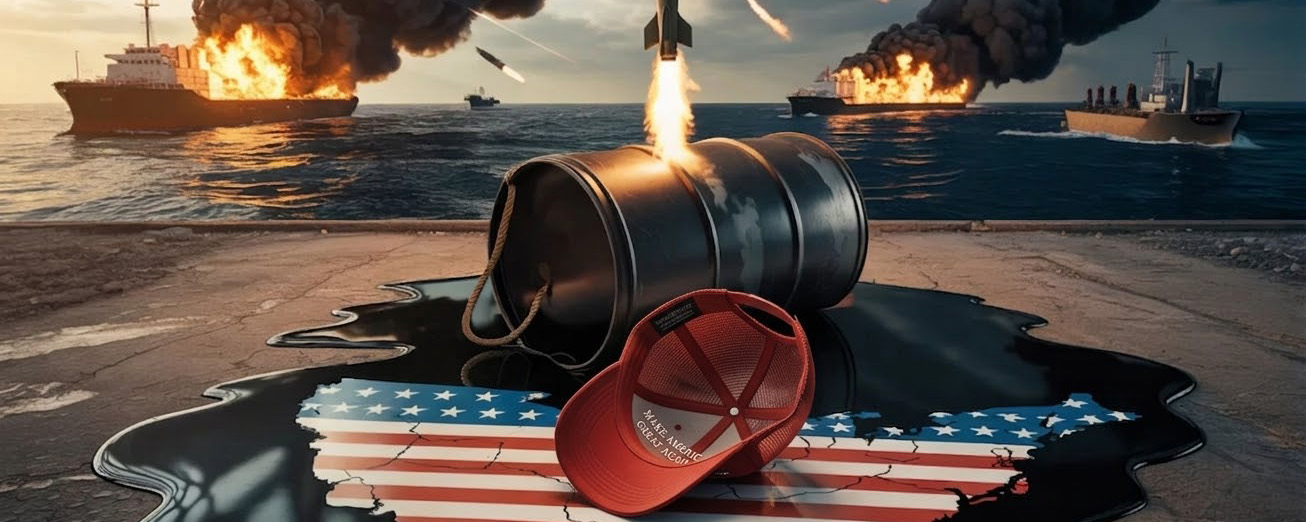
Politics possesses its own ruthless grammar, and the onset of Donald Trump’s second tenure has inscribed its most contentious definition yet. When Trump assumed the Oval Office, he inherited a dual legacy: the unparalleled mandate of his ‘MAGA’ fervor and the carefully crafted façade of a ‘peace envoy’ he had donned during the campaign. He pledged to dismantle the era of ‘Endless Wars’—a system he claimed was nurtured for decades by the Washington establishment.
Yet, the spring of 2026 has arrived with a starkly different reality. In the corridors of Washington, the stench of gunpowder now overpowers the fragrance of peace. Trump championed a ‘transactional worldview’—a paradigm where every policy is a deal, every war a balance sheet, and every international treaty exists solely for American gain. However, the brewing conflict with Iran has demonstrated that geopolitics is not a ‘real estate deal’ to be settled with a mere signature. This is a grand game of chess where the pieces have begun to move of their own accord, and the player who initiated the game finds himself entangled in his own web. Trump’s ‘Grand Illusion’—the belief that he could command the world on his terms—is now obscured by the thick plumes of oil smoke rising from Iranian shores, blinding the global markets.
The West Asian Gambit
The genesis of the US-Iran escalation lies in the erratic strategy of ‘Decapitation Strikes,’ proposed to Trump by a cabal of Pentagon hawks. The logic was deceptively simple: neutralize the Iranian leadership—specifically the radical circle surrounding the Ayatollah—and the entire regime would collapse like a house of cards.
This strategy was essentially a ‘cinematic fantasy.’ While Washington’s strategists might have pored over Sun Tzu’s ‘Art of War,’ they failed to navigate the profound cultural and historical depths of West Asia—a region anchored not just in maps, but on the bedrock of centuries-old ideologies. America thought that by decapitating the leadership, it would sow the seeds of a new ‘Democracy.’ But the outcome was a classic blunder: when you strike a beehive, you do not find honey; you only invite the stings.
The Iranian power structure is no solitary oak to be felled with an axe; it is a ‘Hydra.’ Sever one head, and two more—even more radical—emerge from the stump. In the streets of Tehran, anti-American sentiment was not extinguished; it was resurrected with the fervor of martyrdom. What Washington anticipated as ‘regime change’ evolved into a rigid ‘regime hardening.’ This was the first major strategic inflection point: America had managed to embolden and embitter an enemy it sought to ‘annihilate.’
The Power Vacuum and the ‘Agencyloss’ Moment
The hasty and chaotic withdrawal from Afghanistan created a void that no global superpower was prepared to fill. Iran, having spent years quietly fortifying its regional influence, saw this vacuum as a strategic window. Ironically, instead of containing this rise, the Trump administration tethered its response to its narrow ‘Israeli agenda.’ Washington believed it could manage Iran by acting as Israel’s ‘proxy.’
Here, a grave ‘calculation error’ occurred. Trump failed to perceive that Israel’s own priorities—specifically the expansionist dream of ‘Greater Israel’—could diverge significantly from American strategic interests. The ground incursion into Lebanon gave Iran the ultimate pretext. Suddenly, America was embroiled in a war whose rules it did not script. It stood at the threshold of becoming an ‘active participant’ instead of a ‘silent spectator’—a point of no return.
This was the moment of ‘Agencyloss’—the paralysis of sovereign decision-making. On Pentagon maps, this conflict appeared as a ‘surgical strike’; in reality, it proved to be an inescapable quagmire of ‘unlimited war.’ Trump’s arrogance—the belief that he is the sole operator of the global superpower—has become his greatest burden. He can neither restrain Israel, nor defeat Iran, nor extricate himself from the fray.
The Hollow Card of American Mediation
On this global chessboard, there was a moment the Trump administration tried to market as its ultimate ‘success story.’ In the months following September 2025, Trump theatrically declared himself the ‘peace envoy’ between India and Pakistan. His claim in the White House briefing—that he had pulled both nuclear powers back from the brink—was a quintessential example of ‘American Exceptionalism.’ It was the assumption that every global crisis could be resolved from a desk in Washington.
However, New Delhi dismissed this so-called mediation as nothing short of a ‘ludicrous failure.’ India’s ‘strategic silence’ and diplomatic distance punctured Trump’s grandiosity. The reality was that peace in South Asia was not the result of a Washington phone call, but of the cold ‘Realism’ inherent in nuclear deterrence. This incident proved that the Trump administration’s ‘diplomatic toolkit’ is now obsolete. The ‘deal-making’ Trump boasted about has become ineffective in this complex, multipolar world. America still views the 21st-century ‘Asian Ascent’ through a 20th-century lens—a world where no one asks for its ‘mediation,’ and its presence is merely viewed as a ‘complication.’
The Shattering Mirror of MAGA
Stand on the street of any small town in the American Midwest, and you may still see the ‘MAGA’ flags flying, but their luster has faded. This was the demographic that voted for Trump as an ‘anti-establishment’ warrior, promised that America would cease squandering its resources on foreign wars and prioritize domestic prosperity.
But the war with Iran has burst the bubble of ‘economic nationalism.’ The cost of conflict is being felt not just in the Pentagon’s ledger, but in the kitchens of American families struggling under the weight of rising fuel and electricity costs. The tariff wars and disruptions in global supply chains have plunged American manufacturing into a furnace of rising costs and zero profits. Ironically, the farmers—the backbone of Trump’s most loyal base—now witness their ruin amidst silos of unsold grain and plummeting global demand. It is a staggering irony: the leader who championed ‘America First’ has become the ‘agent of inflation’ for the average American. With the mid-term elections approaching, Trump’s popularity is on a precipitous decline. It is a classic scenario of political entropy—where the image of the ‘strong leader’ begins to melt in the very furnace of the war he helped ignite.
Uni-polar Illusion vs. Multi-polar Reality
The US-Iran escalation is not merely a bilateral conflict; it is the funeral of the ‘Uni-polar’ global order that America has maintained since 1991. Trump harbored the illusion that he could contain Russia and China while stabilizing the Middle East on his terms. Instead, his Iran policy has pushed Moscow and Beijing into a closer strategic embrace.
Today, Beijing stands with Tehran to safeguard its ‘Silk Road,’ and Moscow utilizes Iran’s ‘drone-network’ for its tactical needs. Forums like BRICS are no longer just economic organizations; they have become the axis of an ‘anti-West’ alliance, openly defying American sanctions. Washington’s ‘sanctions policy’ is no longer its greatest weapon, but its most profound weakness. This is a world where the dollar-centric economy is being challenged by the ‘Petro-Yuan’ and other currencies. Instead of isolating Iran, America has fractured the world into two distinct camps.
The Exit-less Trap of a Superpower
We are at a juncture in history where the very definition of ‘Power’ has shifted. Trump’s gamble will be recorded as the ultimate monument to strategic myopia. A superpower that once sought to ‘direct’ the entire world is now merely searching for an exit from the rubble of its own mistakes.
This is the ‘dark side’ of ‘strategic overstretch’ that can no longer be ignored. America sought to play ‘chess,’ but failed to notice that the board itself was slipping from its grasp. The ‘MAGA’ dream, once a beacon of hope, is now mired in a war where ‘entry’ was effortless, but the ‘exit’ remains unknown. This is the decline of a superpower that played to win, but is now engaged in an endless and agonizing attempt to merely ‘postpone defeat.’
The Oil Gambit
No 'Power Grid' or 'Digital Economy' of modern civilization can function without its invisible engine: Crude Oil. The escalating US-Iran conflict serves as a stark reminder that while 21st-century titans obsess over Silicon Chips and Galactic conquests, their strategic foundations remain anchored in oil wells.
By March 2026, global oil production has stabilized at 102.4 million barrels per day. However, 30% of this output originates from the volatile 'hotspot' of West Asia. Iran’s strategic leverage lies not merely in its reserves, but in its command over the 'Strait of Hormuz'—the very jugular of global oil commerce. The data showing 21% of the world’s oil supply flowing through this narrow passage is no longer a statistic for economists; it reads like the script of a high-stakes horror film. Trump’s 'MAGA' rhetoric crumbles into irony as American gas stations see petrol prices surge past $6 per gallon. Energy is no longer just a resource; it is the 'Alpha and Omega' of politics, capable of crowning or toppling governments. In 2026, every drop of oil is being measured in 'Political Capital.'
Iran’s Asymmetric Strike
In this 2026 theater of war, Iran has deployed an 'Asymmetric Strategy' for which the Pentagon has no counter. Tehran has realized it need not engage the massive American military machine directly; it only needs to create a 'bottleneck' in the global supply chain.
From the 'Abqaiq' refinery in Saudi Arabia to the 'Fujairah' terminal in the UAE, Iran has utilized its proxy drone and missile networks to strike the very arteries that oxygenate the world economy. A mere 18% decline in Qatar’s LNG exports has not only inflated European energy bills but also exposed the fragility of 'Energy Security.' The data is haunting: the day two tankers were targeted in Hormuz, Brent crude prices spiked by $12 within fourteen minutes. This is not 'Market Volatility'; this is 'Market Panic.' The decades-long American naval presence, once the guardian of these routes, now stands helpless against swarms of low-cost Iranian drones. This is not a defeat of technological superiority, but a victory of 'Geopolitical Geography.'
The Decline of the Petro-Dollar
The 'Maximum Pressure' sanctions Trump once used to corner Iran have boomeranged into a lethal weapon for Tehran. Iran has transformed these restrictions into its greatest strength. By forging a 25-year 'Strategic Partnership' with Beijing, Iran has institutionalized the use of the Yuan in exchange for oil.
This represents an existential threat to the 'Petro-Dollar.' As Iran operates an 'Underground Energy Network' with China and Russia despite global sanctions, the credibility of the American 'Financial Superpower' is eroding. In the first quarter of 2026, data reveals that nearly 12% of global energy trade has migrated away from the US Dollar to alternative currencies or 'barter' systems. This is more than just economic data; it is the fragmentation of the 'Global Order' established by the 1944 Bretton Woods Agreement. Trump’s obsession with forcing Iran to its knees has instead pushed it into a strategic embrace with nations seeking liberation from American dominance.
The Perfect Storm: A Global Recession
The most visceral casualty of this phase is the common man. The 40% surge in energy prices evokes haunting memories of the 1973 'Oil Shock.' Production costs worldwide have climbed by 22%, while the spike in global freight rates has pushed consumer goods beyond the reach of the average citizen.
The US Consumer Price Index (CPI) hitting 9% is no coincidence; it is the 'Cost of War' ignited by Trump’s transactional politics. History testifies that when oil prices disrupt the lifestyle of the middle class, revolutions follow. The precipitous drop in Trump’s approval ratings in mid-term polls is not due to his foreign policy failures, but the crisis at the 'Petrol Pump.'
The Invisible Equations of Energy
War carries a long tail known as the 'Economic Shockwave.' The 1.4% decline in global GDP during the first half of 2026 is directly linked to the disruptions in Hormuz. Even American 'Shale Oil,' once considered the bedrock of US energy independence, has been marginalized in this global crisis. With crude prices hovering at $115 per barrel, every American refinery is grappling with skyrocketing 'break-even' costs.
The data tells a story of strategic isolation: in 2024, the US was producing 13.2 million barrels per day. By April 2026, that output is being cannibalized by domestic consumption and the desperate demands of European allies. Iran has capitalized on OPEC+ meetings where Russia and Saudi Arabia have signaled a 'Strategic Distance' from Washington. The March 2026 data shows an OPEC+ production cut of 2.5 million barrels per day, a move that serves as a direct and categorical rejection of American 'Price-Capping' efforts.
Petro-Yuan vs. Petro-Dollar
This conflict has transcended missiles and drones; it is now a battle for the survival of 'Reserve Currencies.' The war has exposed the rot within the global financial architecture that Washington economists once called 'Dollar Hegemony.'
China has provided Iran with a 'Lifeline.' Under the 25-year cooperation pact, Beijing now pays for 60% of its Iranian oil imports in 'Digital Yuan.' This is a direct challenge to the 'Soft Power' of American sanctions. By 2026, 18% of West Asian oil trade is conducted in Yuan or local currency baskets. For America, this is a silent but fatal blow. If the US Dollar’s share in global energy trade drops from 80% towards 70%, the demand for US Treasury Bonds will plummet, rendering the management of American national debt impossible. Trump began this war to 'Blackmail' Iran, but he has inadvertently gambled the entire 'Global Financial Architecture.'
Refineries and Logistics
The energy crisis is not just a shortage of 'Oil'; it is a shortage of 'Refined Products' like Diesel and Jet Fuel. Iran’s strategy specifically targets the 'Choke-points' near major refinery hubs in the Gulf. Between February and March 2026, global 'Shipping Insurance Premiums' have surged by 400%. Insurance giants have declared the waters around Iran a 'High-Risk Zone.' Consequently, tankers exiting Hormuz must now take routes 30% longer than usual. This additional 'routing' has not only inflated the final cost of oil but has also triggered a secondary wave of inflation in the global food chain, which relies heavily on diesel-powered logistics.
The Death of the 'Green Transition'
A grim casualty of this energy crisis is the sacrifice of the 'Green Agenda.' Europe, which was leading the march toward 'Net-Zero,' has been forced to return to coal and aging gas refineries. Data from the first four months of 2026 shows European coal consumption rising 25% above 2021 levels.
This war has effectively wiped out decades of 'Climate Change' negotiations in a single stroke. When economies enter 'Survival Mode,' environmental agendas are the first to be discarded. This marks another unforeseen defeat for Trump—he campaigned on 'Energy Independence,' yet he has plunged the world into a 'Fossil Fuel-Centric' war-footing, making environmental progress an impossibility for the next decade.
Collateral Victims: The Emerging Markets’ Agony
India, which relies on imports for 85% of its energy needs, is suffering the 'Collateral Damage' of a war it did not choose. In the first quarter of 2026, India’s trade deficit surged past the $25 billion mark. The arithmetic of this crisis is brutal: every $10 increase in oil prices shaves off 0.5% of India’s GDP growth. But India is not alone. Emerging economies across Southeast Asia and Africa stand on the precipice of a 'Debt Crisis.' Nations that were just beginning to breathe after the pandemic are now being sacrificed at the altar of this 'Oil War.'
The Plate of War: 'Calories' vs. 'Crude'
The energy crisis has dealt its most cruel blow to the global food markets. By March 2026, global food prices have spiked by 22%. The link is direct and devastating: nitrogen-based fertilizer production depends on natural gas, and the 150% surge in gas prices has broken the back of farmers worldwide. The costs of transporting and harvesting staples like corn, wheat, and soybeans have reached astronomical heights. In the already volatile regions of the Middle East and Africa, 'Bread-Bunts' (famine-driven unrest) have emerged as a new political weapon. The Iran war has birthed a global 'Caloric Catastrophe,' ensnaring even those nations that remained strictly neutral.
Trump’s Perfect Storm: The Mathematics of MAGA's Decline
Donald Trump’s mid-term electoral arithmetic has dwindled to 'break-even' points. Early 2026 surveys show his approval rating at a historic low of 38%. The primary culprit is the betrayal of his core constituency: the 'Blue-Collar Worker.'
Data from 'Swing States' like Pennsylvania, Michigan, and Wisconsin suggests that inflation has cannibalized the promises that propelled Trump to power in 2024. His trade wars have led to a 35% decline in agricultural exports. Pre-election polls reveal a staggering truth: 54% of independent voters now view the Iran conflict not as an 'America First' mission, but as a monument to 'Trump’s personal ego.' The challenge for Trump is no longer winning the war, but surviving as a 'strong leader' who promised prosperity but delivered a recession. With the Republican Party fracturing into 'Neo-con' and 'Isolationist' camps, Trump is trapped in a 'Perfect Storm' where energy, food, and politics are eroding the very foundations of American power.
A Desperate Ceasefire: The Silence of Exhaustion
At the end of March 2026, when Washington announced a five-day 'temporary ceasefire' from the Situation Room, it was not a diplomatic overture; it was a confession of 'Logistical Fatigue.' Data reveals that US aircraft carriers were consuming missiles and munitions at a rate the Pentagon could not replenish; stocks of 'high-precision weapons' were projected to run out within 90 days.
This search for a 'Safe Exit' was driven not by magnanimity, but by 'Depletion.' The ceasefire is a 'Ventilator' for Trump’s gasping foreign policy. However, the tragedy of stopping mid-war is that the enemy reads your weakness. Tehran’s official response—'We want results, not a pause'—signals that at the diplomatic table, America is no longer the 'Demand-Maker,' but a desperate 'Bargainer.'
Tehran’s Terms and the Global Pivot
The three conditions Iran has set for negotiations read like 'Dark Humor' directed at Trump’s MAGA vision. Iran’s demand for reparations for infrastructure damaged during the war effectively inverts 'Victor’s Justice.' Should Washington accept, it would shatter the myth of American 'Invincibility' on the global stage.
Furthermore, Iran’s demand for a non-aggression guarantee is a 'political suicide' for Trump, who cannot offer a guarantee that a future president won't revoke. But the greatest threat remains economic. If sanctions are lifted, the sudden influx of 3-4 million barrels of Iranian oil could crash prices to $60, rendering the American 'Shale-Oil' industry bankrupt. Trump wanted a war to win; he is now buying a peace that will destroy his own economic legacy.
Burdened Alliances: The Myth of Western Unity
The 'Greater Israel' alliance, which Trump viewed as a strategic shield, has become his most agonizing 'Exit' thorn. By April 2026, Israel’s ground operations have left America diplomatically isolated amidst mounting global 'Human Rights' outcries. NATO members, specifically France and Germany, have opened 'Secret Channels' with Tehran. This is the empirical evidence that 'Western Unity' is now a myth. With 22 of the 32 NATO nations publicly advocating for 'Trade Continuity' with Iran, Trump’s diplomatic exit has become a 'Solo Act.' America stands alone, searching for a way out of a war it ignited, while the rest of the world carves its own path.
The Economics of Exit: De-dollarization
In the grand theater of diplomatic bargaining, Iran is playing its most potent card: 'De-dollarization.' Tehran has made it clear that it will no longer accept the US Dollar as a 'Medium of Exchange' in any future settlement. This is not just an Iranian victory; it is the formal inauguration of the 'Multipolar World' shaped by Russia and China over the last two years.
The data is categorical: in 2025, the US Dollar’s share in global central bank reserves stood at 58%. By the first quarter of 2026, it has plunged to 55%. This 3% decline signals a 'Capital Flight' of hundreds of billions. Trump’s war has acted as the catalyst for this exodus. Whatever the diplomatic outcome, the 'Reserve Power' of the American Dollar, which once controlled the world, will never be the same.
The Imperial Sunset
This narrative brings us to a singular truth: the US-Iran war is not merely a geographical event. It is a 'Violent Transition'—a period of 'Imperial Entropy.' Trump’s exit, no matter how 'honorable' it is framed, will be recorded by history as a 'Strategic Defeat.'
The world is learning to live without the superpower that, in the 20th century, held the monopoly on both 'Peace' and 'War.' If an agreement is reached with Iran, it will be but a signature on paper. Beneath that ink lies the ash of hegemonic hubris. This year the world realized that Trump’s MAGA dream was, in reality, a 'Global Wake-up Call.' The war may end, but the 'Trust' that once anchored Washington to the world is likely buried forever.