

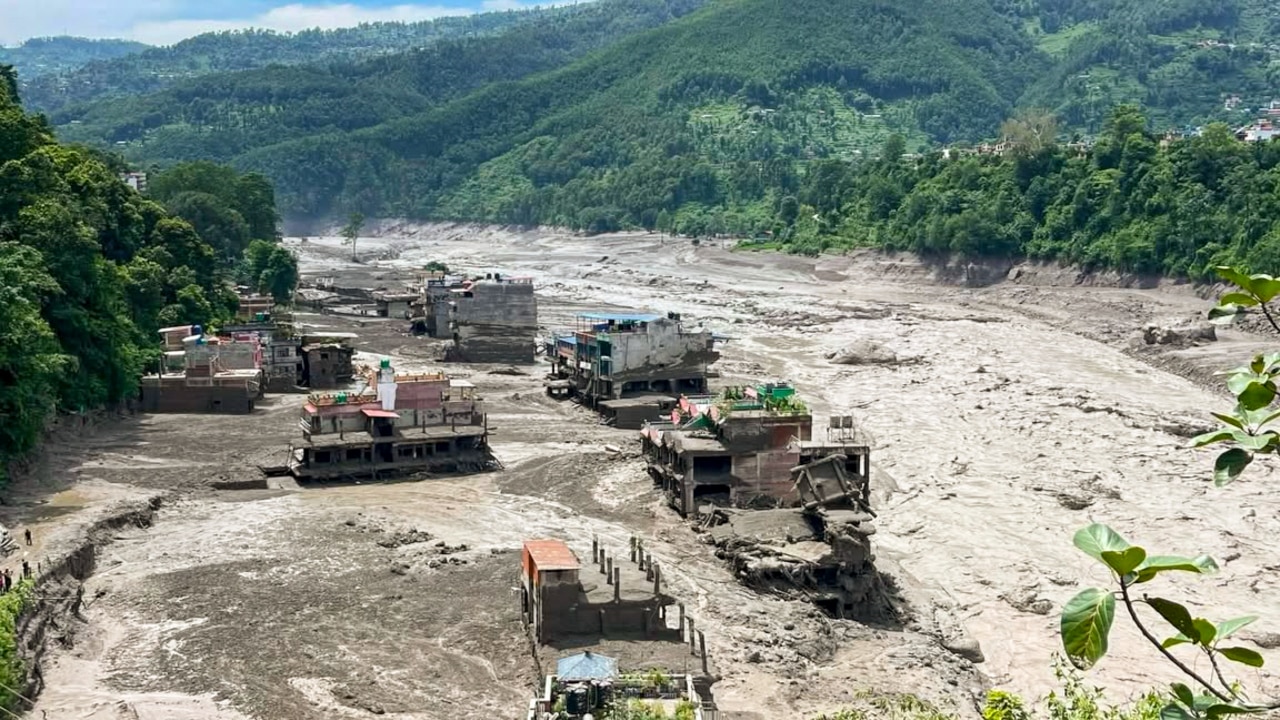
A family's wait for closure - Two months after Nepal floods - Long after flood waters have receded in Nepal, somewhere between death toll and stories of survival is another list: of 5,285 missing people. Among them is Priyanka Choudhary, a 40-year-old public health specialist in Finland.
All of six seconds. That's how long video lasts. In dark jacket and wide-brimmed hat, against clear blue skies and vast, rocky Kailash mountain range, Priyanka Choudhary on a pony, waving at camera, wearing brightest smile. These six seconds now fill mother Madhu's hours as she watches video on loop at her home in Bilaspur, Chhattisgarh. She sometimes attempts to pinch screen and zoom into her face. But it's video, she fails, so she starts all over again.
It's video of Priyanka shot days before catastrophic floods that hit Nepal on August 26. 40-year-old public health specialist was one of 77 pilgrims and three volunteers from Isha Foundation pilgrimage group that was on its way back from Kailash Mansarovar, when giant wall of water, mud, ice, boulders struck Gyirong immigration office at Tibet-China side near Nepal border, levelling entire complex. Two months after tragedy, Priyanka, citizen of Finland, remains on list of 5,285 people reported missing from across Nepal.
Where is Priyanka? Where do you look for loved one, child, who leaves without trace? When questions get unbearably heavy, Madhu, 63, turns to video, one of many in Google Drive link that Isha Foundation shared with family in days after tragedy.
"She watches it again and again. You cannot make a mother understand," says Priyanka's younger brother Tarun Choudhary, 38, who handles family's mining business in Bilaspur.
Tarun says he initially asked his mother not to keep watching video, worried it would only deepen her distress. "But how do you ask a mother to stop looking for her daughter? So now, I sit with her and tell her, 'Look how happy Priya was. She has gone to God, and God has happily taken her away," he says.
A window closes - On October 5, Nepal government announced it was ending search-and-rescue phase of its post-disaster operations and shifting focus to rehabilitation and reconstruction. Authorities said they would continue recovering remains and belongings found during rehabilitation work, but would no longer actively search for bodies. Among those missing are 275 Indians (as of September), besides many others of Indian origin. At media briefing September 22, Randhir Jaiswal, official spokesperson of Ministry of External Affairs, said Indian government was working closely with Nepal to trace missing. "We have forensic team in Nepal, which is working in Kathmandu in several laboratories along with their Nepali colleagues. The Indian team has been working on 3,000 samples, of which they have been able to so far arrive at over 1,200 DNA profiles," Jaiswal said.
Tarun says his family shared their DNA samples too, but haven't heard from authorities yet.
In aftermath of disaster, Nepal government issued ordinance to reduce waiting period for declaring missing person dead - from 12 years to 45 days. October 12 marked 45 days of tragedy. Since then, said Lok Bahadur Chhetri, spokesperson of Nepal's Ministry of Foreign Affairs, over 35 countries, whose citizens are missing, were in touch with government to coordinate process
In statement, Isha Foundation said it remained in regular contact with Chinese, Indian and Nepalese authorities and relevant embassies of 19 countries to seek information about those missing. Speaking to Indian Express, spokesperson for foundation said Priyanka had been associated with them since 2013.
'I was losing all hope' - On August 26, Tarun was on his way to work when he got call from mother Madhu, informing him about floods. Priyanka usually spoke to Madhu every evening, but that day, phone did not ring. Tarun checked his email. Since Priyanka had listed him as emergency contact, he had begun receiving communication from Isha Foundation. "The email spoke about floods and that they had lost contact with group. I didn't know what to do," he says. “I called up my relatives for advice, but there wasn't much we could do from here.”
Three days later, he flew to Kathmandu. He started by visiting some of biggest hospitals in city, hoping Priyanka might be among those who had been rescued but were probably too traumatised to talk or identify themselves. But he soon hit dead end. The hospitals said all those admitted had been accounted for. "I was completely confused, losing all hope. What is this? How can I ever do this? How can I find her?" From Kathmandu, he travelled to Bidur Nuwakot, along Trishuli river, roughly 80 km from immigration centre that was Priyanka's last known location.
He had seen photographs of floods before travelling to Nepal, but nothing prepared him for what he saw at site of tragedy. All around him was mud, with debris in some cases reaching at least 20 feet high and covering buildings up to second and third floors. Trip left him humbled. "It is heartbreaking and traumatic. The human body seemed so small and insignificant amidst all that wreckage," he says. “I felt lost. Where do I find Priya? Where do I even start? Was I blank. I was not able to do anything for my sister.”
Three days later, he returned home to his family in Chhattisgarh, carrying Priyanka's suitcase - and heart full of grief for family waiting for answers.
In Priyanka's suitcase, which she had left at a hotel before she went missing in floods, were chocolates that she had bought for Tarun from Nepal. There were also clothes, souvenirs and gifts for her family.
Now, two months since Tarun brought suitcase home, it remains unpacked, chocolates still inside. "I don't let anyone touch suitcase. These are last things that Priya used, things she bought for us," he says.
She wanted so much...' - The last time Tarun spoke to Priyanka was on night of August 25, day before floods. She had returned from pilgrimage and was at immigration centre in Gyirong, preparing for journey home. "While she was at Kailash, she called us on video. She was very happy, she had been wanting to visit Kailash for very long time. She told me that she was tired after road journey, and now she was just waiting to get home and rest properly," Tarun recalls. “We did not speak for long, I thought, let her rest, we'll talk in detail once she's home.”
The family was excited. This was to be Priyanka's first visit home from Finland in about five years. "She wanted to spend more time with family as she was away from home for so long," says Tarun.
Shortly before pilgrimage, the siblings had got on long phone call, during which conversation drifted towards their growing up years, how they would tease their cousins, how Tarun would play elder brother and irritate Priyanka no end. "It was conversation full of very nostalgic memories," Tarun says. "That was my last proper conversation with her.
The siblings had lived in different countries for much of their adult lives. With family moving from Haryana to Chhattisgarh, Priyanka stayed with her uncle's family in Gurgaon until Class 12. Their father, Ramesh Choudhary, 64, wanted her to be doctor, but she had other plans. After Bachelor's in dentistry from Chhattisgarh, Priyanka went to London for Master's degree in public health and worked there for few years before moving to Finland in 2017, where she worked as postdoctoral researcher in Research Unit of Clinical Medicine at University of Oulu, Finland. She worked on project on obesity-related fibrotic pathologies, and taught in university's International Master of Epidemiology and Biomedical Data Science programme.
Tarun, two years younger, spent four years studying marketing and finance in Australia before returning to India to take over family business. They saw each other from time to time, but their calls could stretch for hours, taking in work, daily life, childhood memories and plans for future.
He remembers his sister as fiercely independent, someone who did not allow other people's opinions to determine her choices. There was so much she wanted... She wanted to be a mother. I wish we had more time with her.
Priyanka was happiest when she was travelling, Tarun says she had visited more than 30 countries and often took four or five trips a year, usually with her husband, Jani Rusaka, who works in construction sector. The couple met in Finland and married in 2022.
The Kailash pilgrimage was unusual because she had chosen to travel solo. "She wanted to do this for herself" Tarun says. “She was deeply spiritual and had followed Sadhguru and the Isha Foundation since around 2013.”
Tarun wishes he had taken some time out to visit Priyanka in Finland. "I was busy with my life and career and always thought there would be opportunities to go to Finland later. Though we would talk regularly, I met her only once in last five years, in Delhi. Now, all I think of are places we did not visit together and all conversations I put off for later," he says.
But there's one trip he wants to go on now - he plans to visit immigration centre in Gyirong where Priyanka was last seen, this time with his parents and her husband, Jani Rusaka. "We will do that whenever they open it up for visitors. It is going to be difficult for me to visit place, but I think it is important for my family to be where Priya last stood," he says.
The evenings are different now - In weeks after Priyanka went missing, Tarun contacted MEA officials, trying to look for leads that might help locate her. "I was told that around 900 articles had been recovered, but I could not obtain details about what items were or whether any belonged to Priya," Tarun recalls.
The family kept hoping. Every time his parents gave up, someone would tell them about people swept away in floods but who had turned up months later. And they would begin to hope again.
The nights were especially difficult, with both parents sleepless and anxious. Tarun knew he would soon have to prepare them for worst. He started showing them videos of floods, explaining to them the odds of someone surviving the catastrophe. Gradually, his mother began to confront possibility that Priyanka may not return. On October 23, family performed her last rites. "I hope my parents find some closure, some peace now. I hope they can have some semblance of ordinary life," he says.
The loss has changed how family spends its days. "Earlier, we largely stuck to ourselves, all of us doing our own things. But now, I try to be home by 6 pm, around time my mother usually speaks to Priya. And then, I don't leave house. I stay with my mom. We watch TV together," he says. "She doesn't say much, but I can sense an insecurity, as if she doesn't want to lose me now.
Others like them - Since his Nepal trip, Tarun has stayed in touch with some of families, who, like him, were looking for their loved ones. "I met a woman whose husband had travelled alone to Kailash Mansarovar and who was now missing. She asked me what she should tell their two children. I met a husband who was waiting for his wife, a mother of three. I had met them in Kathmandu, before I could travel to site of tragedy. I talked to them sometimes, tell them about scenes of destruction that I saw near the river. I can only help them face reality that their loved ones may not return," he says.
Priyanka's husband Jani, too, is struggling to deal with his loss. The couple had been together for eight years. "He isn't doing too well. He is in Finland, away from all of us. It can get lonely in times like these," Tarun says.
He says he is still trying to figure out what to do with things Priyanka left behind. He plans to donate her clothes, while keeping some things close. "Things that remind me of her... A reindeer souvenir she once got. Good memories," he says.
There's one place, one memory, he will definitely hold on to. “I have no answer to where Priya is. But for me, that place (Nepal) is now my sister. I will keep going to Nepal again and again.”
After the deluge - 5,285 missing, 275 Indians among those missing as of September 4, 77 pilgrims and 3 volunteers of Isha Foundation among missing, 3,000 number of samples Indian team working on to generate DNA profiles to identify victims, 1,200 DNA profiles generated so far by Indian team, 1,453 confirmed deaths in Nepal floods, 45 days is new legal waiting period to declare disaster-related missing person dead in Nepal, reducing previous 12-year timeline.
Analytically, Kailash pilgrimage tragedy shows climate change hitting Himalayas - glacial lake outburst floods increasing, infrastructure in Tibet-China border vulnerable. For India, which sends thousands to Kailash via Lipulekh and Nepal routes, safety protocol needs review.
If 5,285 missing, many families like Choudharys wait for closure, DNA profiling is only hope.
Tags: #NepalFloods #KailashMansarovar #IshaFoundation #Missing #PriyankaChoudhary #DNA #Gyirong #ClimateChange #GLOF