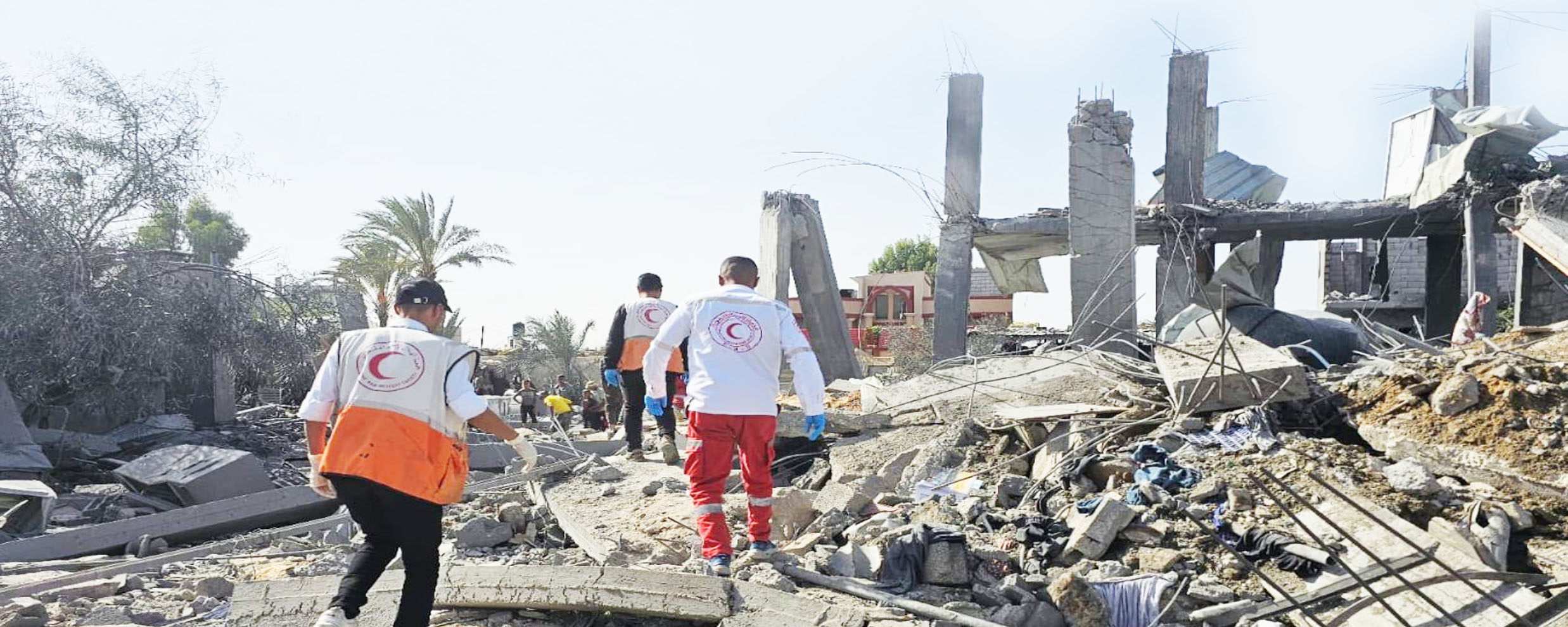

Over the last 15 years, the Middle East has been racked by war, destruction, and displacement. Hundreds of thousands of people have died as fighting raged in Gaza, Lebanon, Libya, Sudan, Syria, and Yemen. Millions more have fled. The violence has rolled back gains in education, health, and income while laying waste to homes, schools, hospitals, roads, railways, and power grids. The war in Gaza has proved especially devastating, setting back the territory’s socioeconomic indicators to 1955 levels. The World Bank and UN organizations have estimated that rebuilding the Middle East and providing enough humanitarian aid will cost between $350 and $650 billion. The UN Development Program has estimated that at least $40 to $50 billion is needed to rebuild Gaza alone.
Offering these shattered societies humanitarian and monetary assistance is critical for the survival of millions, especially in the near term. It is thus deeply concerning that multiple Western governments, including Washington, are curtailing foreign aid and humanitarian assistance. But ultimately, the main obstacle to the Arab world’s reconstruction will not be the lack of funds. It will be political disputes and grievances. The region is filled with failing states. It features competing powers that work to leverage this chaos to their geopolitical advantage. Together, these problems make permanent peace impossible.
The region’s most powerful actors know this. Iran, Israel, the United States, and the Arab Gulf countries have all spent decades trying to shape the region to their liking without addressing the root causes of conflict, and they have repeatedly failed. They have sought security over peace and ended up with neither. And yet their current plans are strikingly similar, at least in spirit, to past efforts. All these countries are committing again to visions of a new regional order in which reconstruction takes place without political settlements. They have put forth lofty proposals—Israeli-Saudi normalization, an economic pact between Iran and the Gulf states—without considering political realities, local dynamics, or other, broader consequences. As a result, their plans will not put an end to cyclical violence. If anything, they will fuel it.
To achieve stability, the war-torn Middle East must shift course. Its powers must stop papering over regional and local divisions and instead do the hard work of addressing them. They need to help fractured societies come together. They must create accountable political institutions and promote systems of transitional justice. They need to support a reconstruction that is part of a broader peace-building agenda. They must create a political framework that actually recognizes the right of Palestinians to self-determination. And they need to figure out how to resolve, or at least better manage, their own differences. Otherwise, it doesn’t matter how much the world spends on reconstruction. The region will remain broken.
In 1945, Europe lay in ruins. Tens of millions of people had been killed in six years of war. Millions more had been driven from their homes. Many of the continent’s most prosperous cities had been demolished by bombs or shattered by artillery. Regional currencies had collapsed, reducing people to begging and bartering.
In response, the Truman administration called on Washington to dedicate itself to rebuilding the continent. Following the advice of U.S. Secretary of State George Marshall, Congress began passing massive aid packages for Europe’s peoples and communities, spending $13.3 billion (over $170 billion in today’s dollars) on the region. But this money came with conditions. Recipients had to remove most barriers to trade with other European states. They had to adopt policies that increased their exports to the United States and made them take in more American goods. The goal was not merely to reconstruct Europe’s homes, roads, and bridges. It was to bring the continent into the emerging U.S.-led liberal order.
The strategy worked. The recipients of Marshall Plan funds joined the U.S.-led North Atlantic Treaty Organization, committing to collective defense. They enmeshed their economies, paving the way for the European Union. Thanks to these decisions, Europe not only economically recovered from the destruction of World War II but, after centuries of fighting, became one of the world’s most peaceful and prosperous regions.
The scale of devastation across the Middle East today resembles that of Europe in 1945. The death tolls are staggering, if not quite as high. Entire economies have been wiped out. National currencies have lost most of their value: the Yemeni riyal has lost 80 percent of its value since 2014. The damage is most visible in Gaza, where, as of late January, the official death toll is over 47,000—likely an underestimate—and where Israeli bombardment reduced around 70 percent of its buildings to rubble in a little over a year. (The UN has projected that it will take more than a decade just to remove the wreckage.) But other countries have suffered similar losses. The 14-year Syrian civil war displaced 12 million people and killed over 600,000; over 90 percent of the country’s residents now live below the international poverty line. In Yemen, more than half the population is now impoverished. Nearly 20 million people there need direct humanitarian assistance. Economic mismanagement and predatory practices have further contributed to economic decline, especially in Egypt, Iraq, and Lebanon.
The Middle East needs a Marshall Plan. But unlike in post–World War II Europe, no country is stepping up. There is no single champion for the region, and there is no consensus on how to bring the area out of its quagmire. On the contrary, the Middle East is plagued by disunity and rivalry. The only thing the various American, Iranian, Israeli, Turkish, and Gulf proposals have in common is that they neglect fundamental challenges.
Consider, first, the American approach. Washington believes the foundations of a better Middle East involve weakening Iran, the United States’ primary regional rival, and normalizing relations between Israel and Saudi Arabia in the hope of unlocking new investments. Washington does want to contribute to the rebuilding of Gaza, although it believes the funds should largely come from Arab countries. But the American plan calls for reconstruction to take place without any horizon for a political solution for the Palestinians. Today, Washington’s imaginary Gaza is either a space ethnically cleansed of Palestinians or an ungoverned political vacuum that would somehow remain stable.
The Israelis share this fantasy. But some of them want to be even more belligerent when it comes to Tehran and the Palestinians. Israelis are broadly supportive of the war in Gaza, and even after the January cease-fire, many want to return to bombing. The bellicosity of Israeli leaders has been boosted by their success in weakening Iran and Hezbollah—the Lebanese militia Tehran backs. Israel wants to reconstruct Gaza only after Palestinians have been, in the words of former Israeli security officials Amos Yadlin and Avner Golov, “deradicalized” and have demonstrated they are capable of “effective governance.” Some Israeli officials don’t want to reconstruct it at all.
The Israeli vision is ethically wrong: the Palestinians have an unequivocal right to self-determination. It is also unworkable. Try as they might, Israel and the United States cannot bring about peace by sidestepping the Palestinians. In fact, attempting to do so is what got them here. During Donald Trump’s first term as president, the United States coaxed Bahrain, Morocco, Sudan, and the United Arab Emirates (UAE) into normalizing relations with Israel as part of the Abraham Accords, creating what Trump hoped would be an Israeli-led security, trade, and investment compact. Israel, meanwhile, ramped up settlement construction, increased repression, and expanded its authority over the Palestinian territories. In response, Hamas launched its horrific October 7, 2023, attack. “All the normalization and recognition processes, all the agreements that have been signed [with Israel], can never put an end to this battle,” said the Hamas leader Ismail Haniyeh, in explaining the assault.
The attack sparked a furious Israeli response, which halted progress toward an Israeli-Saudi agreement and prompted Iran and its nonstate partners to jump into the fray. Israel had prevented this “axis of resistance” from causing substantial damage, and the Israel Defense Forces weakened Iran itself. But the Islamic Republic has responded with a peace proposal designed to undermine its nemesis, offering to join with its Arab neighbors in a nonaggression and economic pact aimed, in part, at isolating Israel.
External Affairs
The Hidden Faultline:Unravelling the New Middle East
Over the last 15 years, the Middle East has been racked by war, destruction, and displacement. Hundreds of thousands of people have died as fighting raged in Gaza, Lebanon, Libya, Sudan, Syria, and Yemen. Millions more have fled. The violence has rolled back gains in education,