

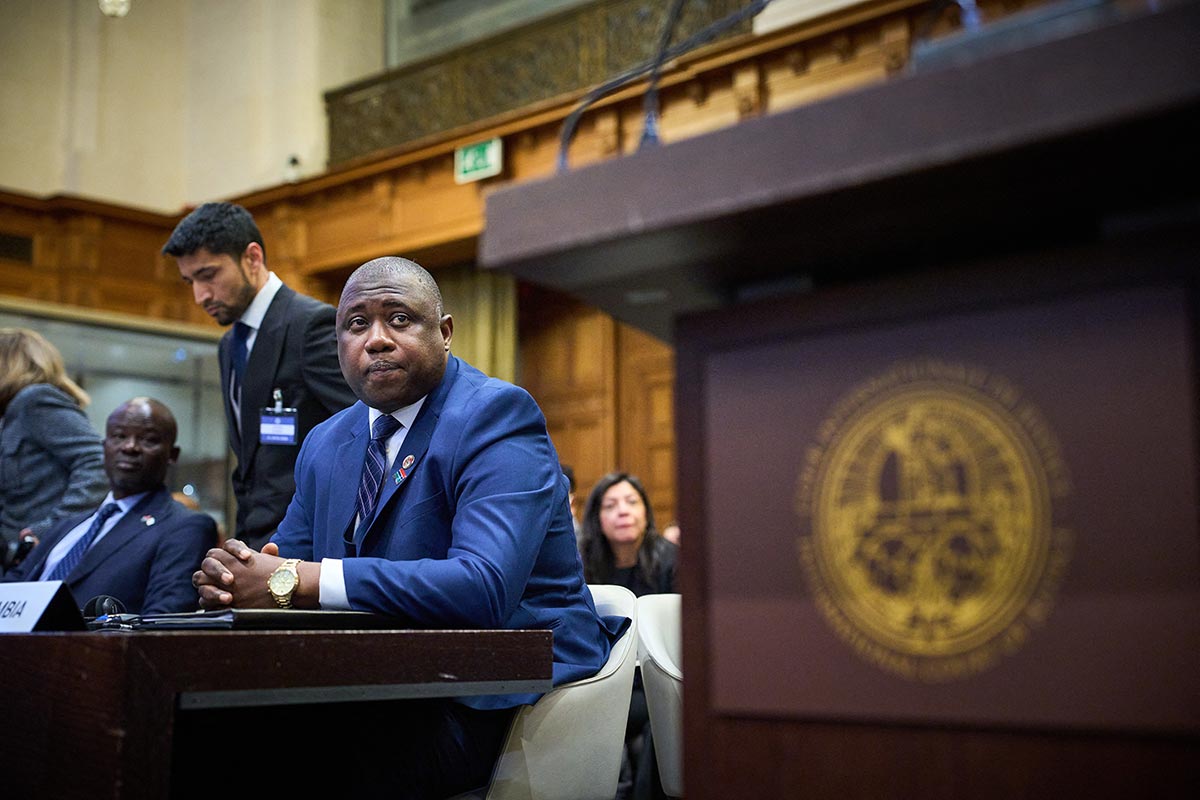
The Gambia v. Myanmar at the ICJ — filed in November 2019 on behalf of the OIC, alleging violations of the 1948 Convention on the Prevention and Punishment of the Crime of Genocide over the 2016-17 clearance operations in Rakhine State.
The Court is now in deliberation after landmark merits hearings.
Where we are:
- Jan 2020: ICJ issued provisional measures ordering Myanmar to prevent genocidal acts, ensure military does not commit them, and preserve evidence. It found the Rohingya's right to protection plausible, citing UN Fact-Finding Mission reports.
- July 2022: ICJ rejected Myanmar's preliminary objections, confirming that any state party to the Genocide Convention has standing to sue — ‘erga omnes partes’ obligation.
- Jan 12-29, 2026: Full merits hearings at the Peace Palace. Two rounds of oral arguments, three witnesses and one expert for The Gambia, one witness for Myanmar, plus closed sessions with Rohingya survivors from Cox's Bazar camps. Myanmar filed its last written submission in Dec 2024.
- Jan 29, 2026: Court announced it has begun deliberation. Judgment expected late 2026 — some reports suggested October 2026, but no date fixed.
What the Court has to decide:
Genocide under Article II requires both acts — killing, causing serious bodily or mental harm, deliberately inflicting conditions of life calculated to destroy, etc. — and specific intent to destroy the group in whole or in part.
That intent is the central legal battle. In Bosnia v. Serbia (2007), its only previous finding on state responsibility for genocide, the ICJ held a pattern of conduct must be such that it could "only point to the existence of such intent." There is no prior criminal tribunal for Myanmar to rely on, unlike Srebrenica for Bosnia. The Court will weigh UN FFM reports, satellite imagery of village burnings, and survivor testimony.
Legal observers outline several plausible outcomes:
1. Full responsibility under Article III(a) — commission of genocide. Unprecedented. The ICJ has never found a state directly responsible for committing genocide. It would carry major reputational, diplomatic consequences.
2. Partial responsibility — failure to prevent, failure to punish, complicity, incitement — under Articles I, III(b)-(e), IV, V, VI. The Court could find Myanmar breached duty to prevent and punish.
3. Breach of provisional measures order of 2020.
4. Mixed or dismissal — finding that while grave international crimes occurred, the high threshold for genocidal intent was not legally established under the Convention.
Will it bring justice and safe return?
For Rohingya refugees in Bangladesh — about 750,000 who fled in 2017, now over 1 million in camps — a judgment would be symbolic and legal.
Potential positives if The Gambia prevails:
- Formal recognition of suffering under international law.
- Order for reparations, guarantees of non-repetition, law reform, citizenship measures.
- Pressure on third states to not aid violations.
Limits:
- ICJ binds states, not individual commanders. Individual criminal liability is for ICC and Argentina's universal jurisdiction case — not the ICJ.
- Enforcement goes to UN Security Council under Article 94 of UN Charter, where veto powers of US, China, Russia, UK, France apply. China and Russia have historically shielded Myanmar.
- Safe return requires conditions on the ground — citizenship, security, end of armed conflict in Rakhine where Arakan Army now controls much territory — which a Hague judgment alone cannot create.
So the judgment, expected later this year, will be a turning point for accountability and for how the Genocide Convention is interpreted — it is already shaping South Africa v. Israel and Ukraine v. Russia cases — but for refugees, it is likely to be a step toward recognition rather than an immediate mechanism for safe return.
#GambiaVMMyanmar #ICJ #Rohingya #GenocideConvention #Rakhine #ProvisionalMeasures #InternationalJustice