

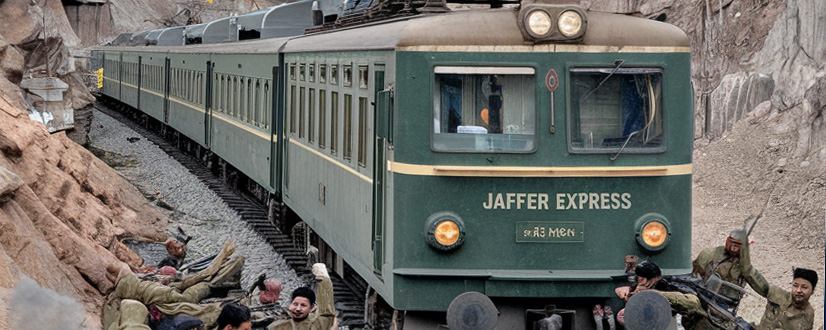
Balochistan, which once flourished in freedom from British rule, was soon to fall prey to the cruel seizure of Pakistan. Since the forcible annexation of 1948, the Baloch people have striven for their liberty. The government of Pakistan hath exploited this region, despoiling its natural resources and depriving the native populace of their fundamental rights. The wealth of Balochistan is used to enrich the other provinces of Pakistan, whilst darkness doth linger in the Baloch villages. To quell resistance, the army hath committed atrocities, violating human rights, and causing the disappearance of dissenters. The Baloch struggle for freedom hath now become as a volcano, ready to erupt at any moment, betokening the aspiration for an independent nation.
The Cult Current team produced this cover story with the valuable insights and expertise of Sanjay Shrivastava, Srirajesh, Sandeep Kumar, and Manoj Kumar.
A grave question doth once again arise upon the world stage, which, though not new, hath gained increased significance after the events of March 11th, 2025: Whether an army, possessed of a nation, doth now intend to sunder the unity and integrity of that very nation? Ironically, this very army hath in times past divided its own country. In 1971, it wrought such conditions that Pakistan was torn asunder, and East Pakistan came into being as a new nation under the name of ‘Bangladesh’.
History doth seem once more to repeat itself. The events of March 11th have drawn the world’s attention to that territory, which seventy and seven years prior, on the 11th day of August, in the year of 1947, was freed from the yoke of the British, and did come into existence four days hence - Pakistan. But alas, only seven months and sixteen days later, on the 27th day of March, in the year of 1948, it was seized. We speak of Balochistan, which Pakistan hath held captive for the past seventy and seven years.
The disquietude of Pakistan was laid bare, when the Balochistan Liberation Army (BLA), an armed group striving for the freedom of Balochistan, did hijack the Jaffar Express train. The Pakistani army, as is its wont, did offer its own claims, which oft seem incredible. The army asserted that thirty and one souls perished in the rescue operation, among them twenty and three Pakistani soldiers, three railway employees, and five innocent passengers. They did also claim that thirty and three BLA combatants were slain upon the spot. Whereas, the BLA, having taken two hundred and fourteen soldiers into the mountains during the train hijacking, did claim responsibility for their demise.
What is truth, and what is falsehood, is made apparent from the reports in the media. After this event, the army and the government of Pakistan did declare that they would hold no converse with these armed factions, but would instead communicate with those who conduct the Balochistan movement peacefully, so as to find a peaceful resolution to the matter.
Howbeit, Mehrang Baloch hath emerged as a leading figure in the Balochistan movement. Near the close of the third week of March, a peaceful demonstration was held under her leadership, when the Pakistani police (behind whom the army is said to stand) did not only use batons, but did also fire bullets. In this incident, three souls were slain, among them a minor of twelve years. Mehrang Baloch was taken into custody and committed to prison. This course of events doth reveal the complexities and human tragedy of the continuing conflict in Balochistan, and doth raise the question whether suppressing peaceful protest may resolve the issue.
Parallels with the state of affairs in 1971 are clear. As Tikka Khan did oppress the Bengalis, so too is Aasim Munir, Chief of the Army, overseeing the oppression of the Balochs. Howbeit, it is not just to hold Aasim Munir alone culpable. The Pakistan army hath oppressed the Balochs from the very beginning.
In recent decades, Baloch nationalism hath risen in Balochistan. The Baloch people have begun to strive for their freedom and rights in an organized manner. Organizations such as the Balochistan Liberation Army (BLA) and the Balochistan Republican Army (BRA) are leading the armed rebellion. Now, several armed groups from Balochistan, Sindh, and Khyber Pakhtunkhwa have joined together to form an organization named “BRAS.” Their primary objective is to make Balochistan an independent nation, free from the oppressive policies of Pakistan.
The hijacking of the Jaffar Express is a part of this struggle. This event is symbolic, indicating that Balochistan is being held forcibly and that its people have been held captive for seventy and seven years. The rebel organizations say that the government of Pakistan has ended the autonomy of Balochistan and deprived its people of their natural rights.
The government of Pakistan has made every effort to crush political activities in Balochistan. Balochistan’s leaders are often arrested, and are sometimes made to ‘disappear’. The major political parties of Balochistan are prevented from participating in elections, and the army has complete control over political activities in Balochistan. Stories of people being “disappeared” are common in Balochistan, which testify to the atrocities of the Pakistani army.
Baloch leaders say that the government of Pakistan has only seen Balochistan as a source of resources and has taken no steps for the well-being of its people. Many times, the army and the government have together made strict laws to suppress political activities in Balochistan, which oppress the local public.
The struggle of Balochistan is not only a challenge for Pakistan, but it has also become an important issue for the stability of the whole of South Asia. The people of Balochistan are fighting for freedom, and this struggle has attracted attention internationally as well.
The government of Pakistan must needs seek a resolution to the travails of Balochistan. They must grant unto its people their fundamental rights. The populace of Balochistan should profit from education, health services, and opportunities for employment. If the government of Pakistan doth not amend its policy toward Balochistan, then this strife may become yet more grievous.
The struggle of Balochistan hath continued for seventy and seven years, and it is not merely a political issue, but rather a question of the very existence, identity, and rights of the Baloch people. The hijacking of the Jaffar Express is a token that Balochistan is now ready for even more fierce conflict. The demands of the Baloch people are just, and they should receive that which is their due.
To understand the dolorous history of Balochistan, we must journey into the past and pass through those events which have brought Balochistan to this pass today. This strife is not merely the result of the present, but is rather the consequence of decades of injustice and neglect.
After deliverance from British rule, Balochistan did forge its own identity as a free nation. The Baloch people took pride in their distinct culture, language, and rich traditions. When Pakistan came into being, Balochistan expressed its desire to maintain its sovereignty. Alas, this freedom endured but for seven months and sixteen days. The Pakistani army did invade Balochistan and forcibly annex it into Pakistan. From that day unto this, Balochistan hath striven for its lost liberty.
In terms of area, Balochistan is the largest province of Pakistan, covering forty and four percent of Pakistani territory. Howbeit, its population is relatively small, approximately one crore and a half. The borders of Balochistan are contiguous with the sea, Iran, and Afghanistan. It is a region which hath been a symbol of conflict, resistance, and the undying spirit of freedom for centuries.
That Balochistan which appeareth as ruins today, was once a paragon of opulence. Buried in the pages of history, this land doth bear witness to those ancient civilizations which did shape human history. The oldest evidence of agriculture in the world hath been found in this region, which is proof that here once surged an immense ocean of life and prosperity.
The excavations conducted in the Mehrgarh region, near Balakot in Balochistan, have revealed the remains of a civilization older than even Harappa. It hath proven that thousands of years ago, a developed civilization did dwell on the banks of the Bolan River, unmatched in its architecture, culture, and way of life.
But this prosperity was not to last forever. The cruel hands of history did alter the fate of Balochistan. In the year of our Lord 711, when Muhammad bin Qasim did begin to invade this region, this area, rich in Hindu-Buddhist culture, gradually came under Islamic influence. For centuries, Balochistan remained under foreign rulers, whose culture and identity did change over time.
In the reign of Akbar, Balochistan became a part of the Mughal Empire. But in 1637, the Mughals ceded this territory to Persia (Iran). Later, in 1747, Mir Nasir Khan of Kalat acknowledged Afghan rule. Balochistan, like a chess board, continued to strive for its identity amidst empires.
It is a curious paradox that Rahmat Ali, in imagining Pakistan, drew inspiration for the “stan” in the name of this Muslim nation from Balochistan itself. Yet, ironically, on the day Pakistan gained its freedom, Balochistan was not mentioned in its map. It was not even conceived, nor was it mentioned in the proposed name. Balochistan, in truth, was free three days prior to Pakistan’s independence, on August 11th, 1947.
Kalat… one of Balochistan’s chief cities, is a populous city situated only ninety miles from Quetta. This city, nestled within stout walls, has a history of two and a half thousand years. The city of Kalat had to be traversed to reach cities such as Khuzdar, Gandawah, Nushki, and Quetta, hence this city held a unique strategic importance. It is a city nestled in the heartland of Balochistan, which has been a hub of this region’s history and culture for centuries.
The city of Kalat, with a magnificent haveli located in the center, within the boundaries of the giant walls, was the center of Balochistan’s politics. In this haveli was located the “Raj Bhavan” (Governor’s House) of the Khans, where a significant treaty was signed on August 11th, 1947, between the Muslim League, the Resident of the British government, and Mir Ahmad Yar Khan of Kalat. As a result of this treaty, Kalat came into being as an independent country.
Along with Kalat, Mir Ahmad Yar Khan also held dominion over neighboring territories such as Las Bela, Makran, and Kharan. Therefore, even before the independence of India and the creation of Pakistan, all of these parts were combined under the leadership of Mir Ahmad Yar Khan, and the Balochistan nation was created.
The Baloch people of Balochistan neither thought of joining Pakistan before, nor do they harbor such a mentality today. Balochistan wanted to be an independent country, and it was. It was a dream that had resided in their hearts for centuries.
But this independence of Balochistan did not please Pakistan. Finally, seven months and sixteen days after the independence of Kalat, on March 27th, 1948, Major General Akbar Khan of the Pakistani army forcibly seized this small country. In the past seven and a half months, this small country had not even been able to properly mobilize its army. Therefore, the resistance was not too great, and Pakistan seized this strategically important and resource-rich province.
As soon as Pakistan occupied Balochistan in March 1948, voices of protest began to rise. Ahmed Yar Khan of Kalat did not greatly oppose the Pakistani occupation, but his brother, Prince Abdul Karim, revolted against this forcible occupation by Pakistan in July 1948. He went to Afghanistan with his followers. The then Afghan government wanted to separate Balochistan from Pakistan and take it under its control, because they had not been able to find a sea port, and Balochistan had access to the sea.
But Prince Abdul Karim could not get the desired support from the Afghan government. Finally, after about a year, Prince Karim surrendered to the Pakistani government. This was a major blow to the independence of Balochistan.
A tremendous name emerged in the Balochistan independence movement - Nawab Nauroz Khan. When the Kalat state was abolished and completely merged into Pakistan under the “One Unit” policy, Nawab Nauroz Khan strongly opposed Pakistan. He launched a guerilla war against the Pakistani government. He did not want Pakistan to control Balochistan like other states. Nawab Nauroz Khan became a symbol of Balochistan’s independence, and his struggle inspired generations to come.
But only a few months later, on May 15th, 1951, Nawab Nauroz Khan was forced to surrender to the Pakistani government. The Pakistani government had assured him and all his companions of forgiveness. But, true to its nature, the Pakistani government broke its promise. Nawab’s relatives and 150 loyal soldiers were arrested on charges of treason. Finally, on July 15th, five leaders of this rebellion were hanged to death. Nawab Nauroz Khan had become old, so he was spared. But five years later, Nawab Sahib passed away in the Kohlu jail itself. With his death, another flame of Balochistan’s independence went out.
The government of Pakistan thought that the spark of this rebellion would also end with this. But this thought proved to be wrong. The flame of freedom continued to burn in the hearts of the people of Balochistan.
Assessing the situation in Balochistan, the Pakistani army began the work of preparing military bases in sensitive areas there. Supporters of an independent Balochistan were outraged by this action. Their leader Sher Muhammad Bijrani set up bases for his guerilla fighters in an area of 72,000 kilometers. There are many reserves of gas in Balochistan, and these rebel leaders wanted the government of Pakistan to share some of the income from these gas reserves with the tribal leaders as well. This war lasted for six years, but in the end the rebel soldiers wanting the independence of Balochistan got tired, and agreed to a ceasefire with President Yahya Khan. This glimpse of peace was fleeting, because the seeds of conflict were still buried in the ground.
In these elections of 1970, where Sheikh Mujibur Rahman’s Awami League won a massive majority in East Pakistan, Zulfikar Bhutto’s PPP managed to win in almost all provinces in West Pakistan – except Balochistan and North West Frontier Province. The National Awami Party, which was the party of pro-independence Balochs, won in Balochistan. Out of 300 seats in the National Assembly, Sheikh Mujibur Rahman’s Awami League won 167 seats, while Bhutto’s party won only 71 seats.
In the year of Our Lord 1971, a year of tumultuous upheaval in the annals of Pakistan, ere the close of that year, Pakistan was sundered into two, and a new nation did arise, under the name of ‘Bangladesh’, erstwhile known as ‘East Pakistan’. The tragedy of Pakistan’s fragmentation did embolden yet more the hope for freedom in the hearts of the people of Balochistan.
In the Pakistan that remained, General Yahya Khan did greatly resent the triumph of the ‘National Awami Party’ in Balochistan. He did apprehend that these Baloch folk, in league with Iran, were about to foment a great conflict.
Taking no lesson from the error of Bangladesh, Pakistan did repeat the same ruthless stratagem in Balochistan – grievous oppression! All routes into Balochistan were closed. Aerial assaults were also made in some regions of Balochistan, where the Pakistani army did suspect the presence of Baloch insurgent bases. In sundry places, a fierce conflict did ensue between Baloch rebels and the Pakistani army. Thousands on both sides were slain. Many rebel Baloch leaders did succeed in reaching Afghanistan.
After this dreadful atrocity, repression, and conflict, there came a transient lull in the Baloch freedom movement. But this lull did give birth to a new form – an organized armed movement – the Balochistan Liberation Army (BLA). The rise of the BLA was the commencement of a new chapter in the freedom of Balochistan.
The people of Balochistan do believe that the government of Pakistan hath exploited their resources and denied them political and social rights. This is a grievance that hath taken root in the hearts of the people of Balochistan for decades.
The chief use of the wealth of Balochistan hath been by the army and the government of Pakistan. This region is one of the largest provinces of Pakistan, and its natural wealth is a significant contributor to Pakistan’s economy. But the benefit of this doth not accrue to the local populace. The people here are still deprived of basic amenities such as electricity, water, health services, and education.
The natural gas of Balochistan hath been exploited to enrich the other provinces of Pakistan, but darkness lingers in the villages and cities of Balochistan. Whenever its people raise their voice for their rights, they must endure the oppression of the army.
Until the government and army of Pakistan are prepared to understand the real problems of Balochistan and seek a solution thereto, the struggle of the people of Balochistan shall continue. Although the present actions do indicate what the government, which is a puppet of the army, shall do, and the attitude of the army is progressing towards the opposite direction instead of progressing towards solving the problem. The recent arrest of Maharang Baloch is proof of this. In such a situation, the army itself appears to be preparing the ground for breaking its country apart again.
The Jaffar Express, was not merely the hijacking of a train, it was the call for freedom of an independent nation, which it hath now become necessary to hear and understand. Balochistan is a volcano, which may erupt at any moment, and the world should be prepared to face its consequences. This is a warning, and ignoring this warning can prove to be a great mistake.