

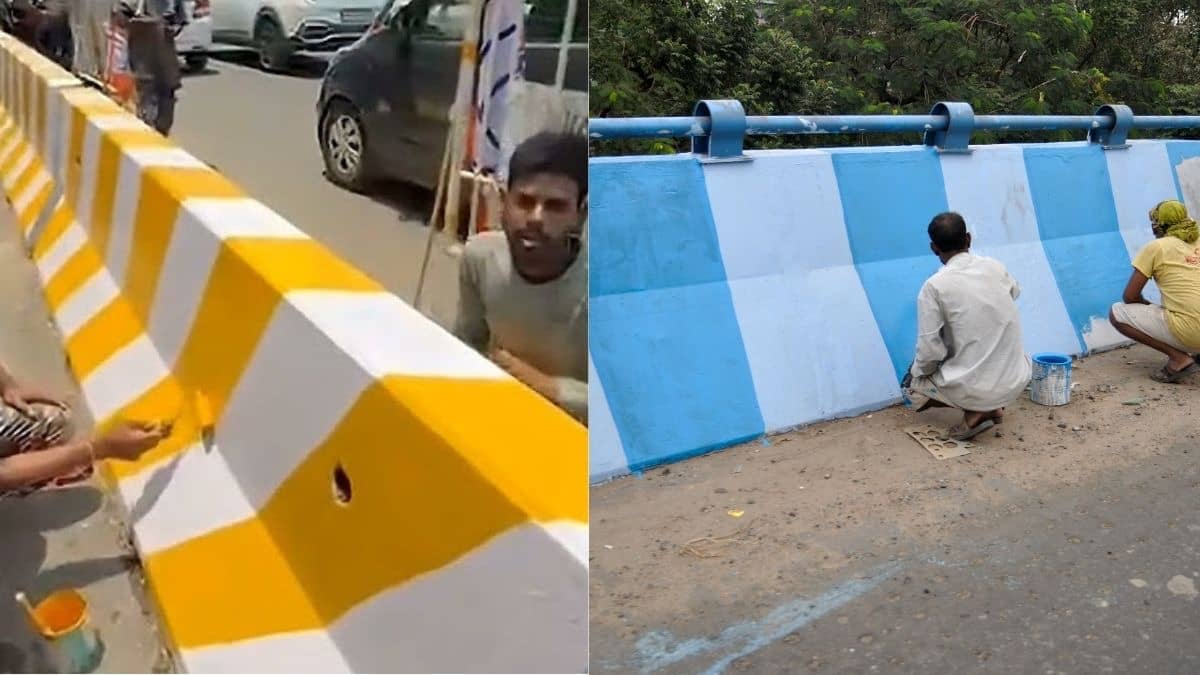
Bengal gains new colour after regime change, loses core character — that has been refrain in Kolkata Facebook posts and ground reports since May 2026.
For years West Bengal especially Kolkata carried iconic blue-and-white identity under Trinamool Congress since 2011, itself replacing 34-year Left red. Within days of BJP forming first government under Chief Minister Suvendu Adhikari after winning 207 of 294 seats, painters began replacing blue-white with yellow and white, described by party as internationally approved colours for barricades and civic infrastructure.
Visual shift mirrored political shift.
What has changed in six months of Adhikari government:
- *From regional to Sanatani narrative:* Adhikari advocate of new phase of Sanatan rule, calling Hindu identity as much as Bengaliness. CM himself referring to Muslims as Friday People, government promising laws against love jihad, land jihad, forced conversion, and Detect, Delete, Deport drive targeting suspected Bangladeshi infiltrators, mostly Muslim.
- *Festival redesign:* Biggest flashpoint Durga Puja. Reports describe navratrification of secular festival, saffronisation of Bengal's daughter Durga, with puja committees handed over. At least 19 people killed in stampede at pandal whose organisers have links to BJP, where crowd management allegedly took backseat to Sanatani branding.
- *Language and soundscape:* Citizens note saffron stoles, Hindi slogans Yeh hamara Vidhan Sabha hai in Assembly, Jai Shri Ram chants on streets, renaming, meat shop demolitions alongside TMC offices post-result.
- *Institutional rewiring:* Secretariat moved back to Writers' Building from Nabanna, Ayushman Bharat cleared, welfare reworked to fit Sankalp Patra, anti-goonda legislation passed. BJP argues break from cut-money syndicate raj that drained Bengal share of manufacturing from 27% in 1950-51 to under 5%, per capita income from 127.5% of national average in 1960-61 to 83.7%.
Why core character debate persists:
- Bengal's political identity historically anchored in secular-regional pride, heavily influenced by 19th century Bengal Renaissance and inclusive paradigms of Tagore and Kazi Nazrul Islam. TMC successfully deployed Bengali sub-nationalism against Hindi-Hindu nationalism.
- Adhikari himself product of secular politics, spent majority career within TMC as Mamata's cabinet minister, joined BJP in 2020, became CM 2026, his 180-degree saffron embrace seen by critics as opportunist.
- Left bookstall demolitions in Kolkata, video of old man in dhoti pleading as books shattered, highlighted by The Wire as darker image of destruction of Bengali identity than regime change. NHRC recorded 1,934 incidents including 29 murders in election cycle.
Old guard BJP warns rapid absorption of defectors dilutes ideological coherence, while new government argues high-velocity expansion needed for legislative majority.
Analysis:
Bengal has done colour change before, red to blue-white in 2011, but that was aesthetic branding. 2026 yellow-white comes with attempt to replace centre-left secular-regional narratives with Hindutva nationalist alignment, a more substantive cultural claim. That claim struggles because Bengaliness was never just colour, it was language, adda, mixed puja, Marxist bookstall, plural table. Gaining new colour is easy with paint budget, losing core character is harder to measure but visible in whose voice counts at para puja, whose bookstall survives. As Quint ground report noted, question is not merely change but absolute shift to right, and whether saffron turn can coexist with Bengal's long plural imagination or will erode it.
Tags: #WestBengal #SuvenduAdhikari #BJP #TMC #BengaliIdentity #DurgaPuja #YellowWhite #BlueWhite #Poriborton #Hindutva