

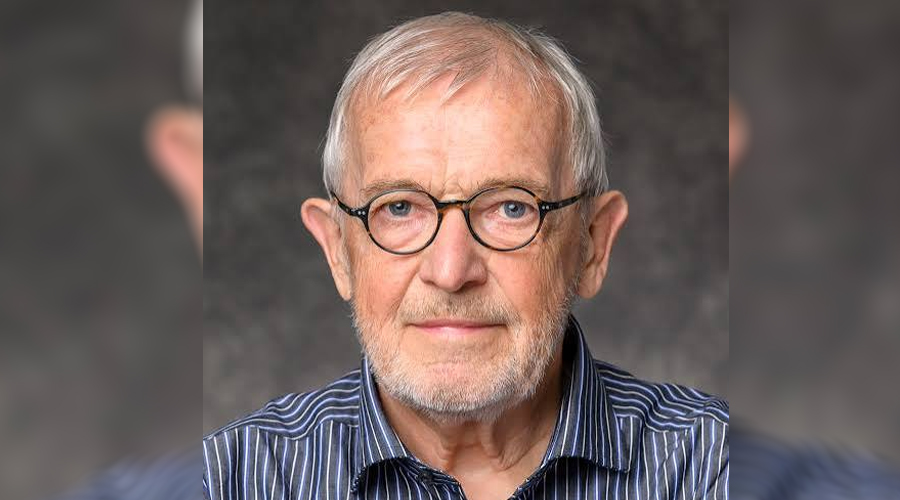
Vision 36 years ago becomes telescope looking down.
The prize:
Nobel Committee: IceCube Laboratory — 5,160 optical sensors frozen 1.5-2.5 km deep in cubic km of Antarctic ice at South Pole — reported first evidence for high-energy astrophysical neutrinos 2013.
Halzen alone — not shared — 81 at award, Belgian-born American particle physicist, Hilldale Professor. CERN Courier Nov 13 feature says he called prize fantastic opportunity to advertise large project that only happened because brilliant people solved problems.
Origin story:
- 1988 Halzen proposed vast detector in ice — then DUMAND ocean attempt failing.
- 1990 with Madison colleagues, later Berkeley, propose freeze photomultipliers in Antarctic sheet to catch Cherenkov light from neutrino interactions.
- 1993-94 AMANDA — Antarctic Muon And Neutrino Detector Array — deployed 800-1000m depth, but air bubbles scattered light too strong.
- AMANDA-II 1500-2000m clearer ice worked.
- IceCube 2004-2010 construction — 86 strings, hot-water drill 2.5 km holes, 1 km3 instrumented.
- 2013: 28 events above atmospheric background — "High-energy starting events" Bert, Ernie etc — 30 TeV to 1 PeV, dubbed cosmic neutrinos. Confirmed extraterrestrial.
- 2017 Sept 22: IceCube-170922A 290 TeV neutrino alert coincident with blazar TXS 0506+056 flaring 4 billion light years away — first neutrino source identification, multi-messenger astronomy.
Why it matters:
Neutrinos ghost particles, no charge, almost massless, travel un-deflected by magnetic fields, un-absorbed — unlike light. High-energy ones trace cataclysmic accelerators — AGN, GRBs, black holes — where protons accelerated to 10^20 eV.
IceCube opened new window alongside gravitational waves 2015.
Latest:
IceCube completed upgrade 2025-2026 Antarctic summer — 7 new strings with enhanced modules, calibration. Next: IceCube-Gen2 8 km3, radio array for 10x sensitivity.
Spokesperson Erin O'Sullivan, Uppsala: prize recognises decades of vision and persistence making high-energy neutrino astronomy reality.
Halzen still active Madison, pushes IceCube-Gen2 to map Milky Way neutrino glow confirmed 2023, and search for Glashow resonance.
Previous neutrino Nobels: 1988 Steinberger Schwartz Lederman, 2002 Davis Koshiba Giacconi, 2015 Kajita McDonald — but Halzen first for astrophysical high-energy, not solar/atmospheric.
Award ceremony Stockholm Dec 10.
#NobelPrize #Physics #FrancisHalzen #IceCube #Neutrino #Antarctica #Astrophysics #MultiMessenger #Wisconsin #SouthPole