

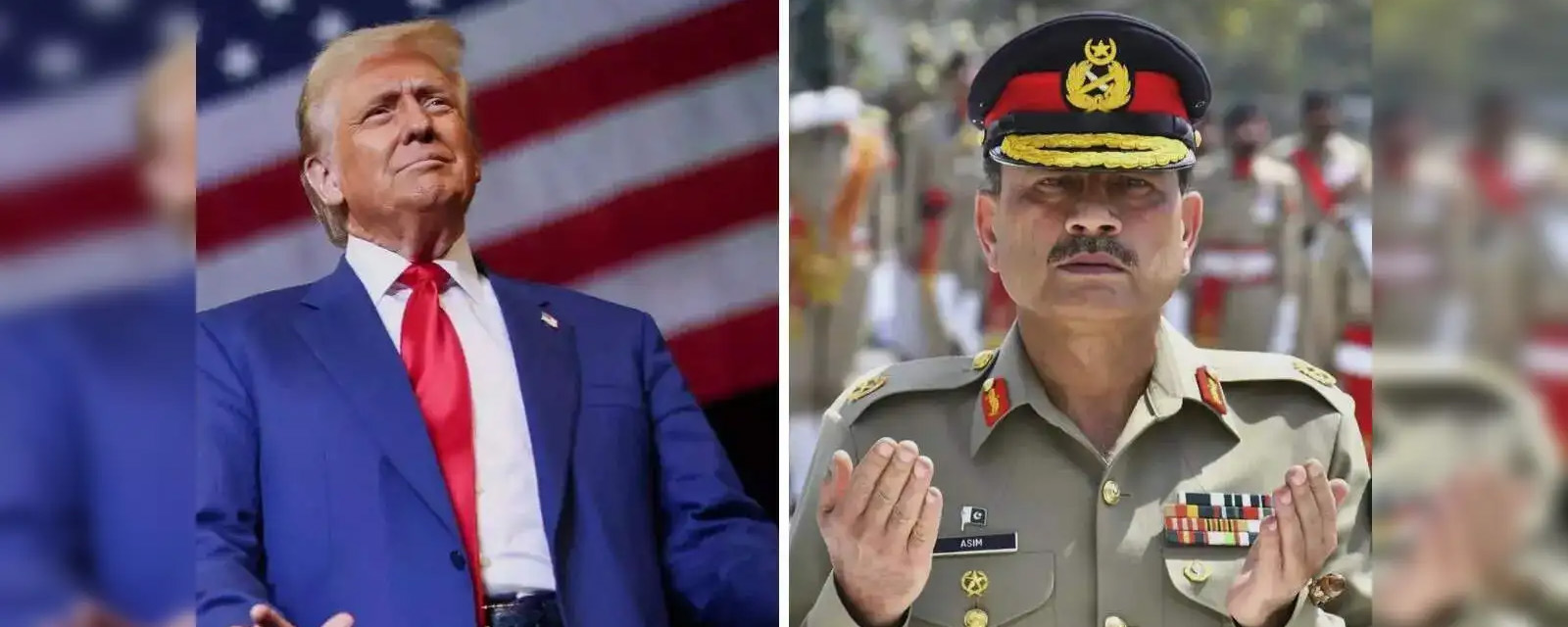
In a development drawing global attention, Pakistan’s Chief of Army Staff, General Syed Asim Munir, is set to meet U.S. President Donald Trump during his official visit to Washington. The scheduled lunch at the White House and high-level meetings with Secretary of State Marco Rubio and Defence Secretary Pete Hegseth underscore the strategic undertones of this rare engagement. Coming just days after public denials that Munir was invited to the U.S. Army’s 250th anniversary celebrations, the visit raises critical questions about U.S.–Pakistan ties, their regional implications, and how India might interpret the evolving dynamics.
Backdrop: The Denied Invitation and Its Symbolism
Just last week, rumors surfaced that General Munir was invited to attend the U.S. Army's historic 250th anniversary event. The U.S. Department of Defense and White House quickly refuted these reports, clarifying that no foreign military officials were officially invited. Yet the fact that such a denial had to be made points to the political sensitivity surrounding Munir’s presence in the U.S.—particularly for India, which has long viewed U.S.–Pakistan military ties with skepticism.
While the disavowal may have been intended to placate New Delhi, Munir’s subsequent high-profile meetings show that his Washington visit is far from symbolic. It signals that while the optics may be carefully managed, the substance of U.S.–Pakistan military diplomacy is alive and strategically significant.
What the Trump-Munir Meeting Represents
The scheduled lunch between Trump and General Munir, while informal, is symbolically potent. Trump, continues to wield considerable influence in Republican foreign policy circles. His willingness to meet Munir may suggest a soft recalibration of U.S. military diplomacy with Pakistan, driven by shared concerns in the region:
1. Afghanistan and Counterterrorism: The U.S. still relies on intelligence sharing and limited cooperation with Pakistan to monitor extremist groups operating in and around Afghanistan. With ISIS-K gaining ground and the Taliban government struggling for legitimacy, Pakistan’s role as a regional gatekeeper remains crucial.
2. China’s Growing Influence: Pakistan's deepening ties with Beijing—especially via the China-Pakistan Economic Corridor (CPEC) and recent defense procurements—are raising red flags in Washington. By engaging Munir directly, the U.S. may be attempting to offer Pakistan a diplomatic counterbalance to Chinese dominance.
3. Middle East and Iran: With tensions flaring again between Israel and Iran, Washington is seeking strategic depth in the region. Pakistan, sharing a border with Iran and maintaining complex ties with Gulf states, could be seen as a valuable interlocutor—especially in areas related to counterterrorism and regional logistics.
Meetings with Rubio and Hegseth: Defense Diplomacy in Motion
Beyond Trump, Munir is also expected to hold meetings with Secretary of State Marco Rubio and Defence Secretary Pete Hegseth. These engagements are expected to focus on formalizing intelligence cooperation, defense technology exchange, and regional security assessments. Rubio, known for his hawkish stance on China and Iran, is likely to push Pakistan for clarity on its long-term strategic commitments. Similarly, Hegseth’s meeting with Munir might explore avenues for joint military training, equipment sales, and contingency planning in case of regional crises.
India’s Watchful Eye
India will undoubtedly view Munir’s Washington visit with concern. New Delhi has long contended that U.S. engagement with Pakistan’s military establishment legitimizes a force it sees as central to regional instability. Moreover, at a time when U.S.–India defense ties aredeepening—through QUAD, joint naval exercises, and technology transfers—the optics of Munir dining at the White House complicate India’s diplomatic narrative.
However, Washington may argue that this is not a “zero-sum” game. Rather, it could be a pragmatic attempt to keep Pakistan within the broader fold of Western influence, especially as India expands its global footprint. From a strategic standpoint, the U.S. is seeking balance—avoiding alienation of a nuclear-armed, China-leaning state, while continuing to strengthen its long-term partnership with India.
Conclusion:
General Munir’s visit may not come with the ceremonial pomp of a parade invite, but it carries significant strategic weight. The meetings reflect a U.S. administration trying to fine-tune its South Asia playbook—one that manages China’s rise, controls Afghan instability, and navigates Iran’s unpredictability, all while keeping India reassured.
As Trump prepares for a potential return to power and Pakistan’s military asserts itself as the country’s most influential institution, this diplomatic outreach marks not just a continuation, but an evolution in U.S.–Pakistan relations—where lunch can be as telling as legislation.
Akansha Sharma is a trainee journalist at Cult Current. The views expressed in the article are
her ownand do not necessarily reflect the official stance of Cult Current