
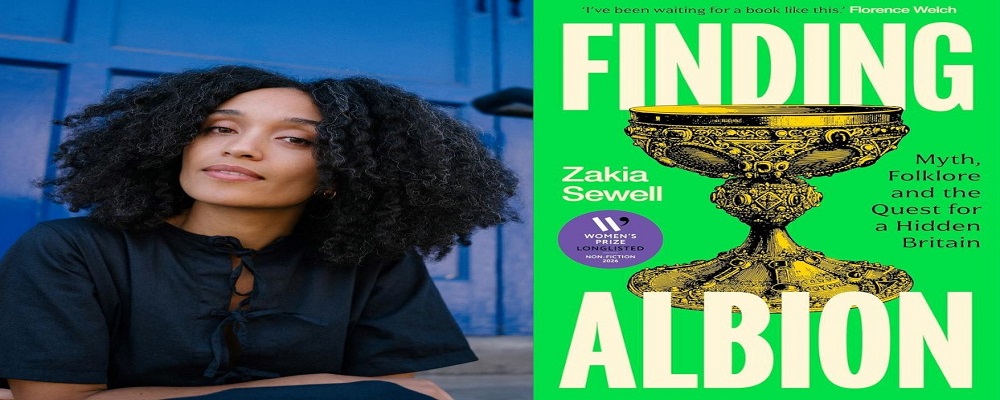
Zakia Sewell didn't find folk where folk is supposed to be found. She grew up under Heathrow's flight path in West London, on grime and Channel U, in a school alive with Diwali. Folk came via her father and Pentangle's 40th anniversary gig in 2008. At 15, she went down a rabbit hole: Davey Graham, Shirley Collins, druids, May Day Morris dancing, and an enchanted Wales glimpsed at her grandparents' house.
That dislocation became her method. As a mixed-race woman, half white English/Welsh, half Black Caribbean; Sewell had a conflicted relationship with Britishness. The imperial pageantry of empire and monarchy offered her no home. In seasonal rites and pagan altars, she found another lineage.
Her book ‘Finding Albion’, born from her acclaimed Radio 4 series ‘My Albion’, argues Britain is now in a full-blown folk revival, and that revival is political. People are not just yearning for rootedness in an age of climate dread and precarity; they are searching for a version of Britishness they can be proud of without joining the far right.
Crucially, Sewell refuses to write a polemic. The book is a first-person quest, present tense, on the ground. It's a deliberate choice from a radio producer who knows intensity needs repose, a hard paragraph on reparations followed by beer-bellied Morris men with tankards. She embodies what she preaches: the oppressor and the oppressed in one body. She can hold two truths at once, that Welsh nationalism is a progressive cause, and that Wales was complicit in empire, without forcing a neat synthesis.
She also weaponizes embarrassment. Folk is cringey, ploddy, silly. That's the point. It punctures haughty, wave-ruling Englishness. That cringe, she argues, explains why Britain only signed UNESCO's intangible heritage convention in 2024, two decades late.
This revival is digital. TikTok and Instagram have made it diverse, connecting isolated kids like her to the Black British Folk Collective but also threatened it. Stonehenge now has a £30 glass-and-steel visitor centre where cloaked pagans queue for lattes.
Sewell offers no absolution. Morris dancing's link to blackface minstrelsy sits alongside its joy. Her final command- “Go forth! Listen, feel and follow”, is not woo-woo. It is a collective storytelling project: to make an alternative Britain visible enough to counter the toxic one.
From a post-colonial lens, Sewell’s quest is not nostalgia but decolonization. The Britain she refuses is the Britain shining as the emblem of empire, monarchy and military. This is what Paul Gilroy calls post-imperial melancholia, a nation clinging to grandeur because it has no other story. Sewell here can afford to offer another story. As a mixed-race woman, she is what Homi Bhabha would call “the hybrid”, the living aftermath of empire. An individual who walks into the most white-coded ritual, Morris dancing, and claims it. She does not whitewash its link to blackface minstrelsy; she sits with it. Her weapon is cringe. Where imperial Englishness demands being ultra-civilised, folk deliberately demands silly, muddy and earthy. That silliness punctures colonial respectability. In reclaiming a pagan, seasonal Albion over an imperial Britannia, she is asking: can Britishness exist without whiteness? Her answer is West London itself — Grime, Diwali, and druids coexisting.