

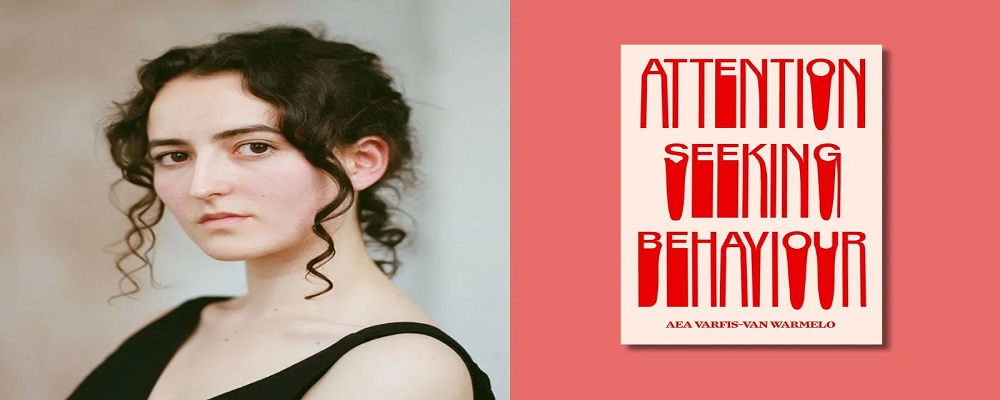
Aea Varfis-van Warmelo's debut novel ‘Attention-Seeking Behaviour’ begins with a body in a park and a confession: "When I found the body I didn't scream." The body isn't real. The lie is.
It is a fitting entry point for a book obsessed with deceit as daily performance. For Varfis-van Warmelo, lying is not an aberration but a texture of modern life; the way we text, the way we grieve, the way we write.
"The difference between having feelings and performing them is significant," she says. She recalls receiving a breakup text that swapped 'because' for 'as' and 'I' for 'myself' which reflects on the translation from formality borrowed to fake conclusiveness. "It felt like a child putting on a suit." That observation became her method. As a young writer, she treated English as a wardrobe of personalities to try on, undermine, and discard. The embarrassment of feeling too much, or performing it badly, turned into a parlour trick: deceive the reader, wrong-foot them.
The novel dwells in hybrid form. A fictional narrative intercut with essayistic chapters on lie detection takes the stage there from the very beginning. She wanted a form aligned to veracity to discredit the pseudoscience of lie detection itself. She also wanted to force the reader into detective work. We don't just read the narrator; we read her work, her arguments, her caustic attempts to reassert moral order. The essays, she says, are the narrator's best effort at telling the truth.
That narrator keeps seeing dead bodies. The image came involuntarily, a week before a major deadline, when she had nothing but abstract notes on lying. "I must start this book, somehow," she thought, and wrote the first line. Psychologically, she now reads those intrusions as deferred suicidal urges; a cerebral liar unable to explain the morbid images that afflict her, confessing to horrors to create the illusion of being impervious to them.
Style follows state. The book's long, breathless, visceral sentences, particularly in a section where the narrator sleeps with other people after ignoring “Normal Ben” are rooted in theatre. Acting taught Varfis-van Warmelo that punctuation is breath. The sonic influence is T.S. Eliot and Beckett, especially ‘Not I’.
Humour is structural, not decorative. Lies and jokes share the same architecture: set-up/punchline, lie/revelation. Normal Ben, the decent, honest foil, needs to be funny to survive her. Irony, she notes, is how both the joker and the liar view the world; rearranging facts to control a narrative.
Underneath is a radical thesis: "There is no such thing as a reliable narrator." Memory is fallible, feelings unnameable, truth a composite of perception, bias and imagination. Lie detectors are just bias-confirming machines built on the naïve belief that truth guarantees justice.
Varfis-van Warmelo calls her protagonist a shadow version of herself. Not autobiography, but biography with the insecurities bloomed tenfold. She did it to put herself on the line. "I want the reader to be punished for reading my work as direct autobiography," she says in an interview. "I am making things up about myself, and you should be embarrassed if you fall for it."