

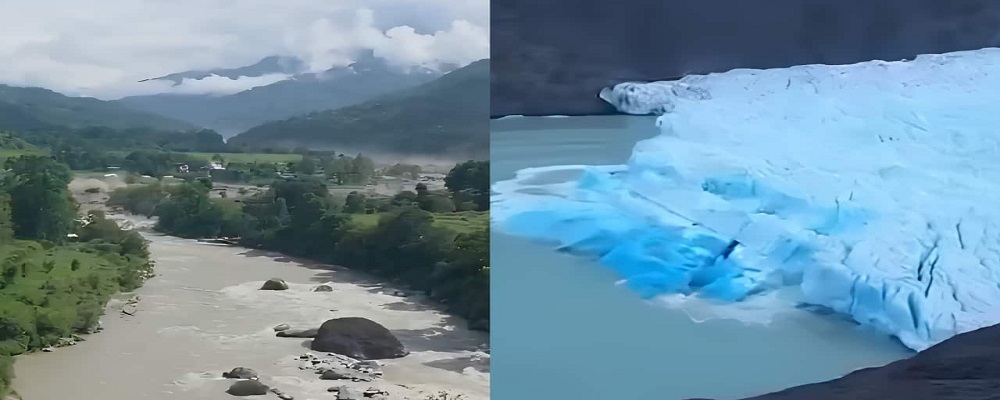
THE FURY of the floods in Nepal, with the shocking social-media visuals, has made GLOF — Glacial Lake Outburst Flood — almost a viral hashtag. Emerging evidence suggests the floods were not technically caused by GLOF, but were the result of an avalanche that turned into a cascading debris-flow hazard. Instead of repeating the clichéd clarion calls about nature taking notice of the Anthropocene, we may be better off paying attention to something more elementary — geography.
The spectacle calls for a kind of geographical revanchanism — a reassertion of South Asia as a geographical and ecological region, rather than a collection of disparate political territories. GLOFs know no borders. Our responses cannot be geography-blind. The manner in which the disaster unfolded should shake the territorial imaginations that we often hold onto when we engage with our neighbourhood. Rivers are central to South Asia's geographical imagination. They cannot just be seen as sources of water to be allocated; they are also carriers of shared risks. The origins of the GLOF in northern Nepal meant that it bore much of the immediate brunt. But India shouldn't be complacent.
India has experienced similar incidents, with implications for its water security. In 2014, a landslide over the same river, Bhote Koshi, led to the creation of a lake impounded by the landslide. India collaborated with Nepal to breach the lake in a controlled manner to reduce the downstream impact. In 2023, the South Lhonak GLOF in Sikkim again demonstrated the speed and scale with which Himalayan hazards can have cascading impacts across settlements and critical infrastructure.
We tend to underestimate the costs of these incidents and do not account for how they can set infrastructure, livelihoods and development trajectories back by several steps. Repeated disruptions to critical infrastructure and water systems cannot be peripheral concerns.
India is not oblivious to these risks. The Parliamentary Standing Committee on Water Resources, in its 2023 report on glacier management, in the Himalaya, discussed flash floods associated with glacial melting and the risks of glacial lake outbursts. It made several recommendations on glacier management, including the need for systematic data gathering and monitoring of glaciers in the Indian Himalayan Region to develop actionable plans. The Committee recognised transboundary coordination as a core challenge and pointed to the absence of a mechanism and the lack of provisions within existing treaties for dealing with glacier-linked risks. It urged the Ministry of Jal Shakti to urge the Ministry of External Affairs to have some kind of agreement with neighbouring Himalayan countries.
This points to a larger issue. Rivers can no longer be peripheral to geopolitical conversations. Geography determines river courses, and with them, the distribution of power and vulnerability. Risks can disrupt conventionally understood power relations, if not flip them.
Srinivas Chokkakula's argument flips the usual climate sermon. Nepal, India, Bangladesh need to reconsider strategies that remain organised around political boundaries, even as risks transcend them. When it comes to risk, an upstream riparian does not necessarily have complete advantage. The Himalayan cryosphere combined with its river systems calls for reimagining the region itself. Regional institutions may be imperfect, but marginalising them when GLOFs can wipe a hydropower dam in Sikkim and flood Bihar is short-sighted. Opportunity: a Himalayan early-warning network, shared cryosphere-risk assessments, common protocols for GLOF and flash-flood alerts, and regular exercises involving disaster-management agencies could be practical foundations for cooperation around shared risks.