

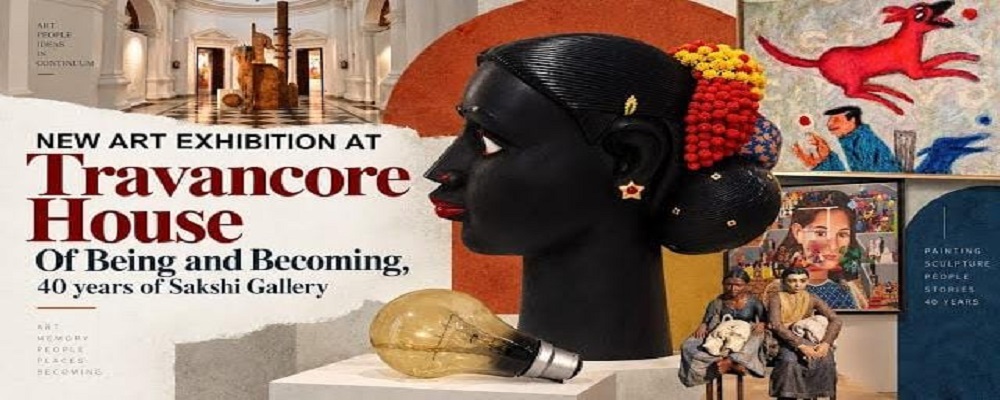
Sakshi Gallery’s 40th anniversary show, ‘Of Being and Becoming’ at Delhi’s Travancore Palace, is not a greatest-hits parade. Curator Manan Shah uses 600 exhibitions as an archive to answer a sharper question: how did Indian art learn to speak politics?
Spanning late-1980s to now, the show with 46 artists — from Vivan Sundaram and Nalini Malani to Rekha Rodwittiya and KG Subramanyan — is structured as three acts: 1980s-1999, 2000s-2014, and 2014-present. That periodisation is deliberate. Shah pinpoints two ruptures: the 1991 economic reforms and the 1992 Babri demolition. Artists moved from formal modernism to narrative, conceptual, socially engaged work. A home became a question of displacement, as in Veer Munshi’s installation with shrapnel and mirrors.
The second shift is more subtle. From the late 1990s, Shah notes a “political minimalism” — politics arriving not as slogan but as satire, fragment, metaphor. A garland made of blades by Sunil Gawde exemplifies it: you must look twice.
The third act — post-2014 — is where the show gets braver. Surveillance, censorship, identity and political violence surface in layered ways. Vivek Vilasini recasts The Last Supper as Gaza, Riyas Komu turns walking into protest, and young artist Salik Ansari’s Altar of Celebrations interrogates celebration itself.
Housed in Travancore Palace, where arches are retained rather than whitewashed, the exhibition proves a point: art history in India is no longer just about style. It is about survival.