

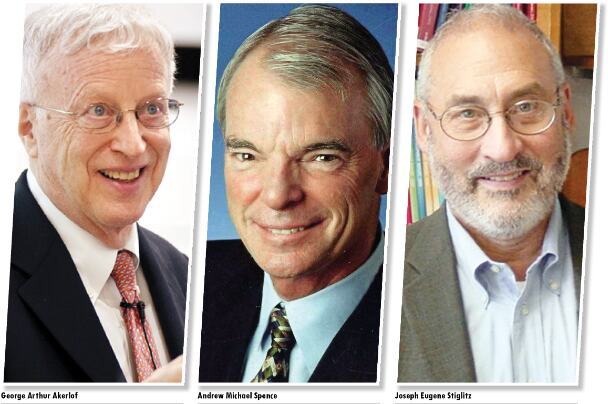
2026 marks the 25th anniversary of the Economics Nobel Prize awarded to trio of George Akerlof, Michael Spence, and Joseph Stiglitz "for their analyses of markets with asymmetric information". The anniversary could not be more important as one of major causes of today's economic problems is information asymmetry. The Tata boardroom fight is keeping shareholders nervous as board members know more than investors. Global bond investors are demanding higher yields as governments know more about their debt levels. Climate change is creating massive economic shocks as there is limited information. Spread of fake news has become a disease of contemporary society. The list goes on and on.
Economics 101 assumes that buyers and sellers have perfect information leading to market equilibrium. In reality, information between buyers and sellers is highly imperfect with one party knowing more about product/ service than other, leading to information asymmetry.
Read more - Union Budget 2026-27: The Growth Gamble
In 1961, George Stigler (1982 Nobel laureate) noted these dispersions and added that buyers compare finding cheaper prices with additional search costs. If costs are lower, buyer will try to find cheaper prices and if costs are higher, buyer will settle for available price. In same year, William Vickrey (1996 laureate), while explaining auctions, said that bidder knows more about price preferences than auctioneer. In 1963, Kenneth Arrow (1972 Nobel), while writing on health economics, commented that "the information possessed by physician as to consequences and possibilities of treatment is necessarily very much greater than that of patient". This kind of information asymmetry leads to problem of moral hazard where an entity provides misleading information about one's health leading to lower insurance premium. Moral hazard not just leads to inadequate provision of medical insurance - as insurer cannot differentiate between healthy and unhealthy - but also increases medical services that are availed aş insurer pavs bill.
In 1970, Akerlof added to discussions by introducing quality of goods in a highly cited article titled The Market for "Lemons": Quality Uncertainty and the Market Mechanism. Akerlof said that in most markets both high-quality and low-quality goods are sold together, creating an information asymmetry between buyer and seller. Akerlof explains this asymmetry in used car market which has both good cars ("peaches") and bad cars ("lemons"). Seller knows more about car than buyer. Buyers do not know quality of vehicles and prefer to buy at lowest price. But at lowest price, only lemons will sell as peaches will opt out of market. Information asymmetry leads to second problem called adverse selection where entity (usually seller) has more information than buyer, leading to products of inferior quality in market.
In article, Akerlof also cites examples from other markets. He adds to Arrow's research, saying medical insurance too would lead to adverse selection if all healthy people stopped paying insurance premium and exited market. This would lead to insurer company having unhealthier patients and higher claims.
There is difference between adverse selection between car and medical markets. While higher premiums in insurance will drive away healthier patients, lower prices in used cars will drive away healthier peaches. The other example is from credit markets, where lender does not have information about borrower. This leads to higher interest rates, which in turn attract lower credit-worthy borrowers. In fact, Akerlof referenced Indian economic history to explain information asymmetry in credit markets, citing examples from our credit markets. In 1966-67, he was working at Indian Statistical Institute on a project related to Bhakra Nangal Dam; he revised peaches-and-lemons research drawing insights from India's economic history.
A key insight from his research is that prevalence of lemons leads to inefficient markets and poor policies. This results in development of market institutions and mechanisms such as guarantees, building of brands, cha stores, franchising, and different types of contracts.
Stiglitz (1973) provided an alternative and said that insurers can get their clients to reveal information about themselves via "screening". For information asymmetry in credit markets, Stiglitz opined that lenders should ration loans instead of increasing interest rates. Landowners and tenants establish share-cropping contracts to deal with information problems.
Spence's (1973) solution to addressing information asymmetry was "signalling", where individuals send some observable action to convince opposite party of their credibility. In a job market, employees can signal their quality to prospective employers by highlighting education qualifications. Likewise, firms pay dividends to signal their favourable prospects despite dividends attracting taxes.
Read more - Fiscal Autonomy vs. National Unity
Contribution of trio was not limited to information economics but also applied to many economic fields such as game theory, financial markets, and development economics.
To sum up, 2001 Nobel in Economics is a major landmark in history of Prize. Rise of digital technology and social media have added several layers of complexity as there is too much noise around available information. Signalling and screening lemons from peaches remains as important and timeless as ever.
Tags: #InformationAsymmetry #Akerlof #Stiglitz #Spence #LemonsMarket #NobelPrize #FakeNews #MoralHazard #DigitalNoise #BehavioralEconomics