

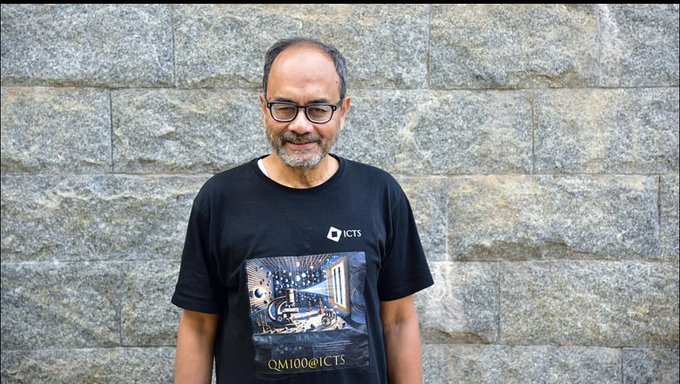
BENGALURU — Ashoke Sen, 70, ICTS-Infosys Madhava Chair Professor at International Centre for Theoretical Sciences, Tata Institute of Fundamental Research, Bengaluru, has been awarded Oskar Klein Medal for 2026, becoming first Indian physicist to receive honour, ICTS announced October 24.
He delivered Oskar Klein Memorial Lecture titled 'Gravity from Strings and Strings from Gravity' at Stockholm University's AlbaNova Centre on October 22.
Medal, established 1988 in memory of Swedish theoretical physicist Oskar Klein (1894-1977) who pioneered Kaluza-Klein theory, is awarded annually by Stockholm University and Nobel Committee for Physics of Royal Swedish Academy of Sciences. Previous recipients — Chen-Ning Yang (1988), Steven Weinberg (1989), Hans Bethe (1990), Stephen Hawking (2003), Peter Higgs (2009), Kip Thorne (2016). Sen joins that lineage.
Read more - Moon's Oldest Scar
ICTS note: “Mr. Sen, an ICTS-Infosys Madhava Chair Professor, is internationally recognised for his pioneering work on S-duality, the precise counting of black hole entropy and string field theory, which have helped shape modern string theory.”
Breakdown of three pillars:
1. S-duality: In 1994, Sen provided evidence that strongly coupled heterotic string theory is dual to weakly coupled Type I theory, then demonstrated S-duality — strong-weak coupling symmetry — in N=4 supersymmetric string theories. Work helped Edward Witten formulate M-theory in 1995 — idea that five different superstring theories are different limits of single underlying theory. 2012 Breakthrough Prize citation: "for his contributions to establishing the unifying structure of string theory." Prize $3 million, inaugural year, shared with 8 others.
2. Precise counting of black hole entropy: Bekenstein-Hawking formula says entropy = area / 4. But can string theory count microstates? In 2008-09, Sen with collaborators developed quantum entropy function formalism, counting exact degeneracy of supersymmetric extremal black holes including subleading corrections — first precision test beyond area law, matching Wald entropy from higher derivative terms. Showed string theory doesn't just give proportionality, gives exact integer.
3. String field theory: Open string field theory formulated by Witten has tachyon — unstable D-brane. Sen conjectured in 1999-2002 (Sen conjectures) that tachyon condensation leads to disappearance of D-brane, potential height equals brane tension, and lower-dimensional branes are solitons. Proved via boundary conformal field theory. Foundation for understanding brane annihilation and K-theory classification.
Academic path — BSc Presidency College Kolkata 1979, MSc IIT Kanpur 1981, PhD Stony Brook 1985 under George Sterman, postdoc Fermilab, Stanford, TIFR Mumbai 1988-2015, then ICTS Bengaluru. Awards — ICTP Prize 1989, Shanti Swarup Bhatnagar 1994, Padma Shri 2001, Fellow Royal Society 1998, Infosys Prize Mathematical Sciences 2009, Breakthrough Prize Fundamental Physics 2012, Dirac Medal 2014 (with Andrew Strominger, Cumrun Vafa for black hole entropy), Padma Bhushan 2013.
Read more - Jupiter's New Eye
ICTS Director Rajesh Gopakumar: “On behalf of all of us, very warm congratulations to Ashoke. It has been no less than wonderful having Ashoke with us and setting the tone for excellence here at ICTS.”
At ICTS, Sen teaches string theory to PhD students, continues work on string field theory and de Sitter entropy — question whether gravity emerges from strings or strings from gravity, theme of his Stockholm lecture.
India has produced Nobel in physics — C.V. Raman 1930, Subrahmanyan Chandrasekhar 1983 — but Oskar Klein Medal first time to Indian. Marks shift — Indian theoretical physics now setting tone, not catching up.
*Tags:* #AshokeSen #OskarKleinMedal #ICTS #StringTheory #BlackHole #SDuality #BreakthroughPrize #DiracMedal #StockholmUniversity #IndianPhysics