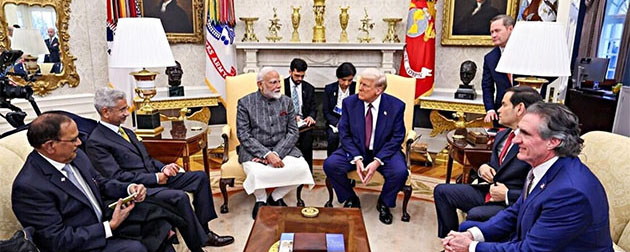
Prime Minister Narendra Modi visited Washington DC at the invitation of US President Donald Trump on 12-13 February, 2025. The visit took place within four weeks of the assumption of Office by President Trump in his Second Term. The first few months after the Inauguration of a US President are normally reserved for visits by USA’s close, strategic allies from Europe, NATO and others. The fact that PM Modi was invited to be one of the first few Heads of State/Government to visit Washington DC (he was preceded by the Israeli and Japanese PMs and the King of Jordan) is testimony to the fact that both countries and their leaders attach huge importance to the India-US ties.
India-US relations have been in a sweet spot since the last twenty-five years from the visit of US President Bill Clinton to India in March, 2000. There has been a bipartisan consensus in both countries regarding stronger ties between the two nations.
There was considerable anxiety in most countries at the election of Donald Trump in early November, 2024 as the 47th President of the United States. The reason is because Trump is known to be unpredictable as well as transactional. In his First Term, Trump was seen to be unsure primarily because his election in 2016 came as a shock, not only to the world but also to himself.
Obstacles Trump faced in his First Term are not present today. He won decisively in garnering a majority of the Electoral College votes. He also swept all the seven swing states and registered a convincing win in the popular votes too.
All this imbued Trump with greater confidence to carry through his Agenda to ‘’Make America Great Again’’. He has installed his loyalists to all significant positions in his Cabinet.
Under these circumstances, the world watched Trump’s ascent to authority on 20th January, 2025 with dismay . India however felt more reassured because of the underlying structural factors binding the two countries and the warm relations between PM Modi and President Trump.
This sentiment was evident in conversations between Modi and Trump after the latter’s election and inauguration, especially on 27th January, 2025. Referring to his friendly conversation, PM Modi in his message on X stated that the two countries ‘’are committed to a mutually beneficial and trusted partnership. We will work together for the welfare of our people and towards global peace, prosperity, and security.” This was also the message that EAM Dr S Jaishankar gave while addressing a Press Conference in Washington DC on 22nd January. Jaishankar said that his interactions with the incoming Trump Administration had led him to believe that there was ‘’an agreement, a consensus….that we need to be bolder, we need to be bigger, we need to be more ambitious.’’
It is however pertinent to state that 2025 is not 2017. The world has changed and so also has Trump. Trump in his second tenure is more confident, self-assured, unencumbered and impulsive than he was eight years ago.
Preparing for the Visit
PM Modi’s visit took place under the shadow of several comments by Trump during his election campaign and even after his election, characterising India as the ‘’Tariff King/Tariff Abuser.’’ He also threatened to impose reciprocal tariffs on countries who imposed higher custom duties than the US imposed on them. India had faced such an onslaught during Trump’s first term also. India took some pre-emptive measures by reducing import duties on several items of export interest to the US like high capacity motorbikes, super luxury automobiles, EV batteries, bourbon whiskey etc.in its budget on February 1, 2025.
The other unsettling factor just before PM Modi embarked on his visit was the unseemly sight of more than 100 Indian illegal migrants transported back to India in a US military aircraft for over 40 hours chained in shackles and handcuffs and without adequate supply of water and food. This infuriated the Indian public as well as the Opposition political class at the humiliation meted out to them.
Preparations for the meeting between PM Modi and President Trump were hit by a third whammy when it was revealed that Trump would be making the announcement to impose reciprocal tariffs just a few hours before the meeting between the two leaders.
PM Modi took the formidable challenges in his stride and delivered an outcome that compelled the CNN to comment that the meeting between Modi and Trump was ‘’a masterclass for other leaders around the world.’’
Relations between India and the US are consequential for India, not only on account of the bilateral partnership in trade, technology, defence and security, but also on account of the geo-political threats from the aggressive rise of China. Similarly, the bilateral relationship is critical for the US considering India’s potency as a major trade, technology and defence as also a geo-political partner to counter the growing challenge from China.
The Outcomes:
Some major takeaways were as follows:
Trade and Tariffs: It was decided to finalise the first tranche of a comprehensive Bilateral Trade Deal by September/October 2025. This effectively removed the threat of immediate imposition of some penalty tariffs on Indian exports. It was agreed to increase the bilateral trade from the current level of US$190 billion to US$500 billion by 2030.
POLITICS
On the Trajectory of A MEGA Partnership for Prosperity
Prime Minister Narendra Modi visited Washington DC at the invitation of US President Donald Trump on 12-13 February, 2025. The visit took place within four weeks of the assumption of Office by President Trump in his Second Term.