

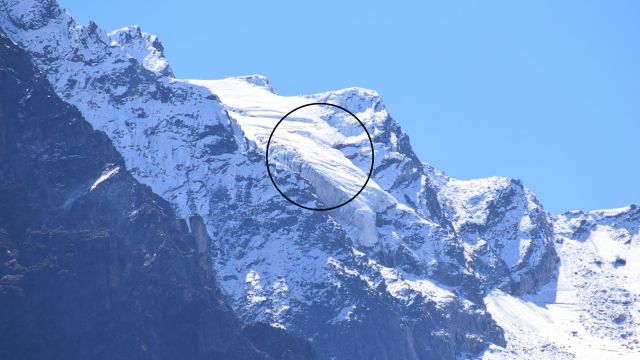
An ice avalanche triggered by the collapse of the largest of three hanging glaciers above Badrinath could damage nearly 398 buildings, 2.66 km of roads, two bridges, a helipad and a parking area in the Himalayan pilgrimage town, according to a worst-case scenario derived by a new modelling study funded by Defence Research and Development Organisation (DRDO).
The peer-reviewed paper, published in Landslides journal on October 28, assessed the vulnerability of three hanging glaciers located between 4,700 and 5,465 metres above sea level and the risk they pose to Badrinath if they detach from mountains.
Researchers used high-resolution satellite imagery and elevation models to identify hanging glaciers around Badrinath. Glaciers with mean surface slopes of 30° or more were screened for instability, and those located close to the town were selected for assessment. The selected glaciers were assessed for their volume, depth and their vulnerable portions.
The second hanging glacier showed the biggest risk of post-failure damage. It contains an estimated 5.32 million cubic metres of volume and a steep slope of 34.57°. Simulations showed that in the event of a disaster, this glacier would attain a peak velocity of 78.5 metres per second and a flow height reaching 73.5 metres.
The study was carried out by Indian Institute of Science, University of Cambridge, and DRDO researchers. The findings are a warning for Badrinath, located at an elevation of approximately 3,415 metres above mean sea level along the banks of Alaknanda River, a major tributary of Ganga.
The town drew around 17 million people during 2025 Char Dham yatra. Speaking to The Indian Express, senior glaciologist Anil V Kulkarni said methodology could be replicated for towns around hanging glaciers.
For India, this is climate security. As glaciers transition toward more temperate conditions, reduced basal resistance enhances likelihood of detachment. Chardham all-weather road widening must respect demarcation of avalanche impact and buffer zones.
Tags: #Badrinath #HangingGlacier #DRDO #Avalanche #CharDham #ClimateChange #Landslides #IISc #Himalayas #DisasterRisk