

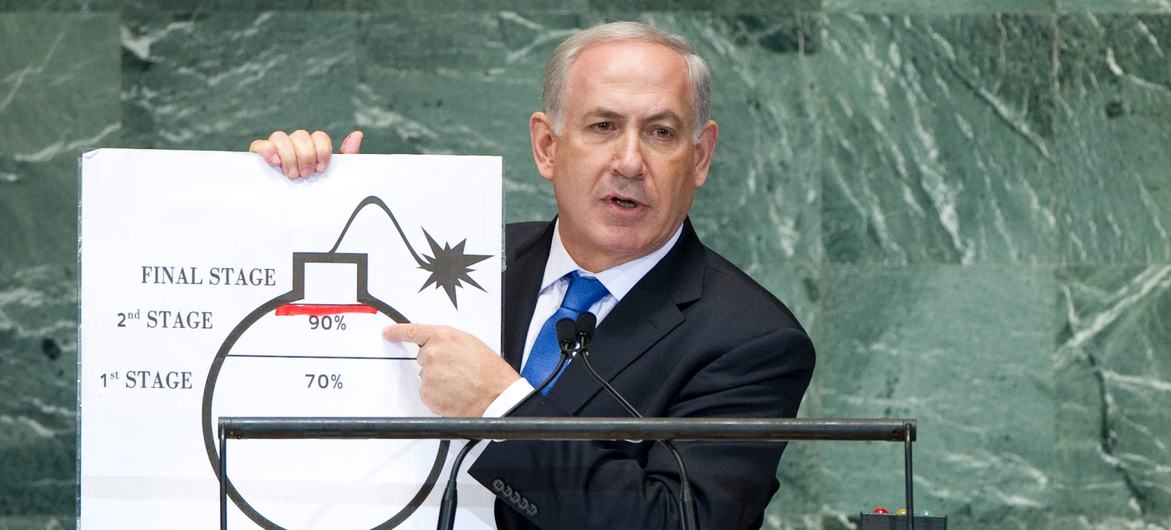
JERUSALEM — For Benjamin Netanyahu, Iran has never been just a security dossier. It is a political instrument, and in the final days before a razor-thin general election, the veteran premier is playing it at full volume.
This is the familiar ritual of Netanyahu electioneering, described by Jerusalem Post columnist Yaakov Katz on Oct 25 as entering its scorched-earth phase: I am the only person who can protect Israel. Without me, the country will fall apart.
Last week preview was talk of a new military operation against Iran. The real campaign began Friday.
In a Channel 10 interview, Netanyahu warned Israel could soon face unprecedented international banking sanctions and that he was working on circumventing them with blockchain and cryptocurrency.
Read more - Eisenkot's Mandate
On Saturday night, he released a video warning Iran had resumed its nuclear program, wanted to destroy Israel, and that the country's very survival was at stake in Tuesday's election. If Israelis wanted to stop Iran, he said, they needed to listen to US President Donald Trump and vote for Netanyahu.
Then came Sunday afternoon. Netanyahu shared on X an AI-generated image of a mushroom cloud rising over Tel Aviv after a nuclear explosion, with the caption: If Iran obtains a nuclear weapon, nothing else will matter. If a voter hopes for survival of himself and his family, his hand would shake before voting for the opposition.
The message could not be clearer: If you want Israel to survive, vote Bibi. If you risk its destruction, through financial collapse or nuclear annihilation, vote for someone else.
This is Netanyahu's election strategy in its most naked form: Fear.
That strategy has now crossed from rhetoric to alleged operational pressure.
Channel 12 reported late Sunday that Netanyahu gave IDF Chief of Staff Lt Gen Eyal Zamir "instructions that could trigger a miscalculation by Iran and lead to an immediate military clash." Zamir reportedly demanded the directive in writing. News outlet Yaron Avraham said he seemed to pale in horror at what he was conveying after getting military censor permission.
Defense Minister Israel Katz denied Monday: "I state unequivocally that Israel had no intention of initiating an attack on Iran before the elections... if Iran attacks Israel, we will respond with great force." The Prime Minister's office called reports nonsense.
But CNN and Financial Times reported Netanyahu had also tried to persuade President Donald Trump to launch another strike against Iran, reviving the February war the two started. Trump, according to sources, dismissed idea until after US midterms. Israeli jets dispatched over Syria and Iraq this week, Axios's Barak Ravid noted, “seemed as if Israel was hoping the Iranians would fire at the aircraft, providing a justification for launching strikes.”
The contradiction is striking. In March, Netanyahu claimed Israeli and US strikes had destroyed Iran's ability to enrich uranium and produce ballistic missiles. In 2025 he declared a historic victory over Iran that would stand for generations. Now, three weeks later, the same threat is existential again.
Why the reversal? The polls.
As of Oct 26, far-right coalition trailed, facing prospect of losing power. The war in Gaza no longer offers scope for expansion, escalation in West Bank, Lebanon, Syria more limited, Washington restraining military option. Netanyahu, at 77 and after 19 years as prime minister, faces not only defeat but the resumption of corruption trial.
Gadi Eisenkot, former IDF chief, head of Yashar! party and centrist opposition bloc leader, Netanyahu's chief rival, responded: "We will not stand by as the IDF is reduced to a pawn for Netanyahu's political survival." He called on Netanyahu to “show restraint and prudence in the face of dangerous initiatives that can wait until the swearing-in of a new government.”
On Nov 10, at inauguration of new Knesset, neither bloc having secured 61-seat majority, Netanyahu again referred to existential threat posed by Tehran seeking to reconstitute its nuclear program, and called for national unity government. President Isaac Herzog tapped Eisenkot to try to form government, possibly minority government with outside support from anti-Netanyahu parties, including Arab parties — whom Netanyahu in same speech cast as existential threat linked to Iran.
Ynet analysis noted: There is no concrete intelligence indicating Iran or Hezbollah intends to attack Israel before or after elections. What exists is assessment Iran could launch preemptive strike if it misinterprets US-Israeli preparations. By amplifying threats hourly, Netanyahu and Katz are increasing likelihood of that miscalculation.
Haaretz columnist wrote Oct 23: “Netanyahu's frenzied, relentless provocations against Iran were designed to goad Tehran into launching a preemptive strike against Israel. Such an attack would have ignited a war, enabling Netanyahu to achieve his ultimate objective of delaying his looming political end.”
Iran indeed poses genuine and serious threat to Israel. Its denial of Holocaust, calls for destruction, hidden nuclear work feed existential memory.
Read more - Iran's Epic Fury 2.0
But there is difference between confronting threats and exploiting them, between preparing public for difficult decisions and deliberately frightening people into believing survival depends on one man.
That distinction is precisely what critics say Netanyahu erased. Iranophobia, manufactured as apocalyptic image, transformed into currency of political survival: Vote for me because I brought you to pinnacle of happiness; vote for me because I brought you to brink of annihilation.
As one Al-Quds commentator summarized Oct 22: Manufacturing fear and spreading panic is Netanyahu's popular trade and circulating currency, and without it, he will lose all gains, paving way to be put on trial after opponents take cake of power.
Tags: #Netanyahu #IsraelElection #Iran #Israellran #MiddleEast #Geopolitics #IDF #IsraeliPolitics #NuclearThreat #FearPolitics