

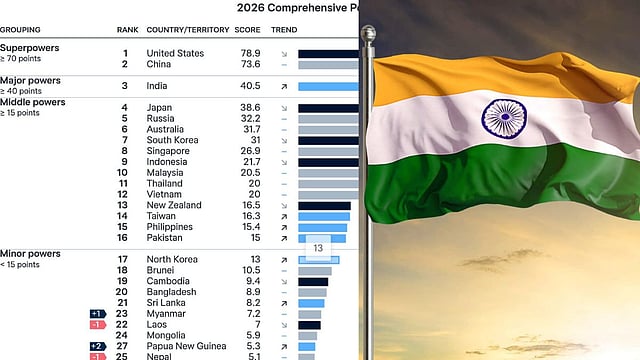
NEW DELHI: The gap between India and China has narrowed to its smallest since the index's inception, while India remains ahead of Russia and Japan. However, closing the gap with China will remain a daunting task, as China is far ahead of India in these rankings.
The Australian think tank's index assesses 27 countries and territories through 131 indicators grouped into eight measures.
*The top 5:*
Rank Country Overall Score Category
1 United States 78.9 Superpower
2 China 73.6 Superpower
3 India 40.5 Major Power
4 Japan 38.6 Middle Power
5 Russia 32.2 Middle Power
The overall score is a weighted assessment of a country's capacity to shape its external environment. Lowy classifies countries scoring at least 40 as major powers. India is therefore the only major power in Asia apart from the US and China.
India's score has risen from 40.0 points in 2025 and 39.1 in 2024, when it overtook Japan to enter the third position. India has now retained third place for the third consecutive year.
*India is gaining ground, narrows gap with China:*
India's overall score increased by 0.5 points in 2026. Its rise is significant because it came despite a decline in economic capability, one of the index's two most heavily weighted measures.
The India-China gap has narrowed to its smallest level since 2018. The difference between their overall scores fell to 33.1 points, the smallest since the index began. But the report cautions against reading this as a dramatic convergence because China's comprehensive power remains around 80 per cent higher than India's.
The latest movement reflects a modest rise in India's score and a marginal decline in China's, rather than a major shift in the balance between the two countries.
*India's scorecard:*
Across the eight criteria, India reported growth in five and a marginal fall in the remaining three.
- *Overall Score:* Rose to 40.5 (+0.5)
- *Economic Capability:* Declined to 26.4 (-0.7), although it retained third position
- *Military Capability:* 48.5 points, ranked 4th. China scored 72.1 and ranked 2nd behind the US. Russia, at 55.8, ranked 3rd. India's military score improved by 0.5 points, but the comparison shows the scale of the capabilities gap it still has to bridge.
- *Future Resources:* Rose to 56.2 points, supported by an improved economic forecast that points to substantial opportunities ahead
- *Diplomatic Influence:* 70.3 points — India's strongest and steadiest measure. Despite a slight decrease, when most countries saw a decline, it held up.
- *Cultural Influence:* Rose to 43.8 points (+2.3) — India's greatest gain in 2026, driven by improvements in cultural projection, information flows, and people-to-people exchanges
- *Defence Networks:* Rose to 18.6 points, lifting India two places to 9th, on the back of greater regional defence engagement and BrahMos missile sales to Southeast Asia
- *Economic Relationships:* Rose to 19.9 points, lifting India two places to 7th. Relative stability in regional trade and investment ties made India one of only five countries whose score did not fall.
- *Resilience:* India ranked 3rd in its ability to withstand economic pressure from other countries, with a score of 68.3, behind China (75.3) and the US (73.5).
Together, these shifts helped India narrow its Power Yield — the gap between expected power based on resources and its actual comprehensive score — for the first time since 2023.
*Modi rated second-most effective leader:*
Prime Minister Narendra Modi was rated Asia's second-most effective regional leader after China's Xi Jinping in the 2026 Asia Power Index.
"Its diplomatic influence held up as experts rated Prime Minister Narendra Modi the second-most effective regional leader after Xi Jinping, though India's low profile during the Gulf conflict weighed on views of his global leadership," the Asia Power Index 2026 said.
Sharing his views on the findings, Dr. Hunter Marston, Director of the Southeast Asia Program at the Lowy Institute and Project Lead for the Asia Power Index, said: “India gains influence. India rose to 40.5, consolidating its place as a major power. The gap with China is the narrowest since 2018, and Modi is now rated the second-most effective regional leader behind Xi, despite a dip in economic capability.”
*US-China gap also narrows:*
According to the Index, the US-China power score has narrowed with just 5.3 points now separating the US (78.9) and China (73.6). This is the narrowest gap since the Index began in 2018. The military capability gap is also at its narrowest on record.
"The US and China still dominate, and neither a middle power bloc nor growing authoritarian alignment is displacing them," said Hunter Marston.
The Lowy Institute attributed the narrowing gap largely to setbacks for Washington rather than a significant rise in Beijing's overall power. "This narrowing divide owes more to Washington's missteps than to any major advances on Beijing's part," the report said.
*What it means for India:*
India is gaining ground, but the report is clear: India is still a distant third.
- China is 80% more powerful overall
- In military capability, China scores 72.1 vs India's 48.5
- In economic capability, India is still third, but its score fell
What India has improved is _how_ it uses its power — better defence partnerships, stronger cultural projection, more stable economic relationships, and a diplomatic profile that holds up even when others fall.
That is why its Power Yield gap narrowed for the first time since 2023: India is finally converting its vast resources — population, economy, geography — into actual influence more effectively.
The challenge now is to sustain that conversion, especially in economic capability, where the dip is a warning sign.
#AsiaPowerIndex #LowyInstitute #India #China #USA #Japan #Russia #NarendraModi #XiJinping #Geopolitics