

In the middle of the Atlantic, where sunlight never reaches, a robot has found something that should not be there.
Scientists on a 35-day expedition aboard Schmidt Ocean Institute's research vessel ‘Falkor (too)’ have discovered the fossilised remains of a prehistoric coral atoll — confirming that these ring-shaped coral islands once existed in the mid-Atlantic, a region where they are not found today.
The find was made in the Romanche Fracture Zone, the longest geological fault in the Atlantic Ocean, which runs across the equator and cuts through the Mid-Atlantic Ridge.
The sunken atoll sits 900 metres below the surface. It is 300 metres tall — nearly the height of the Eiffel Tower — made of fossilised coral, and perched atop a vast ridge that rises 4,100 metres above the seafloor.
It is estimated to be around five million years old.
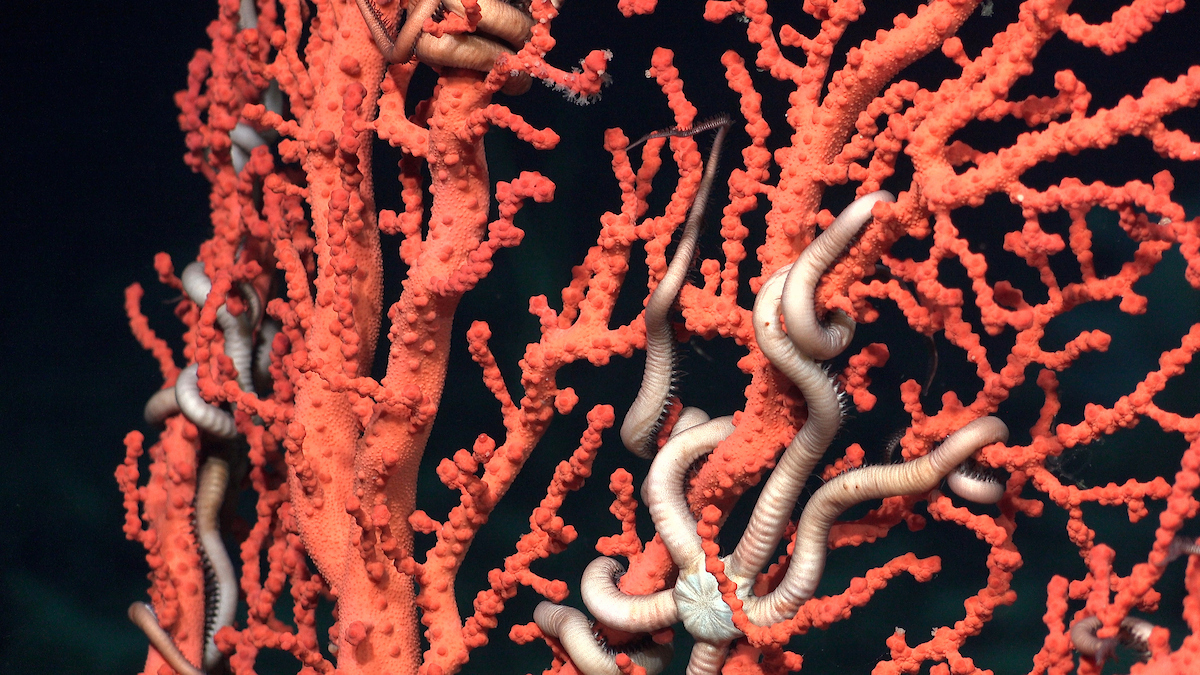
And it is not dead. The ancient atoll is now topped with a bustling deep-sea coral garden — a living ecosystem growing on a fossil from another world.
The discovery was made by the remotely operated vehicle ‘SuBastian’, which descended into total darkness with cameras and robotic arms, beaming live footage back to scientists on the surface.
What stunned the team was not just the atoll itself, but what it means. Atolls form in warm, shallow, sunlit tropical waters, where corals grow around a volcanic island that slowly sinks, leaving a ring of reef. Finding one in the middle of the Atlantic, nearly a kilometre down, tells a story of a very different ocean.
Five million years ago, this ridge must have been near the surface, bathed in light, with a thriving reef. Then, as tectonic plates moved and the seafloor subsided, the atoll sank — slowly, silently — into darkness. The corals died, fossilised, and became a mountain of limestone.
Now, deep-sea corals — which do not need sunlight — have colonised its summit. Brittle stars entwined in Paragorgia soft coral, squat lobsters perched on deep-water corals at 1,200 metres, and a host of other species now call the ancient reef home.
It is a perfect example of what scientists call ecological succession across geological time: one ecosystem dying, another taking its place on its bones.
The Romanche Fracture Zone is one of the least explored places on Earth. It is a place where tectonic plates scrape and slide past each other, creating fault scarps, sedimented basins and chemically altered seawater that can host unique life.
For India, with its own vast deep-sea ambitions — from the Samudrayaan mission to deep-ocean mineral exploration in the Indian Ocean — the discovery is a reminder: we have mapped the Moon better than our own seafloor.
Less than 25% of the ocean floor has been mapped in detail. Every dive by a robot like _SuBastian_ proves how much remains to be found.
A five-million-year-old atoll, lost in the dark, now alive again with coral. The deep sea is not a desert. It is a museum, a garden, and a time machine — all at once.
*Tags:*
#DeepSea #AtlanticOcean #CoralAtoll #SuBastian #Falkor #SchmidtOcean #OceanDiscovery #MarineBiology #Romanche #Science