

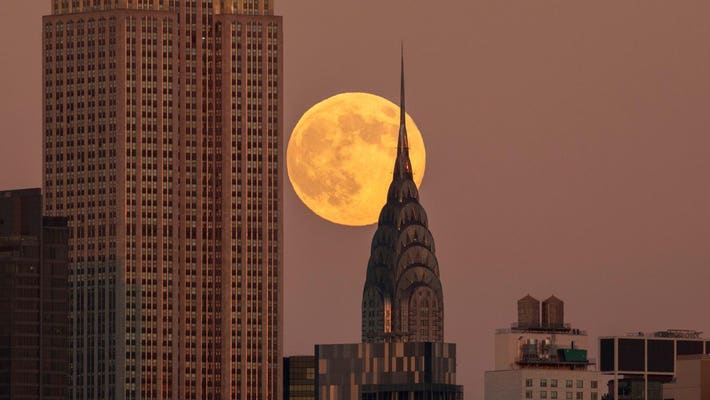
NEW DELHI: If you looked up on Tuesday evening, you saw it — a huge, glowing moon rising in the east, brighter than usual and hard to miss.
That was the Beaver Supermoon, the November full moon, which lit up night skies across India and the world on November 24, 2026. In India, it began appearing between 4:56 pm and 5:01 pm and reached its brightest at 8:23 pm IST.
*What is a Beaver Supermoon?*
It is two things at once: a full moon, and a supermoon.
The Moon revolves around Earth in an oval-shaped, elliptical orbit. Its closest point is called perigee — about 226,000 miles away — and its farthest point is called apogee — about 251,000 miles away.
A supermoon occurs when a full moon happens near perigee. NASA defines it as a full moon occurring within 90% of perigee. The result: the Moon looks up to 14% bigger and 30% brighter than a micromoon, which is a full moon at apogee.
This year's Beaver Moon was about 224,171 miles from Earth. It appeared roughly 7% bigger than an average full moon, and up to 17% larger than the smallest full moon of the year.
*Why is it called Beaver Moon?*
The name comes from the Old Farmer's Almanac, which adopted it from Algonquian languages spoken by Native Americans in New England.
November is when beavers prepare for winter — reinforcing their lodges and dams, storing food, and taking shelter before swamps and rivers freeze. It was also historically the time to set beaver traps for thick winter pelts before waterways froze.
It is also sometimes called the Frost Moon, Freezing Moon or Snow Moon.
*What made this one special?*
It was the first of four back-to-back supermoons — a rare sequence from November 2026 to February 2027. Supermoons can cluster because the Moon takes 27.5 days to return to perigee, while it takes 29.5 days to complete a full phase cycle.
On Tuesday, the Moon also appeared near the Pleiades star cluster — the Seven Sisters in Taurus — separated by just 0.9 degrees, making for a stunning photo opportunity, though the Moon's glare made the fainter stars harder to spot.
No special equipment was needed. It was visible to the naked eye wherever skies were clear.
*When is the next supermoon?*
Mark your calendar:
- *December 23-24, 2026 — Cold Moon:* The last supermoon of 2026, and the biggest and brightest of the year. At 221,668 miles, it will be the closest full moon to Earth since 2018. Under a stricter definition, it is the first Christmas Eve perigee full moon since 1787.
- *January 22, 2027 — Wolf Moon:* The first supermoon of 2027, at 222,230 miles away.
- *February 20, 2027 — Snow Moon:* The final one in the series, at 225,748 miles. Some astronomers using the strictest definition do not count it as a supermoon.
After that, the next major sky event is the Geminid meteor shower, peaking around December 13-14.
If you missed Tuesday, you have three more chances. The best is Christmas Eve — do not miss it.
*Tags:*
#BeaverMoon #Supermoon #FullMoon #Astronomy #Moon #ColdMoon #WolfMoon #Space #Stargazing #NASA