
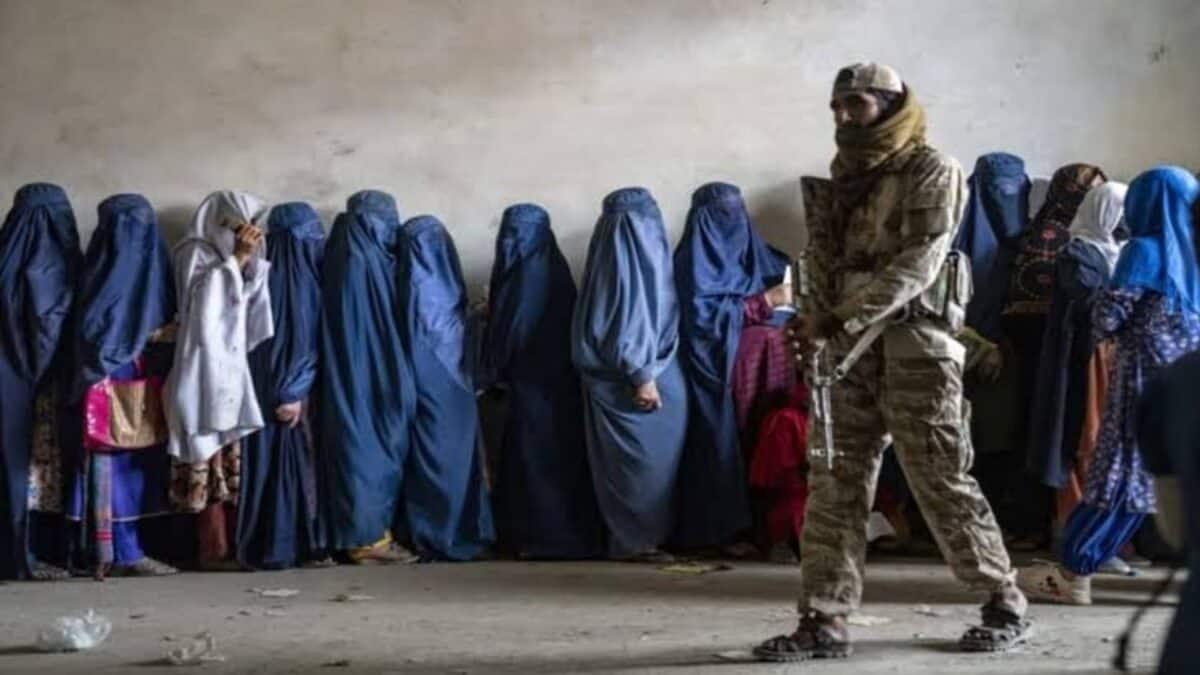
BALKH, AFGHANISTAN: In Afghanistan's northern Balkh province, a woman is no longer called by her name.
Taliban authorities have reportedly directed public employees and healthcare workers to stop using women's real names in official documents, medical prescriptions and hospital records, replacing them with the generic term "Bibi", according to investigations by ‘Zan Times’ and ‘The Guardian’, and reporting by 'El País'.
"Bibi" is traditionally a respectful form of address in Afghanistan, generally translated as "granny" or "old woman". In a culture where pronouncing a woman's first name in public has long been considered an affront to the honour of her husband or children, many women were already listed as "wife of", "daughter of", "mother of" — never simply herself. Even on gravestones, often no trace of a woman's name remains.
But activists say the practice in Balkh has gone further.
Lalah Osmany, an Afghan women's rights activist based in Germany, told ‘El País’ that women have also been referred to using derogatory words associated with animals, including "goat" and "cow".
"This is a systematic process of dehumanisation," she said. “When a regime replaces a woman's name and gives her one of an animal, it is stripping her of her human soul and reducing her to a mere biological creature or the property of a man.”
The directive was reportedly issued in May and applies even to medical prescriptions and records. For now, it has been reported only in Balkh, and there is no confirmation it has been extended nationwide. No text of the order has been published. Some reports say implementation is not uniform — some staff are ignoring it.
But activists fear what happened in Balkh will travel. Zubaida Akbar, who directs the Afghanistan programme at the NGO Femena in the US, said a local measure that meets resistance at first can return later as a decree covering the whole country — as has happened before with other restrictions on women.
"The Taliban are very creative when it comes to imposing bans on women," she said.
More than a word-
The order is not just symbolic. It is dangerous.
If every woman is "Bibi", how do you distinguish one patient's records from another's? Activists warn such a system could increase mistakes involving diagnoses, prescriptions and treatment. It makes it harder for women to assert their identity, access healthcare, and seek legal or administrative remedies.
It also builds on a deeper erasure. Since returning to power in August 2021, the Taliban have issued more than 100 decrees stripping women of rights, and Femena has counted more than 144 restrictive measures. Women are banned from secondary education, from most work, from parks, gyms and many public spaces. They cannot travel without a male guardian. They cannot even be heard singing in public.
During the Taliban's first period in power, between 1996 and 2001, the word "woman" disappeared from street names and public spaces.
Osmany knows this fight personally. In 2017, she launched the campaign #WhereIsMyName — "Where is my name?" — asking why Afghan women were invisible on birth certificates, ID cards and even gravestones. In September 2020, the then-government authorised the optional inclusion of the mother's name on children's birth certificates. It was a small victory.
Now, she says, that victory is being reversed.
"A name is a gift received at birth that endures after death, a face, a voice and a story," she said.
In Balkh, that gift is being taken away — and replaced with a word that means everyone, and therefore no one.
#Afghanistan #Taliban #Balkh #WomensRights #Bibi #WhereIsMyName #Femena #HumanRights #Identity #ZanTimes