

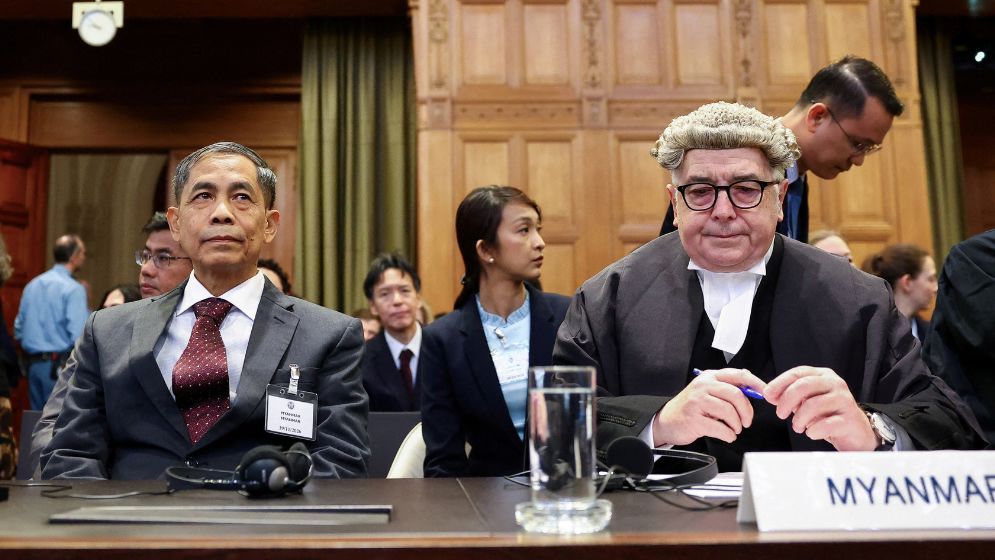
NAYPYIDAW: Myanmar's military-backed president has said his administration will not comply with all measures ordered by the UN's top court, which last week ruled that the country's security forces had committed genocide against the Rohingya.
In his first public comments since the ruling, junta chief-turned-president Min Aung Hlaing rejected the verdict and said Myanmar would take "actions appropriate for a responsible country but would not comply with requirements it considered inappropriate", according to state media reporting on a meeting on Wednesday.
He did not elaborate on which court orders his administration considered inappropriate.
He added that as the country's leader, he considered himself primarily responsible for all matters occurring in the country and would not accept any actions that undermined the nation.
A landmark ruling-
On November 19, 2026, the International Court of Justice found that the Myanmar military's actions against the mainly Muslim Rohingya minority in 2017 — including thousands of killings, the burning of hundreds of villages and widespread sexual violence — amounted to genocide.
It was the first instance in the ICJ's 80-year history in which its judges determined that a state committed genocide. The ruling is final.
The case was brought by The Gambia under the 1948 UN Genocide Convention, which allows any state to file suit against another it suspects of breaching the agreement set up after World War II.
The court dismissed Myanmar's long-standing argument that its operations in northern Rakhine state during 2016–2018 were counter-terrorism actions against an insurgent group, the Arakan Rohingya Salvation Army, after attacks that left a dozen security personnel dead.
Judges found instead that Myanmar forces systematically killed, raped and destroyed property of civilians from the Rohingya during the 2017 crackdown.
What the court ordered-
The ICJ ordered Myanmar to:
- End ongoing breaches of the Genocide Convention and promptly investigate, prosecute and punish people reasonably suspected of involvement in the 2017 military operations, and provide guarantees such violations will not be repeated;
- Facilitate the return of displaced Rohingya, restore or replace lost property, help locate missing people, provide rehabilitation to survivors, and protect Rohingya from discrimination and persecution;
- Pay compensation for harm caused to Rohingya that is not remedied through restitution;
- Report back within two years on measures taken, including proposed compensation. The court will then determine whether the proposal is sufficient.
Judges said previous probes into atrocities by state actors were insufficient.
The human cost-
More than 700,000 Rohingya fled to Bangladesh in 2017, joining hundreds of thousands already there. Most remain in camps in Cox's Bazar, the world's largest refugee settlement, still waiting for safe return, citizenship, and justice.
Myanmar has always denied genocide. It maintains its actions targeted an armed insurgency.
Now, the question is enforcement. The ICJ has very limited options to enforce its rulings. It can refer non-compliance to the UN Security Council, where veto powers and geopolitics often block action.
For survivors, the verdict was historic — a state, not just individuals, held responsible for genocide. For Myanmar's leader, it was something to be selectively obeyed.
Whether the world will insist on full compliance, or let the ruling become a moral judgment without consequence, will define what international law means after The Hague.
#Myanmar #ICJ #Rohingya #Genocide #MinAungHlaing #TheGambia #Rakhine #Bangladesh #InternationalLaw #HumanRights