

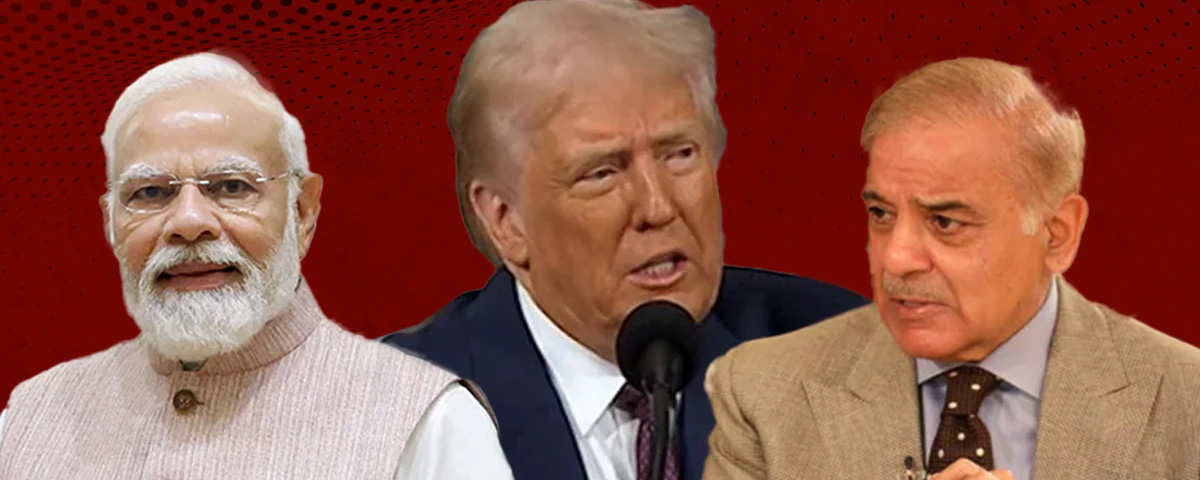
The U.S. President Donald Trump recently engaged in high-profile interactions with the Pakistani Army Chief Asim Munir and Indian Prime Minister Narendra Modi amid the backdrop of the recent India-Pakistan conflict following the Pahalgam terror attack. Does this underscore the U.S. attempt to navigate relations with two nuclear-armed rivals? These parallel interactions raise critical questions about the United States intentions of recalibrating its strategic balancing act between the two nations, crucial for global security.Is Trump seeking to mediate between India and Pakistan in hopes of winning the Nobel Peace Prize?
Questions like these are now being widely raised.
On June 17, 2025, Trump held a 35-minute phone call with the Indian Prime Minister based on the recent Indo-Pak ceasefire, inviting him to stop by Washington D.C., on his return from the G7 Summit, possibly to facilitate a trilateral meeting with Munir. However, Modi declined due to a pre-existing schedule and also firmly rejected Trump’s claim of any mediation during the conflict. The interaction highlighted the strength of India-U.S. ties, built over decades as a counterbalance to China, but India’s rejection to any false mediation claims also revealed tensions. This rejection signals New Delhi’s sensitivity to perceived U.S. “hyphenation” of India and Pakistan, a diplomatic approach that treats the two nations as equals despite India’s larger economic and strategic weight.
On the other hand, President Donald Trump hosted Pakistan’s Field Marshal Asim Munir on June 18, 2025, for a private lunch at the White House, a rare honour, following Munir’s attendance at the U.S. Army’s 250th anniversary celebrations and his visit to CENTCOM headquarters. The White House lunch was a diplomatic coup for Pakistan, signaling a thaw in U.S.-Pakistan relations, which had been strained during Trump’s first term and the Biden administration due to Pakistan’s alleged support for militant groups.
Does this reflect an evolution in the U.S. strategies in South Asia? Historically, U.S. South Asia policy has oscillated between prioritizing India or Pakistan based on strategic needs. During the Cold War, Pakistan was an important ally again the USSR but since 2000s, the U.S. has tilted towards India, counterweighting it to China. The parallel interactions with Munir and Modi reflects that Trump seeks to balance relations with the both the nations while addressing geopolitical priorities. The Munir meeting and Modi call were both framed around the May 2025 ceasefire, indicating a U.S. desire to stabilize South Asia to focus on other global priorities, such as China and the Middle East alongside securing economic and technological advantages.
The entire series of events, reflect a delicate balancing act between India and Pakistan amid rising global polarization, with significant implications for regional security. The unprecedented attention to Munir, coupled with Trump’s mediation claims in the India-Pakistan ceasefire following the Pahalgam attack and Operation Sindoor, suggests a pragmatic U.S. approach to leverage Pakistan’s military influence for counterterrorism and regional stability, particularly against threats like IS-K and potential Iran-related operations, while maintaining strategic ties with India to counter China. However, this perceived “hyphenation” risks straining U.S.-India relations, as New Delhi opposes third-party mediation, potentially fueling mistrust and complicating de-escalation in South Asia’s nuclear-armed rivalry, especially as global powers increasingly align in polarized blocs.
The Munir visit and Modi call reflect a U.S. strategy that balances immediate tactical needs (counterterrorism, Iran) with long-term goals (countering China, stabilizing South Asia). While the Munir engagement signals a partial shift toward re-engaging Pakistan, it does not fundamentally alter the U.S.-India strategic partnership. For regional security, this dual approach risks mixed signals, potentially emboldening Pakistan’s military and straining India’s trust. Amid global polarization, the U.S. must tread carefully to prevent South Asia from becoming a flashpoint, prioritizing clear communication and multilateral frameworks over unilateral mediation claims.
Riya Goyal is a trainee journalist at Cult Current. The views expressed in the article are
her ownand do not necessarily reflect the official stance of Cult Current.