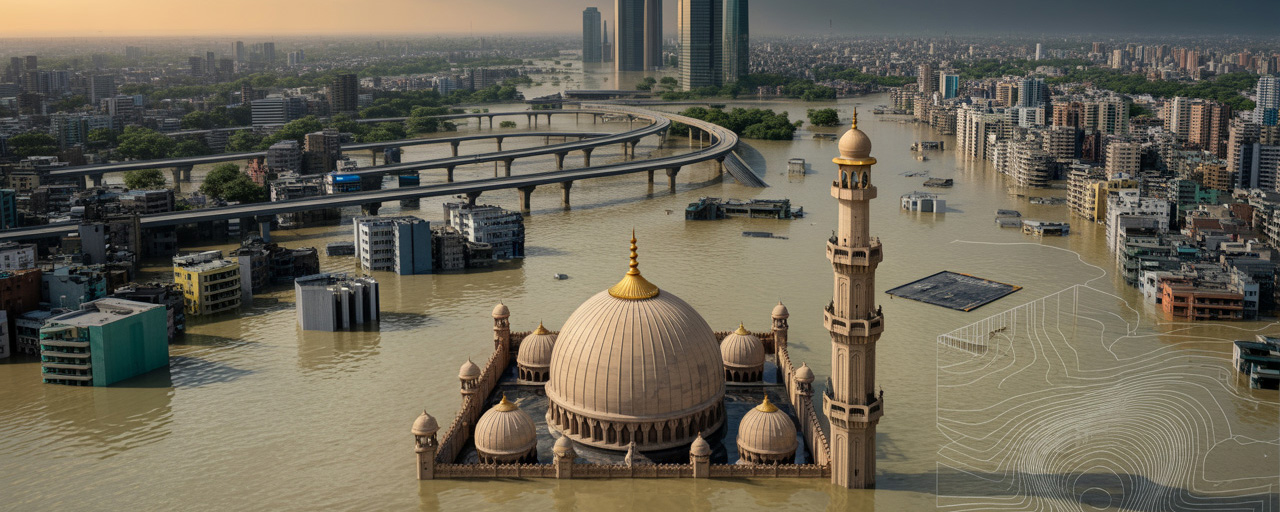

On the coast of North Jakarta’s Muara Baru district, where life once pulsed with vibrant activity, an eerie silence now reigns. Amidst that silence, the 'Waladuna Mosque' stands like a shipwreck—lonely, desolate, and half-submerged. Its walls are no longer inscribed with verses, but with thick, slippery layers of moss. Where the foreheads of the faithful once bowed in prayer, the brackish, murky water of the Indian Ocean now sways. At high tide, the water reaches the mosque's windows, as if the sea is staking its claim, declaring that this edifice no longer belongs to man, but to it. This mosque was not the victim of wartime bombing, nor was it fractured by a sudden earthquake. No foreign army razed it. It was swallowed by the very ground upon which it stood with faith. Today, this mosque is a "ghostly monument" of the 21st century—a testament to the bitter reality that when the Earth groans under the weight of its thirst and the burden of concrete, it spares not even the most sacred of sites.
This scene from Jakarta is not a sequence from some distant horror film or a part of a fictional dystopia. It is the transparent mirror into which India's metropolises are now gazing, even if they refuse to recognize their own terrifying reflection. We often associate disasters with noise and spectacle. The roar of a tsunami, the rumble of an earthquake, the fury of a cloudburst, or the siren of a cyclone—they all grant us at least a few moments to fear, to flee, to react. But the disaster that has besieged our cities in the age of modern urbanization is 'silent.' It arrives on padded feet, like a thief. Millimeter by millimeter, with the pace of a tortoise, it is hollowing out the foundations of our cities. In scientific parlance, it is called 'land subsidence.' But if we view it through a geopolitical and social lens, it is "Infrastructure Warfare"—an invisible war we are waging against our own existence, a war in which our defeat is all but certain until we bring about a revolutionary change in our water and land management strategies.
Recent research published in the prestigious journal Nature Sustainability, based on InSAR satellite data collected between 2015 and 2023, has unveiled a truth that is not merely an environmental concern. It is an existential threat to India's national security, economic stability, and social fabric. Delhi, Mumbai, Chennai, Kolkata, and Bengaluru—the five colossal engines of India's economy—are running on ground that is slowly, but inexorably, sinking. Let us embark on a detailed exploration of the invisible fissures appearing not just in the foundations of our buildings, but in the very framework of our future security and civilization.
The Infallibility of Data:
To comprehend the depth of this crisis and the veracity of its claims, one must first understand how scientists measure this invisible process. This is not conjecture or guesswork; it is the result of precise surveillance from space. For this study, researchers used InSAR (Interferometric Synthetic Aperture Radar) data from the European Space Agency's (ESA) 'Sentinel-1' satellites. This technology can detect millimeter-level changes in the Earth's surface by using the phase shift of radar waves. It is akin to measuring a change in the thickness of a coin on the ground, from space.
In parallel, data from NASA’s GRACE-FO (Gravity Recovery and Climate Experiment Follow-On) satellites was analyzed to understand groundwater conditions. These satellites measure minuscule changes in the Earth's gravitational field, which are primarily caused by the depletion or replenishment of underground water reserves. When these two datasets—surface measurements from InSAR and groundwater measurements from GRACE—were combined, a stark correlation emerged: the very areas where aquifers are emptying the fastest are precisely where the ground is subsiding most rapidly. While scientists clarify that InSAR has limitations in densely vegetated areas or on rapidly changing surfaces, for urban concrete jungles, this data is the most concrete evidence currently available to policymakers.
When the Earth Dries Up Like a Sponge
To understand the process of this disaster is as terrifying as its consequences. We must imagine the world beneath our feet. The soil, sand, and rock under our cities are not a solid block but a vast, complex 'sponge.' For millions of years, the microscopic pores between these layers were filled with water. This water was not just a means to quench thirst; it was a structural pillar. The 'hydraulic pressure' of the water kept the soil particles apart, supporting the immense weight of the land above. It was nature's own engineering.
In the past few decades, in the blind race of unchecked urbanization and population explosion, we have mercilessly squeezed this sponge. According to global studies, particularly research published in the journal Science (2021), the over-extraction of groundwater is directly responsible for approximately 59% of land subsidence cases worldwide. We are pumping out water faster than nature can replenish it. As water is drawn from the aquifer, the hydraulic pressure that supported the soil structure vanishes. The result is a simple matter of physics—the soil particles move closer together, the air pockets between them collapse, and the ground becomes 'compact.' In geology, this is called 'compaction.'
Walking on the surface, we feel nothing. There is no jolt; the coffee cup doesn't fall off the table. But the geological structure beneath our feet has been altered forever. The most alarming fact is that this process is often 'inelastic,' meaning irreversible. Once the clay layers are compressed and their structure has collapsed, you cannot simply pump water back in to re-inflate them. It is a 'one-way ticket.' In parts of Delhi and the NCR, particularly in areas like Kapashera and Bijwasan, where the land is sinking at a maximum rate of 51 millimeters per year, this is precisely what is happening.
This rate might sound small—merely the thickness of a credit card. An ordinary person might wonder, what difference does 5 centimeters a year make? But when you project it over decades, the math becomes horrifying. A rate of 50 millimeters per year means we are losing a meter of ground every twenty years. And the problem isn't just the sinking; it's the inequality of it. The real devastation begins when this subsidence is not uniform across a city but is 'differential.' When the left side of a massive building sinks by 10 millimeters and the right side by 40, it creates stress in the structure. Concrete and steel are not flexible; they tolerate stress up to a point and then they break. Engineers call this 'angular distortion.' This is the point where science turns into disaster.
Infrastructure Warfare
The problem of land subsidence has thus far been viewed primarily through the lens of environmentalists, hydrologists, or urban planners. This is a monumental error. If we shift our perspective and look at it through the eyes of a defense expert or a national security analyst, the picture becomes deeply alarming. To call it "Infrastructure Warfare" is no literary hyperbole.
In traditional doctrines of war, the enemy's objective is to destroy your 'critical infrastructure.' They target your airport runways, port docking capacities, the levelness of railway lines, and underground oil, gas, and communication cables to paralyze your logistics and response capabilities. In India's metropolises, by over-extracting groundwater unscientifically, we are doing exactly this to ourselves. It is a form of 'self-sabotage' that appears on no radar.
Consider this empirically: the integrity of airport runways is paramount. Pavement analysis shows that if the ground subsides unevenly, it can cause subtle changes in the runway's slope. In peacetime, these can be repaired, but during a national emergency or war, this could pose a fatal risk for the landing and take-off of heavy military transport aircraft (like the C-17 Globemaster) or high-speed fighter jets. A millimeter of undulation can cause a tire burst or landing gear failure at high velocity.
Similarly, consider energy security. A web of high-pressure gas and oil pipelines lies beneath our cities. 'Pipe fracture modeling' studies show that as the soil shifts unevenly, immense 'shear stress' is exerted on the pipe joints. This can lead to leaks, explosions, or supply disruptions. In coastal cities like Mumbai and Chennai, home to naval dockyards, submarine bases, and strategic coast guard installations, land subsidence and sea-level rise are a double blow. The level of jetties and docks changes relative to the water, affecting the loading, unloading, and maintenance of naval vessels.
Furthermore, modern cities run on 'data.' Underground optical fiber cables are the city's nervous system. The stretching of the ground can snap these delicate glass wires. Banking networks, stock exchanges, and military communications—all depend on them. A metropolis's communication blackout or the rupture of its pipelines is not merely a civic inconvenience; it is a direct assault on the national economy and a grave threat to internal security.
Internal Displacement and the 'Urban Refugee'
The recent crisis in Joshimath, Uttarakhand, shook the entire nation. We witnessed how cracks appeared in people's homes, forcing them to abandon everything overnight and flee to relief camps. Joshimath gave us a glimpse of the human face of a land that is no longer habitable. But Joshimath was a small hill town. When we speak in the context of mega-cities like Delhi, Mumbai, or Kolkata, the scale becomes so vast it is difficult to even imagine. We are looking at the potential displacement not of thousands, but of millions.
Global assessments indicate that over 80 million of India's urban population reside in areas potentially prone to subsidence. According to the Nature Sustainability research, densely populated areas like Delhi’s Bijwasan, Faridabad, parts of Mumbai’s Dharavi and Wadala, or Chennai’s T. Nagar are at the highest risk. These areas have some of the highest population densities in the world. Millions live here. When the cracks in the buildings in these areas transition from 'cosmetic' to 'structural,' and municipal engineers declare them 'unsafe' or 'unfit for habitation,' where will these people go?
This will be a new, complex, and brutal form of 'internal displacement.' We often use the term 'climate refugee' for those who flee floods or droughts. But here, the term doesn't tell the whole story. These people will not be fleeing rising waters or parched fields; they will be fleeing the very ground disappearing from under their concrete homes. This displacement will deepen class divides. The affluent have resources—they can retrofit their foundations, use piling techniques, or move to safer, more expensive parts of the city. But the lower and middle classes, often living in unauthorized colonies, slums, chawls, or old, dilapidated buildings, will be the first and worst hit. Mumbai's old chawls or Delhi's unplanned colonies, already precarious due to weak infrastructure and poor construction, could collapse like houses of cards. This will be a humanitarian tragedy whose management would be a nightmare for any government.
Whose Water Is It Anyway?
At the root of this entire crisis lies not just a technical failure, but a profound legal and moral question: to whom does the water beneath the ground belong? In India, under the colonial-era 'Easements Act, 1882,' it is assumed that the owner of the land has absolute rights to the water beneath it. This law may have been suitable for the 19th century, but for the mega-cities of the 21st, it is proving to be catastrophic.
From a hydrogeological perspective, water is not private property; it is a 'shared resource.' Aquifers do not recognize property lines. When an individual or an industry drills a deep borewell on their private land and extracts water around the clock, they are not just taking water from under 'their' land. They are drawing from a common bowl, an act that affects their neighbor's land, the foundations of the entire locality, and ultimately, the stability of the whole city. This is a living, terrifying example of the famous "tragedy of the commons," where the unbridled pursuit of individual gain leads to collective ruin.
Morally, should one person have the right to extract so much water for their swimming pool or to wash their car that their neighbor's house begins to sink? The current legal framework is incapable of answering this question. Until groundwater is redefined not as private property but as a 'national heritage' and a 'community resource,' and its extraction is brought under strict regulation, stopping subsidence will be impossible. This battle is not just against nature, but against our own archaic and irrelevant legal dogmas.
The Geo-Economic Bubble
Real estate is a massive pillar of the Indian economy and is considered the safest investment for the middle class. We often hear that land prices in a particular area are skyrocketing. 'Location, location, location'—that is the mantra of real estate. But what happens when the market discovers that the "prime location" is, in fact, sinking? The economic impact of land subsidence could be more devastating and permanent than any stock market crash.
This phenomenon can reduce property values to zero. Apartments selling for crores of rupees today could see their market value plummet overnight if they are scientifically identified as future 'high-risk zones.' This would be a classic case of "stranded assets"—property with no buyers. The global finance and insurance sectors, masters of risk calculation, are beginning to take note. In the US and Europe, insurance companies have either stopped offering policies in flood and subsidence-prone areas or have raised premiums so high that they are beyond the reach of the common person. In India too, insuring properties in 'subsidence-prone' zones may become impossible in the future.
The ripple effects will be far-reaching. If banks stop issuing home loans in these areas because the future of the mortgaged asset is uncertain, the entire housing market could collapse. People who have taken 20- or 30-year loans will find themselves paying EMIs for an asset whose value is now less than their outstanding loan. Furthermore, imagine the financial burden on municipal corporations. Repeatedly filling cracked roads, replacing underground sewage lines clogged due to altered slopes, jacking up metro pillars—all this will demand billions of rupees. It is an 'invisible tax' that every citizen will pay, whether directly for repairs or through increased taxes.
A Tale of Five Cities
A micro-analysis of India's five metropolises reveals that while the root cause is the same—the greed for water and mismanagement—the symptoms and threats vary according to geographical conditions.
Delhi-NCR's case is perhaps the most severe and complex. Its soil is primarily 'alluvial,' deposited over thousands of years by the Ganga and Yamuna rivers. This soil is a boon for agriculture but a challenge for engineering. It contains layers of silt and clay that are highly 'compressible.' When water is extracted, it compacts rapidly. In Delhi, the groundwater level is plummeting. In posh areas of Dwarka, Kapashera, and South Delhi, home to large farmhouses and societies, borewell motors run day and night. It is an irony that the Yamuna's floodplains, which should have been left to naturally absorb water and recharge the city, are now concrete jungles. The load of heavy construction from above and water extraction from below—this is a double jeopardy for Delhi.
The story of Kolkata and Chennai is linked to their coastal soil structure. Kolkata is built on the delta of the Hooghly river. Its soil has a very high content of 'clay' and organic matter. A characteristic of clay is that it shrinks significantly when water is withdrawn, much like a sponge. Kolkata's old, historic buildings, built on shallow foundations, are now tilting under their own weight and the settling of the soil beneath them. In Chennai, uncontrolled construction in the floodplains of the T. Nagar and Adyar river and the nature of coastal sand make it vulnerable. Here, the threat is twofold: as the land sinks and sea levels rise due to climate change, saltwater intrusion will follow.
Mumbai's crisis is one of man-made land. The city was created by joining seven islands. A large part of the city—from Nariman Point to Bandra Kurla Complex—was built by pushing back the sea and filling in swamps. This reclaimed land is naturally unstable and continues to settle slowly over decades. Constructing skyscrapers on this unstable ground is a risky gamble. In areas like Dharavi, where population density and construction load are at their peak, even slight subsidence disrupts drainage. This is why the flooding situation in Mumbai worsens with every monsoon. There was a misconception that Bengaluru was safe because it sits on the hard granite rock of the Deccan Plateau. But recent data has shattered this illusion. Newly developed IT hubs like Hebbal, Bellandur, and Whitefield, where lakes and ponds once existed, now host massive glass buildings. In these areas, lakes have been filled in, and the water supply is entirely dependent on tankers and thousands of feet deep borewells. The layer of soil above the rock is drying out and subsiding. This shows that even a rock-bed cannot keep you completely safe if you tamper with the ecology.
Lessons from History and the Present
India is not alone in this battle. This is a global pandemic that questions the very model of human development. Indonesia's example is the most stark. Its government has made the historic and bitter decision to abandon its capital, Jakarta, primarily because 40% of it has already sunk below sea level, and floodwaters cannot be pumped out. They are now building a new capital, 'Nusantara,' in the jungles of Borneo, at a cost of over $30 billion. But can India afford to relocate its capitals? Can we leave Delhi and move elsewhere? No. We have neither the land nor the resources. Mexico City, built on an ancient lakebed, has sunk by up to 10 meters over the last 100 years. Its historic cathedrals now stand askew. But there are also rays of hope. Tokyo, the capital of Japan, has shown us the way. In the 1960s, Tokyo was also sinking rapidly. The government took decisive action. They imposed strict restrictions on groundwater use by industries and arranged for alternative water sources. The result was that within a decade, the rate of subsidence dropped to near zero. This proves that with political will and the right policies, this disaster can be averted.
SCIENCE
COVER STORY- THE SINKING METROPOLIS
The Earth speaks even in its silence—we simply fail to listen. Between 2015 and 2023, satellites have recorded its slow groan across more than 50 urban hotspots. This groan is the sound of groundwater's fading veins and the oppression of concrete. If we do not listen now, our metropolises, while reaching for the sky, will lose their faith in the ground beneath.