

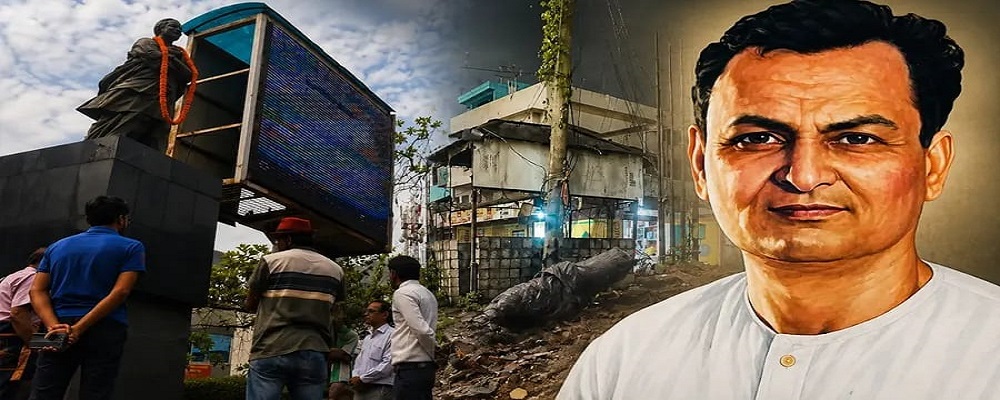
Recently, the statues of the famous Hindi writer Mahapandit Rahul Sankrityayan - who gave the call of 'Don't run away, change the world' - and the poet Dhumil, who spoke of 'From Parliament to the Street', were broken. This is not the first time that writers and artists have been disrespected. But the truth is that such an attack on knowledge was never so intense before. Earlier, there was ample space even for disagreements. Such a cruel and insensitive act of breaking a writer's statue was rarely seen in this country before.
The breaking of Rahul Sankrityayan's statue in Bengal leaves us stunned. Bengal has, from the beginning, been a great centre of renaissance. Compared to the Hindi heartland, the people here have always showered immense affection and respect on their cultural sages. Bengal's identity has been formed by reformers and writers like Raja Ram Mohan Roy, Vidyasagar, Rabindranath, Bankim Chandra, Sarat Chandra. Across the country, this region is seen as a cultural centre. The breaking of Rahul Sankrityayan's statue installed in Raniganj, Bengal, is in fact an attack on nearly 150 years of Bengal's scholarship and cultural identity.
Rahul Sankrityayan is a writer of Indianness. The critical and rational perspective with which Rahul Sankrityayan, full of progressive ideas, evaluated Indian society, culture, history and philosophy is worthy of welcome. He is such a neutral writer who does not fit into the frame of any ideology. His entire literature is a narrative of the heritage of Indianness.
At a time like this, this incident disturbs us even more. These days, a wave of Indian knowledge tradition is sweeping through the entire academic world of the country. At such a time, such disrespect for Rahul Sankrityayan, a scholar of the branches of Indian knowledge tradition, raises a question within us - are we really honouring the Indian knowledge tradition? Or are we merely pretending? Can this incident also be seen as something that happened to Rahul because of the rise of fascist forces in Bengal, like in the Hindi belt?
It is quite possible that today, in this era of religious superiority and bigotry, Rahul Sankrityayan's words are creating fear in the minds of fascist forces. When he says - "May your religion perish, may your God perish, may your morality perish, may your caste-system perish, may your leeches perish." Certainly, he opposes every kind of religious blindness that creates enmity and hatred among people.
Today, when the entire system is engaged in promoting hatred, violence and division, an attack on Rahul, who talks about opposing religion, God, the varna system, loot and corruption, is natural.
One reason for hatred towards Rahul could also be this: some people are searching for the Indian knowledge tradition only in old manuscripts, while the truth is that Rahul looks at old manuscripts with an eye of suspicion. He believes - "75% of our old manuscripts are full of foolishness." In that era, even Nehru was an admirer of Rahul Sankrityayan's scholarship. Today, Nehru is a villain in the eyes of the fascists. It is quite possible that the attack happened for this reason too.
In such a scenario, the reactionary forces must understand that by breaking the statues of Rahul Sankrityayan and Dhumil, they cannot stop their cultural consciousness and resistance. This is a time of illiteracy and information. The rise of blind devotion is natural. The blind devotee considers knowledge as his enemy. How can those who consider knowledge as an enemy tolerate writers like Rahul Sankrityayan and Dhumil? Both writers were opponents of religious bigotry and the negative legacy of caste culture. Although these days religion is being seen as a big tool of power dominance. As a by-product of that tool, caste, language, culture, province and sect etc. are being used. The attempt of the nationalists to make the country into a Nation has put India's pluralistic identity in crisis. On the pretext of the revival of religion and the nation, on one hand a narrative of the return of 'national pride' is being built, while on the other hand we can see how this very revivalist mentality is giving birth to religious bigotry.
Rahul Sankrityayan always criticized this form of religion - "Religion even today is just the same, a nurturer of thousands of foolish beliefs and a supporter of man's mental slavery." Today we can see such intellectual slaves around us. Who are, for the record, educated people, but their intellectual colonization has already taken place. People are being divided in the name of religion, caste, sect, provincialism, language. So that the intellectual sterilization of divided people can be done. In this process of sterilization, the biggest role is of the sold-out media, the IT cell and a crowd of culturally impoverished people. Such people are engaged in distorting history. People cut off from historical consciousness, instead of understanding their tradition and inclusive heritage, are becoming synonyms of enmity. In such a scenario, an attack on Rahul Sankrityayan - a knower of more than two dozen languages, a saviour of rare Buddhist texts, one who honoured Sanskrit poets, historians, philosophers, historical characters and who advocated for farmers - and on Dhumil, who 'decoded' the contradictions of India's democracy, is not unnatural but a well-planned attack.
This time is getting trapped in the duality of 'Us' and 'Them'. Those who are not on our side are our enemies. Perhaps this is why Rahul and Dhumil, who talk about progressiveness, appear like enemies to the fascists. Now progressive people have started to prick the system. Those who criticize religious bigotry seem anti-religious to them. Those who talk about the soul of the country instead of the Nation and question power are anti-nationals. Those who talk about justice, rights and employment seem like law-breakers. In such a situation, it is necessary that this game of duality and versus must now stop. This is the time to build an inclusive bridge between India's rich tradition and pluralistic culture. Only then will we be able to stop the displacement and encroachment of literary and cultural symbols like Rahul Sankrityayan and Dhumil.