

Balanced Strategy: The Vocal Voice of the Global South
India's approach towards BRICS has always been based on a fine balance. For New Delhi, BRICS is not an anti-Western bloc, but a powerful forum that protects the interests of developing countries, i.e., the 'Global South'. This year's theme - 'Building Resilience, Innovation, Cooperation and Sustainability' - reflects this far-sighted thinking of India. Prime Minister Narendra Modi has often emphasized a 'Humanity-First' and people-centric agenda. Its objective is to prevent BRICS from becoming an arena of superpower rivalry and to make it an effective medium for practical economic and technological cooperation. India wants to send a message to the world through BRICS that emerging economies are no longer merely silent spectators, but are rule-making powers.
Resilience: Learning from Crises and Securing Supply Chains
Among the four pillars of the presidency, Resilience is the most important. What the world has endured in the last few years - whether it be the global pandemic, the breaking links of supply chains or stringent economic sanctions - all have exposed the fragility of emerging economies. During its presidency, India is emphasizing on building a supply chain in the areas of critical minerals, agriculture, energy and manufacturing that is not dependent on any single country or region. India believes that if the Global South is to truly become independent, it will have to build a more diversified and robust framework for its needs.
Innovation: The Global Model of Digital India
Digital integration and innovation is an area where India has extraordinary diplomatic strength. India's 'Digital Public Infrastructure' model, which includes systems like UPI and Aadhaar, has today become an example for the whole world. India wants to transform this technical experience into a shared agenda of BRICS. Facilitating cross-border digital payments, harmonizing Central Bank Digital Currencies and preparing a common global approach on responsible Artificial Intelligence is India's priority. New Delhi's aim is to create a technological bridge between BRICS countries that can protect the digital sovereignty of developing nations.
Cooperation: The Agenda of Reformed Multilateralism
The third pillar of cooperation is directly linked to India's old demand which is called 'Reformed Multilateralism'. India's argument is clear: institutions like the United Nations Security Council, the International Monetary Fund and the World Bank do not represent today's global reality. These institutions are products of an era when a large part of the world was under colonial control. BRICS provides India with a platform from where it can demand greater representation and decision-making power for the Global South in these global institutions.
However, here India's strategy is different from that of China or Russia. New Delhi's objective is not to completely dismantle the existing international order and create a parallel or separate system. Instead, India wants to use BRICS to rebalance the current order from within. India supports an open and rules-based global framework that is more transparent and accountable. The challenge for India will be how it makes this reformist thinking effective between the strident positions of countries like Russia and Iran and the concerns of countries like Brazil or South Africa.
Economic Autonomy and the Role of the New Development Bank
To achieve the goal of sustainability, India is a strong proponent of promoting trade and payment systems in local currencies among BRICS countries. This will not only reduce dependence on the dollar but will also reduce transaction costs. In this direction, the role of the 'New Development Bank' becomes extremely decisive. India wants this bank to give more loans in local currency for the basic projects of the Global South, so that developing countries can remain free from the fluctuations of the global market and the pressure of the financial architecture of a third country.
Geopolitical Challenges and the China Factor
The mountain of challenges before this ambitious plan of India is no less high. The biggest obstacle is that BRICS is not a group with a uniform strategic thought. The ideological differences between its members are deep. For example, the view of Russia and Iran towards the West is completely confrontational, while India has deep strategic and economic relations with America and Europe. New Delhi will have to ensure that the BRICS forum does not become merely a means to criticize Western countries, because if that happens, the credibility and utility of this group may diminish.
Relations with China are the most intricate part of India's BRICS diplomacy. Both countries are strategic rivals and the tension on the border is well known. Despite this, their interests coincide on issues like the leadership of the Global South and international economic reforms. India's success will depend on how it is able to keep its bilateral disputes with China separate from the broader agenda of BRICS. New Delhi will also have to keep in mind that after the expansion of the group, China's influence in it should not increase too much.
The Shadow of Expansion and Mutual Disputes
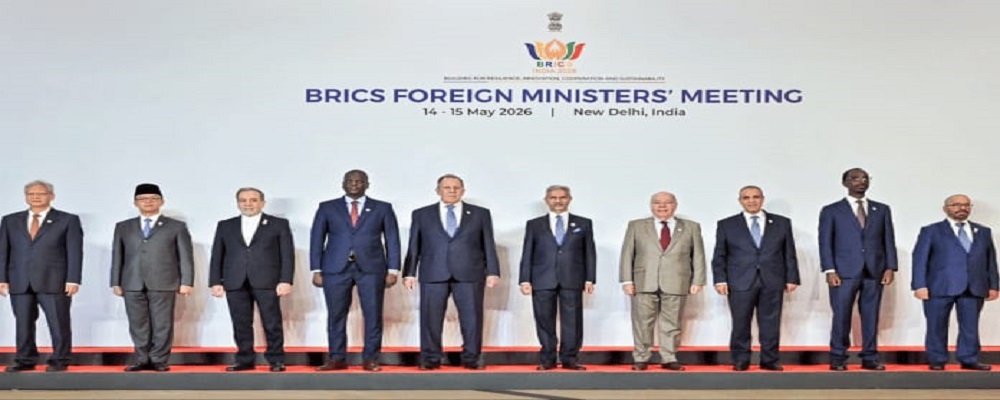
The recent expansion of BRICS is proving to be a double-edged sword. With the increase in the number of members, the global weight of the group has increased, but reaching a consensus on any one issue has become more difficult than ever. The meeting of BRICS foreign ministers held in New Delhi in May 2026 is a fresh example of this. Due to the growing regional tensions between Iran and the UAE, that meeting ended without any joint statement. India was forced to issue a 'Chair's Statement'. This incident shows how challenging it is to maintain the unity of BRICS when the members of the group themselves are entangled in mutual disputes.
This situation is particularly dire for India because both Tehran and Abu Dhabi are important strategic partners of New Delhi. This is not the factionalism of Punjab or West Asia, but a global responsibility where India has to play the role of mediator and problem-solver. India has to ensure that the diversity of BRICS countries becomes its strength, not its weakness.
A New Chapter of Diplomatic Influence
India's fourth BRICS presidency should not be seen only from the perspective of the final declarations of the summit. It is part of India's vision where it wants to see the world not as unipolar or bipolar, but as multipolar. The aim of India's diplomacy is neither to blindly imitate the Western order nor to erect a wall against it. India wants to reshape the rules of global governance in such a way that India's own interests remain secure and the Global South gets its due.
This is an extremely difficult and risky task, but India's growing economic and diplomatic influence provides it this opportunity. This presidency of 2026 will be proof of whether India can pull BRICS out of geopolitical noise and transform it into a platform for solid global cooperation. If New Delhi is able to present a concrete economic and technical framework through this summit, it will prove to be a milestone not only for the future of BRICS, but also for India's claim of becoming a 'Vishwaguru'.