

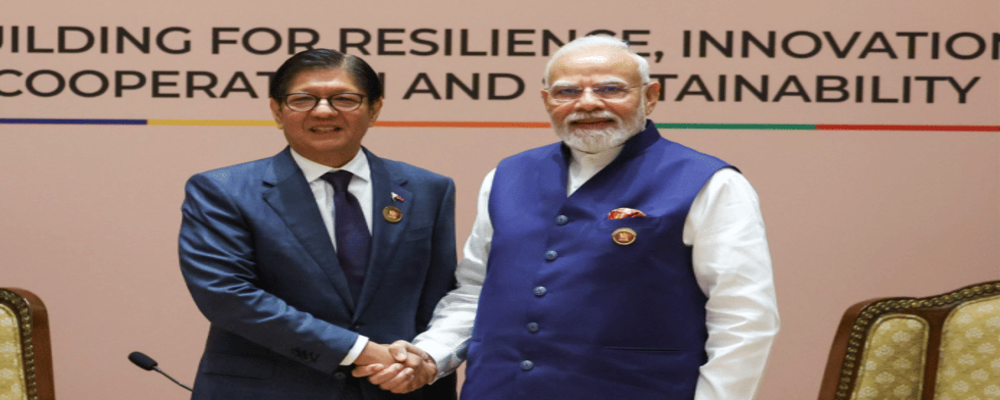
A year after elevating ties to a strategic partnership, India and the Philippines moved to make that label mean something.
On the sidelines of the BRICS Summit in New Delhi, Prime Minister Narendra Modi and President Ferdinand R Marcos Jr held wide-ranging talks. Modi also welcomed Manila's decision to join the India-led Coalition for Disaster Resilient Infrastructure.
The context matters. Marcos Jr, who visited Delhi in August last year, attended the BRICS Summit as current ASEAN chair. His presence underscores India's Act East policy and its Comprehensive Strategic Partnership with ASEAN.
India and the Philippines have rapidly strengthened diplomatic, economic and security ties, marked by the 2022 deal to supply BrahMos supersonic cruise missiles to the Philippine Navy. That was the headline. The new agenda is wider.
According to the MEA, the two leaders expressed satisfaction at progress and agreed to deepen collaboration across defence and security, trade and investment, space, railway infrastructure, fintech, education, tourism, science and technology, innovation and people-to-people ties.
Trade has grown past $3 billion, driven by pharma exports, IT services and agriculture. But the real strategic alignment is in the maritime domain. Following Marcos Jr's visit last year, India and the Philippines adopted a 2025-29 roadmap to expand military training, staff talks, and maritime security cooperation in the Indo-Pacific.
Both sides are driven by shared concerns over China's aggressive territorial assertiveness in the Indo-Pacific and South China Sea. India has consistently supported a rules-based maritime order in the South China Sea, based on UNCLOS.
This is no longer just a buyer-seller missile relationship. It is a convergence of two democracies trying to build resilience - from space to fintech to railways - in a region where one power wants to redraw maps. BrahMos was the entry point. The roadmap is the destination.