

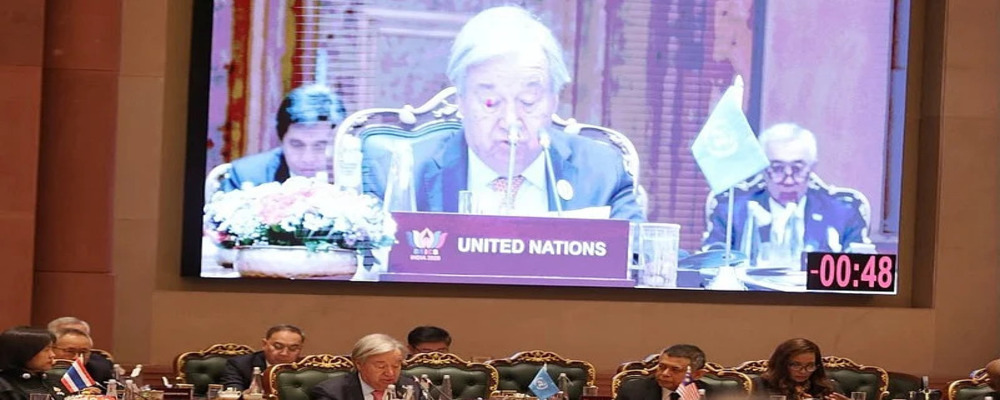
Speaking at the BRICS Summit on Sunday, UN Secretary-General Antonio Guterres backed what India has argued for years: expand the UN Security Council.
"The institutional structures must reflect it," Guterres said, noting that today's economic, demographic and geopolitical realities are not those of 1945. Countries represented at the Summit speak to that changing reality, he said.
Prime Minister Modi had pitched on Saturday for a greater role for developing countries in global decision-making, saying the Global South should move from being a "rule-taker" to "rule-shaper." Echoing that, Guterres said major emerging nations have called for an expansion of the Security Council.
It is a significant endorsement from the top of the UN system. The Security Council still has five permanent members - China, France, Russia, UK and US - each with veto power. That number has remained unchanged since 1945.
In the New Delhi Declaration on Saturday, China and Russia reiterated support for India and Brazil to play a greater role in the United Nations, including its Security Council. The declaration called for a “comprehensive reform of the UN, including its Security Council.”
Guterres also laid out an agenda for a world facing geopolitical flux: financing, multilateral development banks must become bigger, better and bolder, with a new business model to mobilize private investment and expand concessional funding to developing countries.
The demand for reform is not new, but the context is. Operation and sustainability, Guterres said, is imperative for "shaping inclusive global growth." When the world has moved towards multipolarity, a Council that still reflects the victors of World War II cannot maintain legitimacy. As Guterres put it, reforming multilateral institutions - including the UN Security Council and Bretton Woods system - is necessary to "bring balance and equity to global systems."
The question is no longer if the Council is unrepresentative. The question is how long it can remain so.