

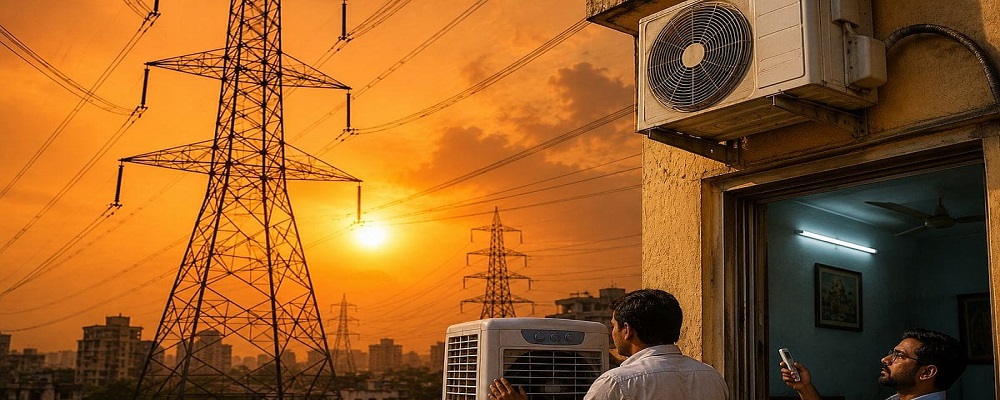
INDIA is seeing an unusual surge in electricity demand this September, with peak power demand nearing the level recorded during peak summer. And that is rewriting the power sector's calendar.
On September 10, the peak power demand touched 269 gigawatts (GW), the highest-ever peak demand recorded for the month. So far, the peak power demand for the year was 270 GW which was recorded during the peak summer in May. The year has seen the year's highest demand only twice in recent years — in 2023-24 and 2020-21. What is driving electricity consumption to remain elevated this September? What challenges does it pose to the power system?
In recent years, electricity demand has generally peaked during the summer months of April, May, June and July, driven largely by widespread use of air conditioners and other cooling appliances across households and commercial establishments. By September, demand typically begins to ease as the summer heat recedes and the country moves into the post-summer demand pattern. Yet this year, electricity consumption has remained unusually high, keeping peak demand close to its summer level.
As per power sector experts, the unusually high demand is being driven by a combination of factors such as persistent heat, deficient rainfall and higher irrigation demand, with weather conditions linked to El Nino adding to the pressure.
"The increase is being driven by persistent heat and cooling demand, with El Nino-related weather conditions and deficient rainfall also contributing to higher irrigation demand," said Alekhya Datta, Director, Electricity and Renewables Division, TERI.
The India Meteorological Department (IMD) had also forecast that monthly average maximum temperatures in September are likely to remain above normal over most parts of the country. It also forecasted below-normal rainfall.
Between June 1 and September 9, India received 648 millimeters (mm) of rainfall, compared with the normal 760.6 mm, leaving the country with an overall seasonal deficit of 15%, data from IMD shows.
"When monsoon is deficient and temperatures are high, both agricultural load and air conditioning load go up, leading to surge in peak demand," said Alok Kumar, former Power Secretary who currently serves as director general of the All India DIS-COM Association, adding that this type of uncertainty will prevail given the global warming and consequential changes in the weather and climate.
The supply side is equally stressed. Rohit Bajaj, Joint Managing Director of Indian Energy Exchange (IEX), the country's largest power trading platform, told The Indian Express, that India's electricity consumption stood at 49.84 billion units during September 1-9, up 20.7% from the same period last year. The September demand surge is also coming when deficient rainfall has squeezed hydropower generation, increasing the power sector's dependence on thermal generation even as demand remains elevated.
The combination has tightened supply-demand balance and pushed up prices in spot electricity market.
*Analysis:* This is no longer a summer peak problem, it is a climate volatility problem. For years, India's power planning assumed a predictable curve — peak in May, dip in September, ramp up again in winter for heating in the north. El Nino and a 15% monsoon deficit have broken that curve. Irrigation pumps are running when they should be idle, ACs are running when they should be off, and hydropower — the cheapest balancer — is down. With 269 GW in September just 1 GW shy of May's annual peak, grid operators have no off-season to do maintenance, coal stocking, or manage reserves. If monsoon remains 15% deficient, India will enter October with low reservoirs and high thermal plant load factor — a perfect recipe for the spot price spikes already seen on IEX.