

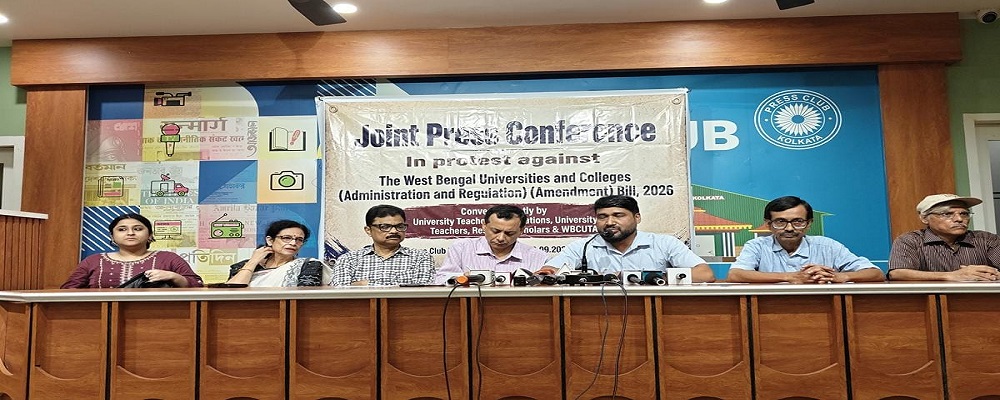
THE PASSAGE of the West Bengal Universities and Colleges (Administration and Regulation) (Amendment) Bill, 2026, sets a troubling precedent for higher education in the state. While the previous law allowed the transfer of teaching and non-teaching staff between colleges under the same university, the legislation empowers the state to move teaching and non-teaching employees between state universities, ostensibly to distribute experienced personnel more evenly across weaker or newer universities to help create new "centres of excellence".
But appointments, academic responsibilities and institutional affiliations are tied to the character of universities. Faculty strength, for instance, is a major criterion for NAAC accreditation. By making it conditional on government discretion — the CM has said the legislation will balance university autonomy with accountability to the government — the law risks weakening institutional independence and teaching quality.
Public universities in the state have, for years, been mired in governance-related disputes, from questions over the Governor's role as chancellor to prolonged vacancies in vice-chancellor positions and disagreements over appointments. The intra-university transfer provision adds to that history by giving the executive broad power without setting out clear criteria. The state Assembly has, in parallel, passed the West Bengal University Laws (Amendment) Bill, 2026, bringing the provident funds of employees of 21 state universities under an existing 1983 framework.
Teachers' associations have protested on several grounds, including the infringement of autonomy. Vacancies exceed half of the sanctioned strength across state universities; in Calcutta University alone, over 40 per cent of teaching posts reportedly lie unfilled. Many universities announced during the second term of the Trinamool Congress government in 2017-18 have no permanent campuses or adequate infrastructure. Redeploying staff will merely redistribute an existing shortage, not address the deficit that has chipped away at the state's once-formidable higher education system.
The idea of moving experienced faculty to new universities sounds egalitarian, but universities are not interchangeable government departments. A physics professor recruited for Presidency's research profile cannot be parachuted to a nascent university in Jhargram without consent, career plan or lab. Worse, without clear criteria, transfer becomes punishment posting — a fear already voiced by young academics. Bengal's real crisis is not misdistribution but non-recruitment: 50% vacancies, no campuses, PF confusion. Centres of excellence are built by attracting talent with autonomy, grants and tenure security, not by making that talent state-transferable. By tying excellence to executive discretion, the Bill risks accelerating the exodus to private universities and other states.