

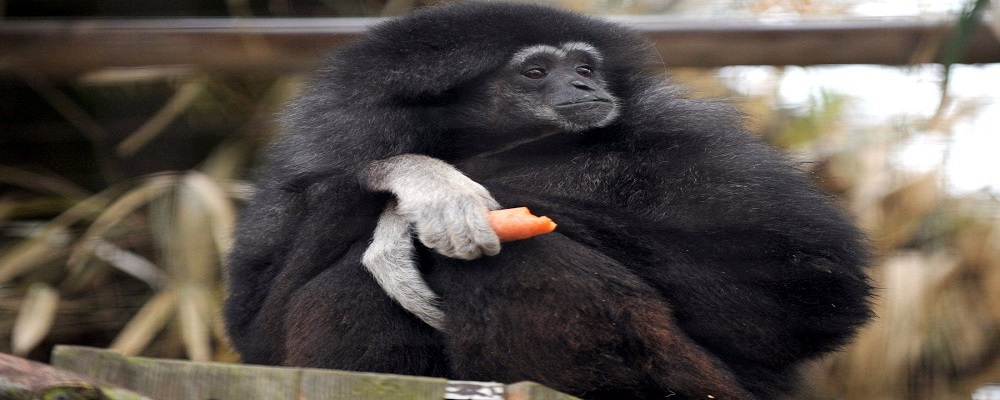
IN THE jungle, the sound of silence is a cacophony. A chorus of insects, birds, mammals and reptiles talk within and across species, often to each other's benefit. The dark lar, or white-handed gibbon, is a particularly adept vocalist, and its range has been compared to an opera singer's. Like the langurs of the Subcontinent, the white-handed gibbon's calls communicate among members of a troupe and also serve as an alarm for approaching predators and intruders for other species. Unfortunately, the soprano of the simians is singing less.
A report in The Guardian about research by an international team on the dark lar in Malaysia shows how the animal is less vocal when it is close to human settlements. A growing body of research shows how the constant noise from "civilisation" is affecting animals. In the case of social animals like the gibbon, their silence in response to traffic could affect their community life. The greater impact may be on other species that rely on the dark lar's call as an alarm.
In the jungle, the monkey warns the deer, the vulture and dung beetle keep things running. Of course, there is no going back to a kind of nature without human influence. And people need to live, work and travel — the noise of man is its own sign of life. In some tragedies, there are no villains. And if the gibbon stops singing, it will be tragic indeed.
The gibbon study is a small lens into a large crisis: anthropogenic noise. We measure deforestation in hectares, but noise pollution is invisible. For a species like the white-handed gibbon, which uses duets to mark territory and maintain pair bonds, going quiet near roads is not adaptation — it is social erosion. The second-order effect is more serious: in forest networks, one species' alarm is another's survival cue. When gibbons stop calling, deer, squirrels and birds lose early warning. Malaysia's finding resonates for India, home to the hoolock gibbon — India's only ape, endangered, and living on forest edges in Assam, Meghalaya, Nagaland. As highways cut through Hollongapar, as resorts come up near Kaziranga, we are not just fragmenting habitat, we are silencing its communication network. There is no villain here, but there is a choice: buffer zones, noise barriers, traffic curfews at dawn chorus.