

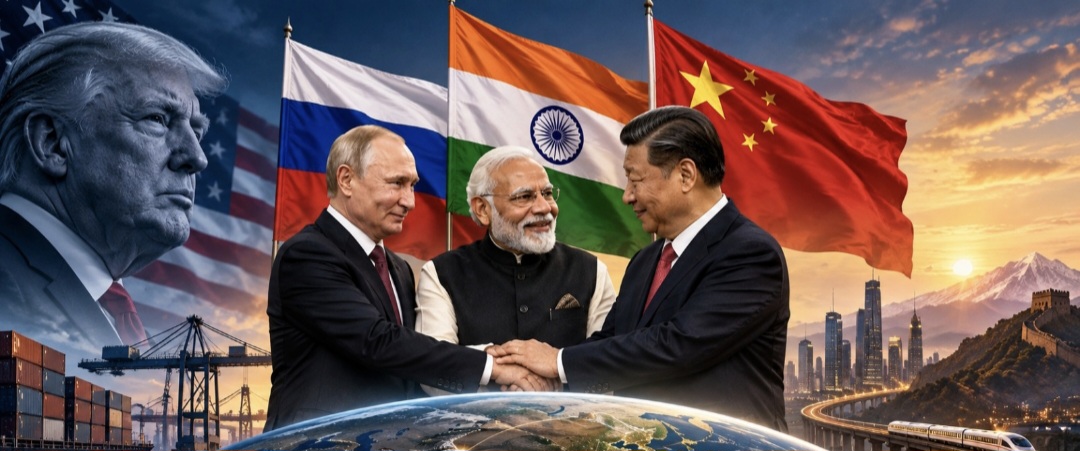
In a world reshaped by Trump’s “America First” policies, tariff pressures and intensifying strategic rivalries, the RIC triangle is gaining renewed relevance. The India-China thaw at the 18th BRICS Summit signals not reconciliation, but a cautious recalibration of Asia’s shifting power balance.
In Donald Trump’s second term, the U.S. "America First" trade policy, sweeping tariff framework, and economic pressure strategy have introduced new uncertainties into global trade and diplomacy. The U.S. administration itself has linked its trade policy to reciprocity, domestic manufacturing, and national economic security. In such an environment, it is a natural strategic necessity for major Asian powers like India, Russia, and China to avoid over-reliance on any single power center. It is within this broader context that discussions on the utility of the Russia-India-China (RIC) trilateral have gained renewed momentum, given a fresh perspective by the 18th BRICS Summit held in New Delhi on September 12–13, 2026.
The RIC is not a new concept. In December 1998, then-Russian Prime Minister Yevgeny Primakov put forward the idea of a "strategic triangle" between Russia, India, and China in New Delhi. His goal was to promote multipolarity in a changing world order. Later, this idea evolved into regular diplomatic dialogue among the three nations rather than a formal military alliance. In 2002, the first meeting of RIC Foreign Ministers took place, establishing it as a regular consultation mechanism. Therefore, viewing the RIC today as a new military or political bloc would be incorrect. Its significance lies in dialogue, the balance of power, and the potential for coordination on shared interests.
During the 18th BRICS Summit in New Delhi, the bilateral meeting between Prime Minister Narendra Modi and Chinese President Xi Jinping on September 12 made India-China relations an important part of this entire discourse. The two leaders noted the progress made in relations since their previous meeting in Tianjin in August 2025, and considered peace in border areas and adherence to existing agreements as essential foundations for the development of bilateral ties. Both sides also emphasized continuing talks to resolve the border issue, addressing trade imbalances and supply-chain concerns, and making market access more predictable.
However, it would be premature to label these developments a "complete reconciliation." While dialogue and contact between India and China have improved, strategic competition has not ended. The border dispute, security concerns, China-Pakistan relations, the evolving strategic landscape in the Indian Ocean, and issues related to technology and supply chains continue to define the boundaries of both countries' relations. Therefore, describing the current situation as "managed competition"—where both sides understand the costs of conflict and are increasing dialogue, but without backing down from their core strategic priorities—is more accurate.
This is precisely where the relevance of the RIC comes to the fore. It places three major Asian powers on a dialogue platform where, despite differing interests in many areas, common or parallel perspectives can be developed on certain global issues. Amid Western pressures, Russia is expanding its Asian economic and diplomatic ties. Amid strategic competition with the U.S., China is broadening its international options. For India, the RIC is not about joining a bloc, but rather a medium to balance relations with various power centers while safeguarding its strategic autonomy.
India's multi-alignment is clearly visible in its current foreign policy conduct. It maintains cooperation with the U.S., Europe, Japan, and Australia, preserves defense and energy ties with Russia, and keeps the channels of dialogue open with China despite competition. The utility of the RIC lies in this very flexibility. It provides India with additional diplomatic options, but does not serve as a basis for lowering its security vigilance regarding China.
On the economic front, both BRICS and the RIC bring opportunities and challenges together. An expanded BRICS now accounts for a major share of the global population and economy. According to official BRICS data, the group's PPP-based share of global GDP was approximately 39 percent in 2023, and its share of the world population stood at 48.5 percent. The New Delhi Declaration also emphasized reforming multilateral financial institutions, strengthening the WTO system, and enhancing the voice and representation of developing countries.
Cooperation on local currency financing and cross-border payment systems is also a part of this process. The New Development Bank has highlighted increasing local currency financing as a key part of its strategy, while BRICS nations have agreed to continue discussions on the possibilities of greater interoperability of cross-border payment systems. However, this does not mean the immediate creation of a dollar-free global financial architecture. It is more factual to view this as an expansion of alternative financial instruments and payment options.
The biggest challenge in India-China economic relations is the trade imbalance. During the Modi-Xi talks in New Delhi, both sides acknowledged structural trade imbalances, supply chains, and market access issues. Therefore, economic dialogue cannot mean unconditionally opening up markets. For India, export opportunities, supply-chain security, investment screening in sensitive sectors, and strengthening domestic manufacturing will remain parallel priorities.
The true test of India-China relations will ultimately take place at the border. The warmth of summit meetings can translate into lasting political outcomes only if peace is maintained in border regions, military and diplomatic dialogue remains effective, and previously agreed understandings are respected. In 2024, an understanding was reached between the two countries regarding patrolling arrangements along the LAC, following which high-level dialogue was reactivated. Consequently, border stability, trade balance, and people-to-people contacts will be crucial indicators determining the trajectory of this relationship in the future.
India should view the RIC not as an anti-Western axis, but as a flexible platform for dialogue and the balancing of interests. The New Delhi Declaration of the 18th BRICS Summit emphasized multipolarity, global governance reform, and a more representative role for developing countries. The challenge for India is to leverage these platforms while maintaining a balance among its strategic autonomy, economic interests, and national security.
The discussion around the RIC and the India-China dialogue in New Delhi are indicative of a changing world where competition and cooperation are no longer mutually exclusive, but parallel processes. This is neither the birth of a new grand coalition nor the end of India-China differences; rather, it is the return of dialogue and a diplomacy of risk control. If stability at the border, more balanced trade, and dialogue based on mutual interests move forward, today's cautious thaw can become a vital foundation for broader Asian stability.