

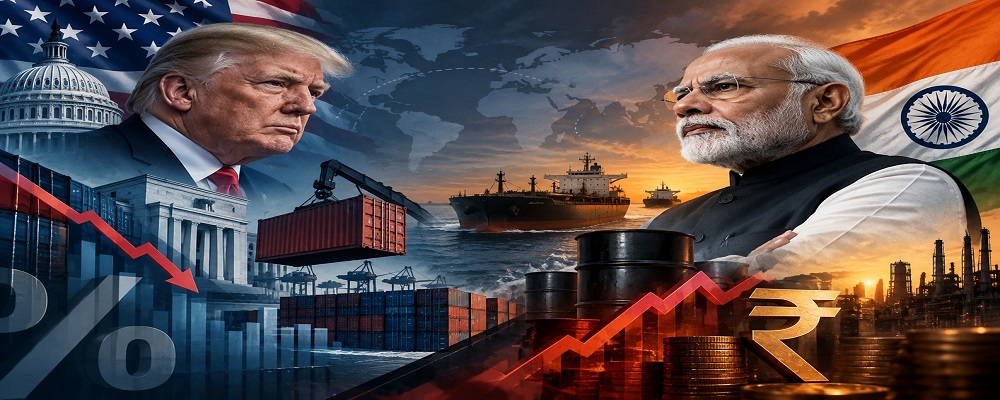
The global economic landscape is entering a new phase of uncertainty. On one side, the U.S. Federal Reserve has resumed monetary tightening after a prolonged pause, raising its benchmark interest rate by 25 basis points to 3.75–4.00 percent. On the other, Washington has enacted legislation giving President Donald Trump sweeping new powers to impose tariffs of up to 100 percent on major buyers of Russian oil and gas, including India.
For New Delhi, the two developments are occurring at a particularly sensitive moment. Higher U.S. interest rates can strengthen the dollar and tighten global financial conditions, while the new tariff legislation introduces an additional layer of pressure on India’s trade and energy choices.
Yet the Indian response has been notable.
The Ministry of External Affairs has reiterated that India’s energy-sourcing decisions are guided by national interest and the imperative of meeting the energy requirements of its 1.4 billion people. New Delhi has also stated that it remains determined to take all necessary measures to protect its trade and economic interests.
This suggests that India is not treating the American tariff instrument merely as a bilateral trade issue. It is increasingly becoming part of a larger economic and strategic calculation involving energy security, currency stability, inflation and India’s room for manoeuvre in an increasingly fragmented global economy.
The Fed Turns More Restrictive
On September 16, the Federal Open Market Committee voted unanimously, 12–0, to raise the federal funds target range by 25 basis points to 3.75–4.00 percent. It was the first U.S. rate hike since July 2023. The Federal Reserve said inflation remains elevated and that the latest move was intended to support a return toward its 2 percent inflation objective.
The September projections also point to a relatively restrictive policy path. The median projection for the federal funds rate at the end of 2026 stands at 4.1 percent, while the median projection for PCE inflation is 3.7 percent. These projections indicate continued concern about inflation, although they should not be interpreted as a guarantee of another rate hike. For emerging markets such as India, the transmission mechanism is important.
Higher U.S. rates can make dollar-denominated assets relatively more attractive. If global investors reallocate capital toward U.S. fixed-income and other dollar assets, emerging-market currencies, equities and bonds can come under pressure. The effect is not automatic or uniform, but the direction of the pressure matters.
India has already experienced some of these pressures. The rupee moved close to the ₹96-per-dollar level during the week following the Fed decision. On September 18, it closed around ₹95.88 per dollar, after touching weaker levels during the week. The movement came against a backdrop of elevated oil prices, a stronger dollar and expectations of tighter global monetary conditions.
The Indian 10-year government bond yield had also risen to around 7.09 percent on September 15 as investors assessed the implications of higher global yields and oil prices.
The challenge for India is therefore not simply the level of the U.S. rate. It is the cumulative effect of higher global yields, currency pressure, capital flows and imported inflation.
The 100% Tariff Weapon
The second pressure point is more directly connected with trade. The U.S. House of Representatives passed the Russia sanctions legislation by 262 votes to 159. President Trump subsequently signed the legislation into law on September 18, giving the administration expanded authority to impose tariffs and other economic measures on countries that continue to purchase Russian energy. The legislation provides for tariffs of up to 100 percent under specified conditions.
India is particularly exposed because Russia has become a major source of its crude oil imports. According to Reuters, Russian crude accounted for 50.83 percent of India’s total oil imports in July 2026, equivalent to around 2.47 million barrels per day. Between April and July, Russia’s average share was 43.25 percent.
The significance of Russian crude is not simply its volume. For Indian refiners, Russian supplies have at various times offered attractive pricing and helped diversify procurement away from traditional Middle Eastern sources.
However, the structure of the U.S. law is important. It gives Washington the power to impose tariffs of up to 100 percent; it does not mean that India has automatically been subjected to a 100 percent tariff.
That distinction is critical for assessing the economic risk. A tariff of that magnitude, if actually imposed on a broad range of Indian exports, could significantly affect the competitiveness of Indian merchandise in the U.S. market. Engineering goods, textiles, chemicals, pharmaceuticals and other export-oriented sectors could face higher costs and weaker demand.
The impact on services such as IT would operate through different channels and should not be treated as equivalent to a customs tariff on merchandise. However, a broader deterioration in India-U.S. economic relations could have indirect consequences for investment, corporate sentiment and cross-border business.
India’s Energy Calculation
The most difficult part of the equation is energy. India imports close to 90 percent of its crude oil requirements, making international oil prices a critical variable for its external balance and inflation outlook.
At a time when geopolitical disruptions have pushed Brent crude above $100 a barrel, any significant reduction in access to discounted or competitively priced Russian supplies could increase procurement costs. Brent was still above $100 a barrel in mid-September amid continuing disruptions and geopolitical tensions in the Middle East.
This creates a difficult policy equation. If India substantially reduces Russian crude purchases in response to U.S. pressure, it may need to source larger volumes from other suppliers at potentially different prices. If it continues purchasing Russian oil, it could face the possibility of additional U.S. trade measures.
New Delhi therefore has to balance three objectives simultaneously: maintaining affordable energy supplies, protecting trade interests and managing its relationship with Washington.
The latest statement from the Ministry of External Affairs is significant in this context.
India has said that its energy sourcing is based on national interest and that meeting the energy requirements of its population remains an imperative. It has also said that the issue has been discussed at high levels with U.S. interlocutors and that India will take necessary measures to protect its trade and economic interests.
This is not necessarily a rejection of engagement with Washington. India has simultaneously reiterated its interest in a balanced and mutually beneficial trade relationship with the United States.
But it does indicate that energy security is being placed firmly within India’s strategic and economic decision-making framework.
The Inflation Constraint
The timing becomes more complicated because India is already facing elevated wholesale price pressures.
India’s provisional CPI inflation for August 2026 stood at 4.82 percent, while food inflation was 5.95 percent. Wholesale inflation was considerably higher at 9.92 percent, with fuel and power inflation at 22.93 percent.
The distinction between CPI and WPI is important. The Reserve Bank of India’s monetary policy framework focuses on consumer inflation rather than wholesale inflation. Nevertheless, persistent increases in energy and input costs can eventually feed into consumer prices and corporate margins.
That could narrow the RBI’s policy room. If the rupee remains under pressure and crude prices remain elevated, monetary authorities may have to balance growth considerations against imported inflation and currency stability. At the same time, higher domestic interest rates can increase borrowing costs for businesses and households, potentially affecting investment-sensitive sectors such as infrastructure and real estate.
The policy challenge is therefore not simply about defending the rupee. It is about managing several interconnected variables at the same time.
A Two-Channel External Shock
The Fed and the U.S. tariff legislation originate from different policy processes and should not be described as a coordinated financial squeeze. But for India, their economic effects can converge.
The first channel is financial. Higher U.S. interest rates can strengthen the dollar, raise global borrowing costs and increase pressure on emerging-market currencies and capital flows.
The second channel is trade and energy. The new U.S. tariff authority creates uncertainty for countries continuing to purchase Russian energy. For India, that uncertainty intersects directly with its crude procurement strategy and its dependence on the U.S. as a major export market.
Together, these developments create a more complicated external environment for the Indian economy. India’s policy response will therefore have to extend beyond conventional monetary or fiscal measures. It will require continued diversification of energy supplies, careful management of foreign-exchange volatility, protection of export competitiveness and sustained diplomatic engagement with Washington.
Strategic Autonomy Under Economic Pressure
The larger question is whether economic pressure can force a significant adjustment in India’s strategic choices.
At present, New Delhi’s public position suggests that it intends to negotiate rather than simply concede. India has already communicated its concerns to the United States and has highlighted the potential implications of the legislation for bilateral relations and global energy markets. At the same time, it has made clear that protecting its trade and economic interests remains a priority.
This does not eliminate the economic risks. A 100 percent tariff, if imposed broadly, could affect Indian exporters. Sustained higher U.S. rates could continue to influence global capital flows. Higher crude prices could increase the import bill. And a weaker rupee could amplify the domestic inflationary impact of imported commodities.
But India also has policy options: diversify energy procurement, deepen trade relationships beyond a single market, strengthen domestic manufacturing competitiveness, expand alternative export destinations and continue negotiations with Washington.
The immediate challenge, therefore, is not to choose between the United States and Russia. It is to protect India’s economic interests while navigating an increasingly transactional global economic order.
The coming months will test the resilience of that strategy. The Fed’s higher-for-longer trajectory, the new U.S. tariff powers and continuing energy-market disruptions have created a difficult external environment. Yet India’s response indicates that New Delhi sees energy security and trade autonomy as matters of national interest—not merely variables to be adjusted under external pressure.
For the Indian economy, the objective will be to absorb the shock without allowing currency pressure, imported inflation and trade uncertainty to reinforce one another.
The twin squeeze is real. But how India manages the pressure may matter as much as the pressure itself.