

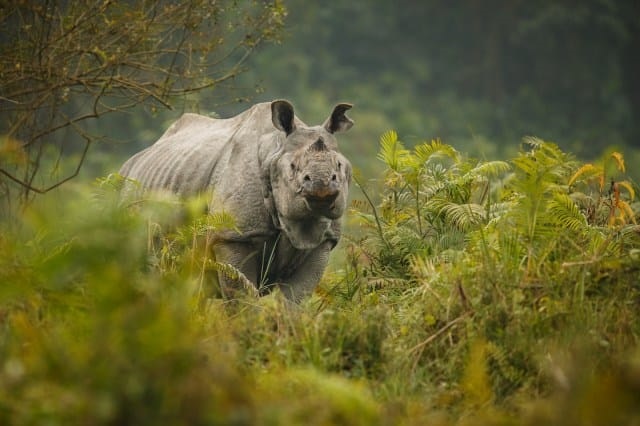
For India, the greater one-horned rhinoceros is not just a species. It is the Brahmaputra floodplains, writes Union Environment Minister Bhupender Yadav on World Rhino Day.
From 1,500 in the 1980s to over 4,000 in September 2024, the recovery is a conservation success. But Yadav argues the next step must be expansion, not just protection.
The National Conservation Strategy (2019) and the new five-year Phase I (2026-2031) under National CAMPA — covering Assam, Arunachal, Bihar, UP and West Bengal — aim to move rhinos back into parts of their historical range along the Indus, Ganga and Brahmaputra. It involves scientific translocation, genetic security, habitat restoration and corridor connectivity.
Yadav flags a parallel crisis: grasslands. Habitats for swamp deer, wild buffalo, elephants and tigers are dynamic ecosystems facing invasive species and inappropriate succession. A separate five-year project (2026-2031) by WII, ICFRE and FSI will comprehensively assess Indian grasslands to create a National Grassland Atlas.
Climate is the new threat. Flooding is intrinsic to Kaziranga, but extreme events demand climate-resilient management — access to higher ground, dispersal routes.
Technology — drones, spatial monitoring, genetic tools — will aid, but not replace, forest guards and mahouts. And conservation cannot be a government island. At the Second Asian Rhino Range States meeting in 2019, India joined Bhutan, Indonesia, Malaysia and Nepal in the New Delhi Declaration.
"The rhino's recovery is a national achievement. Its future is a national responsibility," Yadav writes. Protecting it, he argues, protects rivers, wetlands and the communities that depend on them.