

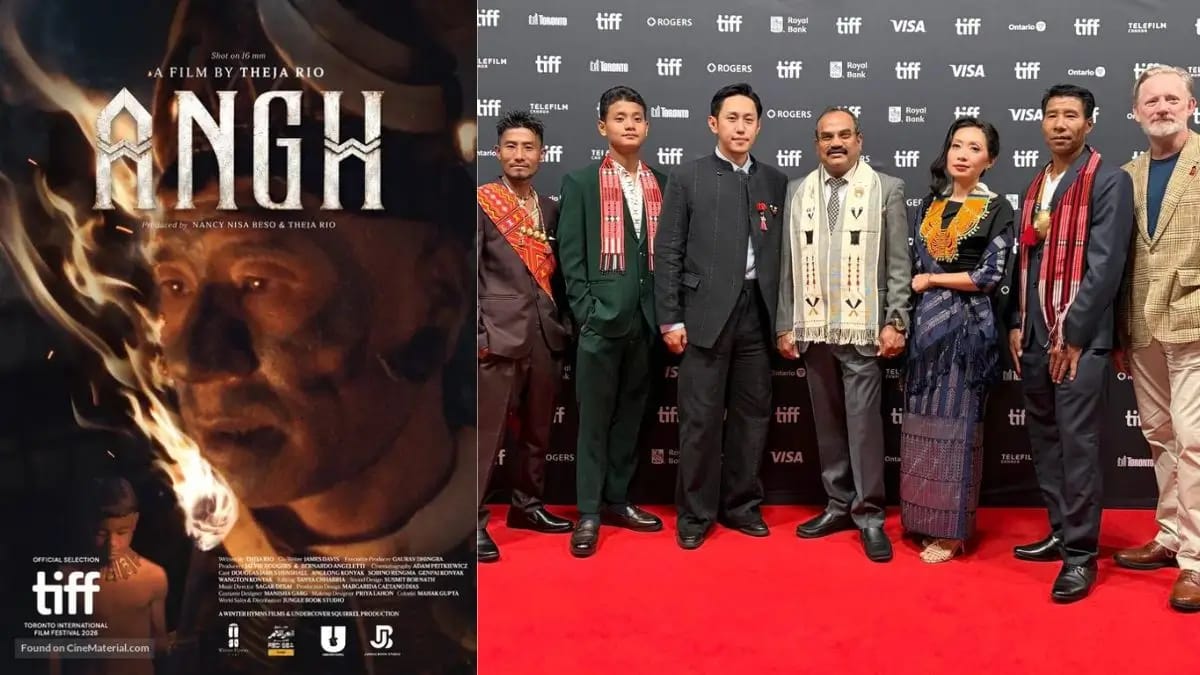
There is something pleasingly improbable about Angh.
The film comes from Nagaland, a mountainous state of fewer than two million people on India's north-eastern frontier, and is in Konyak — a tribal language spoken by less than 250,000 people, unfamiliar to most Indians, let alone audiences abroad. Its director, 31-year-old Theja Rio from Kohima, was making his first feature. Most of its cast — Anghlong Konyak, Amah Konyak, Genpai Konyak — had never faced a camera before, street-cast from villages because, as Rio put it, "where we come from, the film industry is almost non-existent."
And yet at the Toronto International Film Festival this month, this quiet 103-minute film on 16mm won the Platform Prize, TIFF's only juried competition for distinctive directorial vision, beating 11 international titles selected from over 4,000 submissions.
The jury citation praised its "refreshing perspective, strength of filmmaking, and deeply resonant portrait of a world," and Rio's "vision, audacity and courage."
Angh means chief. Set in the early 1960s near the Indo-Myanmar border, it follows Anghba, the last surviving chief of a deserted Konyak village, living in isolation with his ailing wife and speech-impaired son after his people leave. An American missionary — played by BAFTA winner Douglas Henshall of “Shetland” arrives, and his son is drawn to the new faith and its comforts. It is a father-son story about cultural erasure, told not as polemic but as memory.
Rio expanded it from his 2021 short that won at Clermont-Ferrand. He shot with cinematographer Adam Pietkiewicz in remote jungles, rooted in oral histories of his own people.
The win is historic. It is the first film from Nagaland to play TIFF, and the first to win a major prize at a top-tier global festival. It is also the only Indian film in Platform this year.
Crucially, it also opens an Oscar route. Under new Academy rules for the 2027 Oscars, winners of six designated festivals — including TIFF's Platform Prize — become automatically eligible for consideration in the International Feature Film category, bypassing the usual one-film-per-country selection.
That doesn't make Angh an Oscar nominee. But it puts a Konyak-language film about an abandoned chief inside a conversation from which such worlds have been absent.
As Rio said in Toronto: "I come from a small part of Northeast India, where dreams do not often come true for our people."