

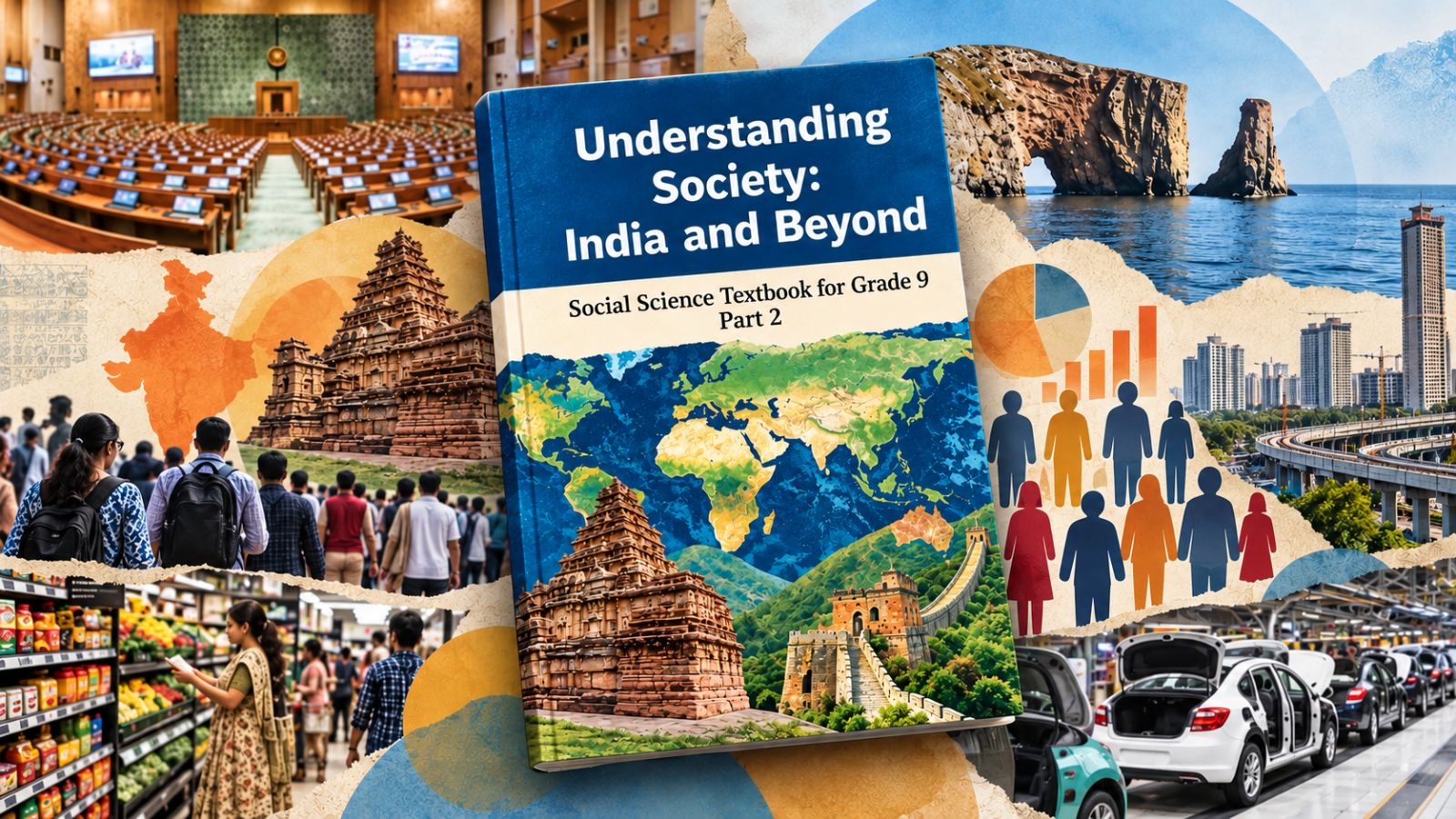
In its newly released Class 9 social science textbook, Understanding Society - India and Beyond, NCERT has a chapter on medieval Indian history focused on "foreign invaders" - the Delhi Sultans and the Mughals - with a cursory mention of how Mughals were distinct from Sultans and Rajputs. The period being talked about is same, but interpretation of past has undergone a discernible change.
Indian history as modern discipline was first written by British after conquering Bengal, to frame Indians as having a static past. As colonial historiography periodised Indian history as Hindu India, Muslim India and British India, historian Gyanendra Pandey argues that both textbook and post-colonial historiography saw religion as moving force in Indian history - something that additionally got cemented when NCERT history textbooks produced during UPA rule have undergone deletions and replacements under Modi dispensation, which sees "secular" and Marxist historians as ideological adversaries.
Read more - Innovation in Higher Education: The Impact of NEP 2020
The period being talked about is same, but interpretation: UPA textbooks did discuss battles but also discussed in detail instances of cooperation between diverse local kings apart from pointing that medieval times saw development of composite culture despite Muslim rulers being part of Islamic influences.
Under Atal Bihari Vajpayee, NCERT textbooks were authored by scholars like R S Sharma, Satish Chandra, Bipan Chandra, Romila Thapar and Arjun Dev - with books authored by those like Makkhan Lal, Meenakshi Jain and others considered right-leaning. The books, which drew criticism from many "secular" historians, were again replaced with books by Left historians in power from 2004 to 2014. JNU historian S K Mohapatra was advisor to NCERT in production of new textbooks.
What changed? After Congress split in 1969, Indira Gandhi fell short of majority mark in Lok Sabha by about 45 seats. Given its leftward tilt, CPI was delighted to join in, seeing Mrs Gandhi's Left turn as opportunity for expanding its own influence - particularly in academia. The Left was pre-eminent intellectual force, and not just in history - in historiography in India, with creation of India as "this, while" of India is this, while of many medieval times were culturally same at much same way as nationalists earlier ha Kosambi turned critical gaze on ancient India, demolishing wha many Hindus considered their beliefs through a "rationalist" lens.
Read more - Game On, Parents Off
Jawaharlal Nehru's Discovery of India - Nehru was appreciative of Akbar but critical of Aurangzeb for "setting the clock back" - Later works of "secular" historiography from mid-1960s onward, D D Kosambi among first well-known Marxist historians. Here, "secular historiography" was seen as alternative way to understand medieval India.
For Indian classrooms, the question remains: should textbooks teach history or heritage? Balance is missing.
Tags: #NCERT #HistoryTextbook #MarxistHistory #Hindutva #EducationPolicy #IndianHistory #TextbookRow #Secularism #Historiography #NewEducationPolicy