
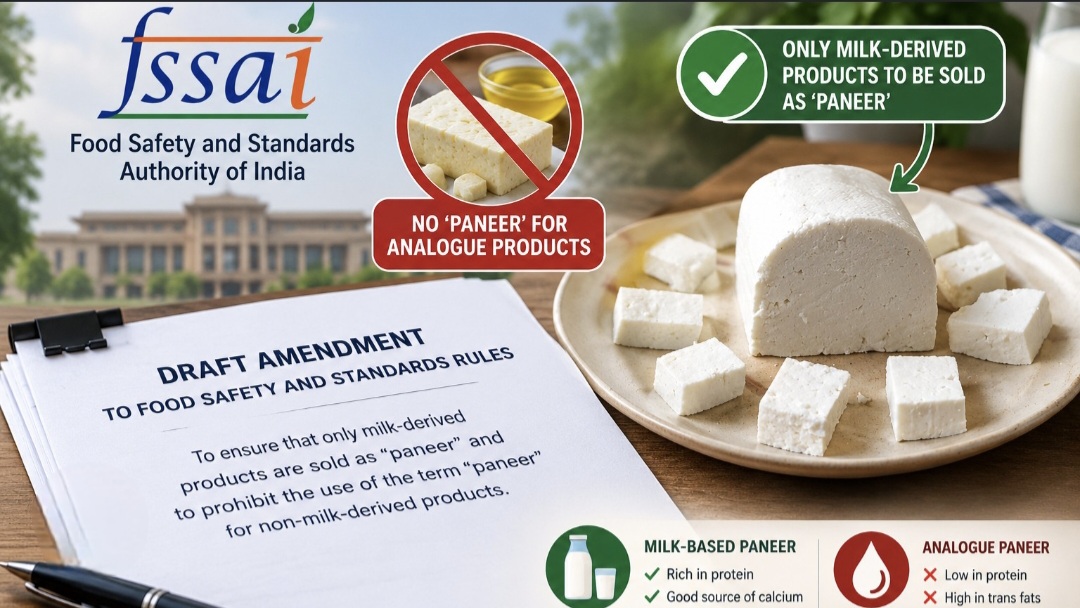

The Food Safety and Standards Authority of India (FSSAI) has proposed to ban sale of analogue paneer made from constituents not derived from milk, saying move is aimed at safeguarding consumer interests. The draft notification, published on September 24, also requires products already licensed under 'analogue in dairy context' category to drop word paneer from nomenclature, labelling and marketing.
What is analogue paneer? According to FSSAI standards, product can be called paneer when it is made from milk or milk solids using permitted acids. In case of analogue paneer, milk fat or milk protein may be partly or wholly replaced with non-milk constituents such as vegetable fat or oil or vegetable protein. Depending on formulation, manufacturers may also use ingredients such as starches, milk solids, emulsifiers and stabilisers. There is no exact composition, so nutritional aspect varies.
Why make an analogue in first place? Because replacing relatively expensive milk fat and milk protein with cheaper non-milk ingredients can substantially reduce production costs. Industry estimates suggest analogue paneer can cost about 30-50% less than conventional paneer, with reported prices of around Rs 200-250 a kg, compared with roughly Rs 400-600 per kg for milk-based paneer.
Read more - The Red Hexagon War
FSSAl's central advisory committee has noted that absence of specific quality parameters for dairy analogues, particularly in case of paneer, makes enforcement difficult. It also raised concerns that consumers may not be able to distinguish an analogue from genuine paneer made from milk, especially when it's used in restaurants. Punjab, Karnataka, Maharashtra, Gujarat, Chhattisgarh, Madhya Pradesh, Himachal, Telangana and Uttarakhand have imposed restrictions and ban on manufacture and sale analogue paneer.
Is it unsafe? Being an analogue doesn't by itself mean it is unsafe to consume. The concern stems from not knowing what went into making of product, or what has been used to substitute for milk constituents and rest of composition. Unlike conventional paneer, there is no single ingredient list for making an analogue. Mislabeling deceives consumers. An analogue made with vegetable fat and starch, for instance, cannot be assumed to provide same amount or quality of protein and nutrition as conventional paneer. Paneer made from milk products has defined nutritional profile set by National Institute of Nutrition (NIN-ICMR). Their Indian Food Composition Tables puts average protein content of paneer at about 18.9 grams per 100 gram, with about 24.8 gram of fat and 2.4 gram of carbohydrate. For analogue paneer, though, there is no equivalent standard nutritional value or protein data because formulation varies.
Read more - The Protein Panic
Can you tell if paneer you are buying is analogue? For packaged products, checking ingredient list and nutrition information are starting points. But, for food eaten outside, menu declarations about analogue use are nearly rare-to-non-existent. Price, texture and appearance may offer clues, but they cannot by themselves establish authenticity. Same applies to commonly circulated home tests such as iodine test or dry-pan test. An iodine reaction, for example, can indicate presence of starch adulterants, but it does not by itself prove that product is an analogue. Laboratory testing remains more reliable way.
For India, world's largest milk producer, analogue paneer is existential threat to dairy farmer trust. FSSAl's ban is not food snobbery - it is labelling honesty.
Tags: #AnaloguePaneer #FSSAI #FoodSafety #PaneerFraud #MilkProtein #ConsumerRights #FoodAdulteration #DairyIndia #Nutrition #StreetFood